
Understanding the Fibo Swing Indicator for MT4: A Comprehensive Guide
Introduction to the Fibo Swing Indicator
The Fibo Swing Indicator is a powerful technical analysis tool designed for the MetaTrader 4 (MT4) platform, widely used by forex and stock traders to identify potential price reversal points and trend continuation levels. Built on the principles of Fibonacci retracement and swing trading, this indicator helps traders pinpoint critical support and resistance zones based on market swings. By leveraging the mathematical precision of Fibonacci ratios, the Fibo Swing Indicator provides a structured approach to analyzing price movements, making it a valuable addition to any trader’s toolkit.
In this blog, we’ll explore the Fibo Swing Indicator in depth, covering its functionality, setup, application in trading strategies, advantages, limitations, and practical tips for maximizing its effectiveness. Whether you’re a novice trader or a seasoned market participant, understanding how to use this indicator can enhance your decision-making process and potentially improve your trading outcomes.
What is the Fibo Swing Indicator?
The Fibo Swing Indicator is a custom tool for MT4 that automatically plots Fibonacci retracement and extension levels based on significant price swings (highs and lows) in the market. Unlike manual Fibonacci retracement tools, which require traders to select swing points themselves, the Fibo Swing Indicator identifies these points algorithmically, saving time and reducing subjectivity. It uses Fibonacci ratios—such as 23.6%, 38.2%, 50%, 61.8%, and 100%—to map out potential support and resistance levels where price is likely to reverse or consolidate.
The indicator is particularly popular among swing traders, who aim to capture price movements between significant highs and lows over a medium-term timeframe (days to weeks). By combining Fibonacci analysis with swing detection, the indicator provides a dynamic framework for identifying high-probability trade setups.
How the Fibo Swing Indicator Works
The Fibo Swing Indicator operates by detecting swing highs and swing lows in the price chart and then applying Fibonacci retracement and extension levels to these points. Here’s a breakdown of its core mechanics:
-
Swing Detection: The indicator uses a predefined algorithm to identify significant swing points. These are typically peaks (highs) and troughs (lows) in the price action, determined by parameters such as the number of bars or price movement thresholds.
-
Fibonacci Levels: Once a swing high and low are identified, the indicator plots Fibonacci retracement levels (e.g., 23.6%, 38.2%, 50%, 61.8%) between these points. It may also plot extension levels (e.g., 127.2%, 161.8%) for projecting potential price targets.
-
Dynamic Updates: As new price data emerges, the indicator dynamically adjusts the swing points and Fibonacci levels to reflect the latest market conditions, ensuring relevance in real-time trading.
-
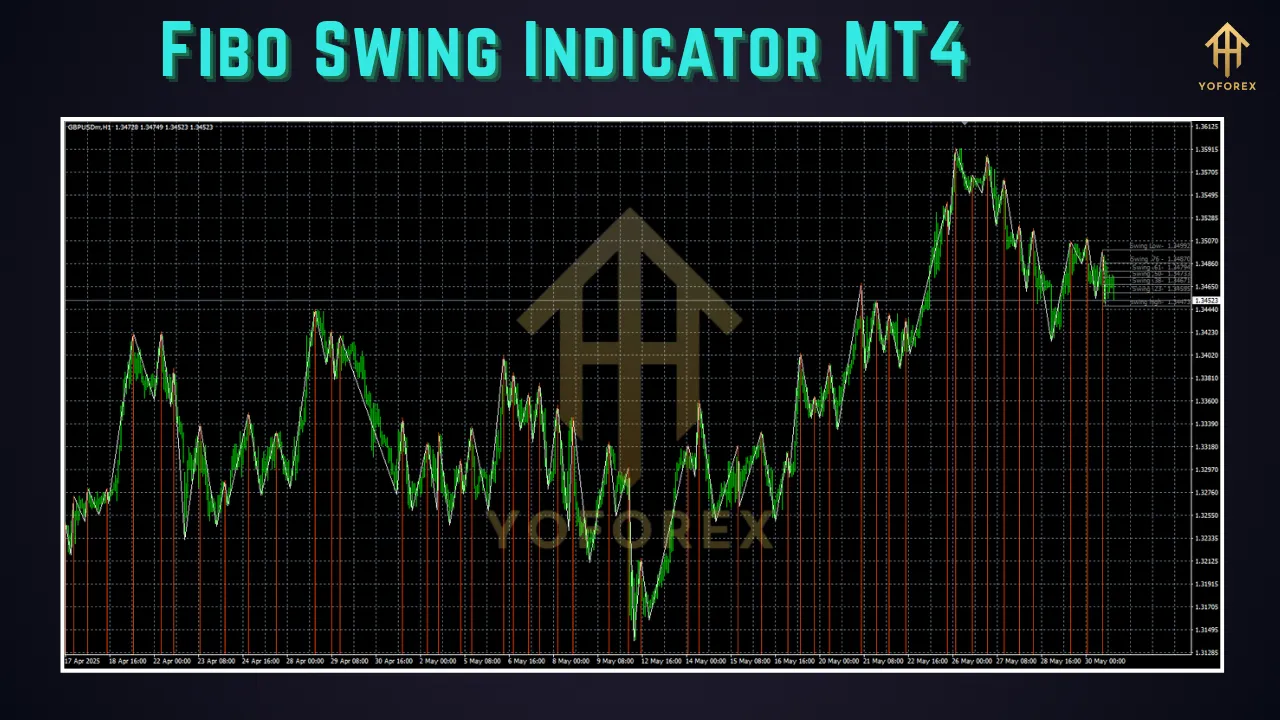
Visual Representation: The indicator displays Fibonacci levels as horizontal lines on the chart, often color-coded for clarity. Traders can use these lines to identify key price zones for entries, exits, or stop-loss placement.
Setting Up the Fibo Swing Indicator on MT4
To use the Fibo Swing Indicator, you’ll need to install it on your MT4 platform. Here’s a step-by-step guide:
-
Download the Indicator: Obtain the Fibo Swing Indicator file (usually in .mq4 or .ex4 format) from a reputable source, such as trading forums, indicator marketplaces, or developer websites. Ensure the file is compatible with your MT4 version.
-
Install the Indicator:
-
Open your MT4 platform.
-
Navigate to File > Open Data Folder.
-
Go to MQL4 > Indicators and copy the indicator file into this folder.
-
Restart MT4 to load the indicator.
-
-
Apply to Chart:
-
Open a chart for your desired trading instrument (e.g., EUR/USD, XAU/USD).
-
Go to Insert > Indicators > Custom and select the Fibo Swing Indicator.
-
Configure the indicator settings (e.g., swing sensitivity, Fibonacci levels to display) as needed. Default settings are often suitable for beginners.
-
-
Customize Settings: Most Fibo Swing Indicators allow customization, such as adjusting the number of bars for swing detection, selecting specific Fibonacci levels, or changing line colors for better visibility.
-
Save as Template: Once configured, save the chart setup as a template for quick application to other charts.
Using the Fibo Swing Indicator in Trading
The Fibo Swing Indicator can be used in various trading strategies, particularly for swing trading, trend following, and reversal setups. Below are some practical applications:
1. Identifying Support and Resistance
The Fibonacci levels plotted by the indicator act as dynamic support and resistance zones. For example:
-
In an uptrend, a pullback to the 38.2% or 61.8% retracement level may signal a buying opportunity, as these levels often act as support.
-
In a downtrend, a bounce to the 50% or 61.8% level may indicate a selling opportunity, as these levels can act as resistance.
2. Entry and Exit Points
Traders can use the indicator to time entries and exits:
-
Entries: Enter a long position when the price bounces off a key Fibonacci retracement level (e.g., 61.8%) with confirmation from other indicators, such as candlestick patterns or RSI.
-
Exits: Set profit targets at Fibonacci extension levels (e.g., 127.2% or 161.8%) or previous swing highs/lows.
3. Stop-Loss Placement
Place stop-loss orders just below key Fibonacci levels or swing lows (for long trades) or above swing highs (for short trades) to protect against unexpected price reversals.
4. Trend Confirmation
Combine the Fibo Swing Indicator with trend-following tools, such as moving averages or the ADX, to confirm the direction of the trend before trading Fibonacci-based setups.
Example Trading Scenario
Suppose you’re trading EUR/USD on a 4-hour chart, and the Fibo Swing Indicator identifies a swing low at 1.0800 and a swing high at 1.1000. The indicator plots retracement levels at 1.0944 (23.6%), 1.0908 (38.2%), 1.0872 (50%), and 1.0836 (61.8%). If the price pulls back to 1.0836 and forms a bullish candlestick pattern (e.g., a hammer), you might enter a long position, targeting the 1.1000 level or the 127.2% extension at 1.1072, with a stop-loss below 1.0800.
Advantages of the Fibo Swing Indicator
-
Automation: Eliminates the need for manual Fibonacci plotting, saving time and reducing errors.
-
Dynamic Analysis: Automatically adjusts to new price swings, ensuring relevance in volatile markets.
-
Versatility: Suitable for various markets (forex, stocks, commodities) and timeframes.
-
Enhanced Precision: Combines Fibonacci ratios with swing detection for high-probability trade setups.
-
User-Friendly: Easy to set up and interpret, even for beginners.
Limitations of the Fibo Swing Indicator
-
Lagging Nature: Like most technical indicators, it relies on historical price data, which may not always predict future movements accurately.
-
False Signals: In choppy or range-bound markets, Fibonacci levels may produce false signals, leading to losses.
-
Parameter Sensitivity: The indicator’s effectiveness depends on proper swing detection settings, which may require optimization for different markets or timeframes.
-
Not a Standalone Tool: Best used in conjunction with other indicators or price action analysis to confirm signals.
Tips for Maximizing the Fibo Swing Indicator
-
Combine with Other Tools: Use the indicator alongside oscillators (e.g., RSI, Stochastic) or momentum indicators (e.g., MACD) to filter out false signals.
-
Test on Demo Accounts: Before using the indicator in live trading, backtest it on a demo account to understand its behavior in different market conditions.
-
Adjust Settings for Volatility: Fine-tune the swing detection parameters based on the asset’s volatility. For example, increase the bar count for swing detection in highly volatile markets.
-
Focus on Higher Timeframes: The indicator tends to produce more reliable signals on higher timeframes (e.g., 4-hour, daily) due to reduced market noise.
-
Practice Risk Management: Always use proper position sizing and stop-loss orders to manage risk, as no indicator guarantees success.
Common Mistakes to Avoid
-
Over-Reliance: Don’t treat the Fibo Swing Indicator as a “holy grail.” Always confirm signals with other analysis methods.
-
Ignoring Market Context: Fibonacci levels work best in trending markets. Avoid using the indicator in choppy or sideways markets without additional confirmation.
-
Improper Settings: Using default settings without optimization can lead to inaccurate swing detection, especially for unique trading instruments.
-
Neglecting Risk Management: Failing to set stop-losses or over-leveraging can amplify losses, even with accurate Fibonacci setups.
Customizing the Fibo Swing Indicator
Advanced traders can modify the Fibo Swing Indicator’s code (if available in .mq4 format) to suit their needs. For example:
-
Adjust the swing detection algorithm to use a different number of bars or price thresholds.
-
Add custom Fibonacci levels (e.g., 78.6%) or remove unnecessary ones.
-
Integrate alerts for when the price approaches key Fibonacci levels.
To modify the code, open the .mq4 file in MetaEditor (accessible via MT4), make changes, and compile the updated indicator. Always test modifications on a demo account first.
Where to Find the Fibo Swing Indicator
The Fibo Swing Indicator is available from various sources, including:
-
MT4 Marketplace: Check the MQL5 community for free or paid versions.
-
Trading Forums: Websites like Forex Factory or TradingView often share custom indicators.
-
Developer Websites: Some developers offer the indicator with additional features or support.
Always download from trusted sources to avoid malware or poorly coded indicators.
Conclusion
The Fibo Swing Indicator for MT4 is a versatile tool that combines the power of Fibonacci analysis with automated swing detection, making it an excellent choice for traders seeking to identify high-probability trade setups. By plotting dynamic support and resistance levels, it simplifies the process of finding entry and exit points, particularly for swing traders. However, like any technical tool, it’s most effective when used as part of a broader trading strategy that incorporates other indicators, price action analysis, and robust risk management.
By understanding how to set up, apply, and optimize the Fibo Swing Indicator, traders can gain a deeper insight into market dynamics and improve their trading performance. Whether you’re trading forex, stocks, or commodities, this indicator can be a valuable asset in navigating the complexities of financial markets.