Divergence CCI Indicator V1.1 MT4: A Comprehensive Guide for Traders
In the world of technical analysis and trading, indicators play a crucial role in helping traders make informed decisions. Among the many available tools, the Commodity Channel Index (CCI) stands out as a powerful momentum-based oscillator. However, its effectiveness can be further enhanced when combined with divergence analysis. The Divergence CCI Indicator V1.1 for MetaTrader 4 (MT4) takes this concept to the next level by automating the detection of divergences between price action and CCI values. This comprehensive guide will explore the features, functionality, and practical applications of this specialized trading tool.
Understanding the Commodity Channel Index (CCI)
Before delving into the specifics of the Divergence CCI Indicator, it’s essential to understand the foundation upon which it builds: the Commodity Channel Index (CCI). Developed by Donald Lambert, CCI is a momentum-based oscillator designed to help traders identify trend strength, reversals, and overbought/oversold conditions.
The CCI measures the deviation of the current price from the average price over a specified period. It is calculated using the following formula:
CCI = (Price – SMA) / (Mean Deviation) × 15
Where:
- Price represents the current price (typically closing price)
- SMA is the Simple Moving Average of the price over the specified period
- Mean Deviation is the average of absolute differences between price and SMA
The resulting CCI value oscillates between +100 and -100. Readings above +100 suggest the price is above the average price (overbought condition), while readings below -100 indicate the price is below the average price (oversold condition). When CCI crosses from below -100 to above -100, it can signal a potential buy opportunity, whereas a cross from above +100 to below +100 might indicate a sell signal.
While CCI is a valuable tool on its own, its effectiveness can be significantly enhanced by analyzing it in conjunction with price action, particularly through the identification of divergences.
What is Divergence in Trading?
Divergence is a critical concept in technical analysis that occurs when there is a discrepancy between the price action of an asset and the movement of an indicator. This phenomenon can signal potential changes in market trends and is widely used by traders to anticipate reversals.
There are two primary types of divergence:
Bullish Divergence
A bullish divergence occurs when the price of an asset is making lower lows (LL) while the indicator is making higher lows (HL). This discrepancy suggests that the downward momentum is weakening, potentially indicating the emergence of a bullish trend. In practical terms, this would appear on a chart as price reaching successively lower points while the indicator itself reaches higher lows.
In the context of CCI, a bullish divergence would manifest when price is declining but the CCI is rising. This contradictory behavior can signal that the selling pressure is waning, and a potential bullish reversal might be brewing.
Bearish Divergence
Conversely, a bearish divergence appears when the price is making higher highs (HH) while the indicator is making lower highs (LH). This suggests that upward momentum is diminishing, possibly foreshadowing a bearish trend. On a chart, this would appear as price reaching successively higher points while the indicator fails to match those highs.
When applied to CCI analysis, a bearish divergence would occur when price is rising but the CCI is falling. This contradictory pattern can indicate that buying pressure is weakening, potentially leading to a bearish market correction.
The importance of divergence lies in its ability to provide early warnings of potential trend changes. By identifying these patterns, traders can position themselves advantageously before significant market movements. However, detecting divergence manually can be time-consuming and error-prone, especially when monitoring multiple charts and timeframes. This is where automated tools like the Divergence CCI Indicator become invaluable.
Introduction to the Divergence CCI Indicator V1.1 MT4
The Divergence CCI Indicator V1.1 for MetaTrader 4 is a specialized oscillator tool designed specifically to detect divergences between price action and the Commodity Channel Index. Developed to address the challenges of manually identifying these patterns, this indicator automates the detection process, making it easier for traders to identify potential trend reversals or changes in market momentum.
Key Features of the Indicator
The Divergence CCI Indicator V1.1 offers several notable features that enhance its utility for traders:
Automated Divergence Detection
One of the primary advantages of this indicator is its ability to automatically scan for divergence between price and CCI. This automation saves traders significant time and reduces the risk of missing important signals that might occur quickly or be subtle in nature.
Customizable Settings
The indicator provides various parameters that traders can adjust to suit their specific trading strategies and market conditions. These settings include:
- CCI period: Determines the number of bars used in the CCI calculation
- CCI deviation: Measures how far the price has deviated from the average price
- Bars back: Specifies how many bars back the indicator should look to detect divergence
- Minimum box size for valid swing: Sets the minimum size of price swings considered valid for divergence detection
These adjustable parameters allow traders to fine-tune the indicator’s sensitivity and behavior according to their preferences and market analysis approach.
Visual Indicators
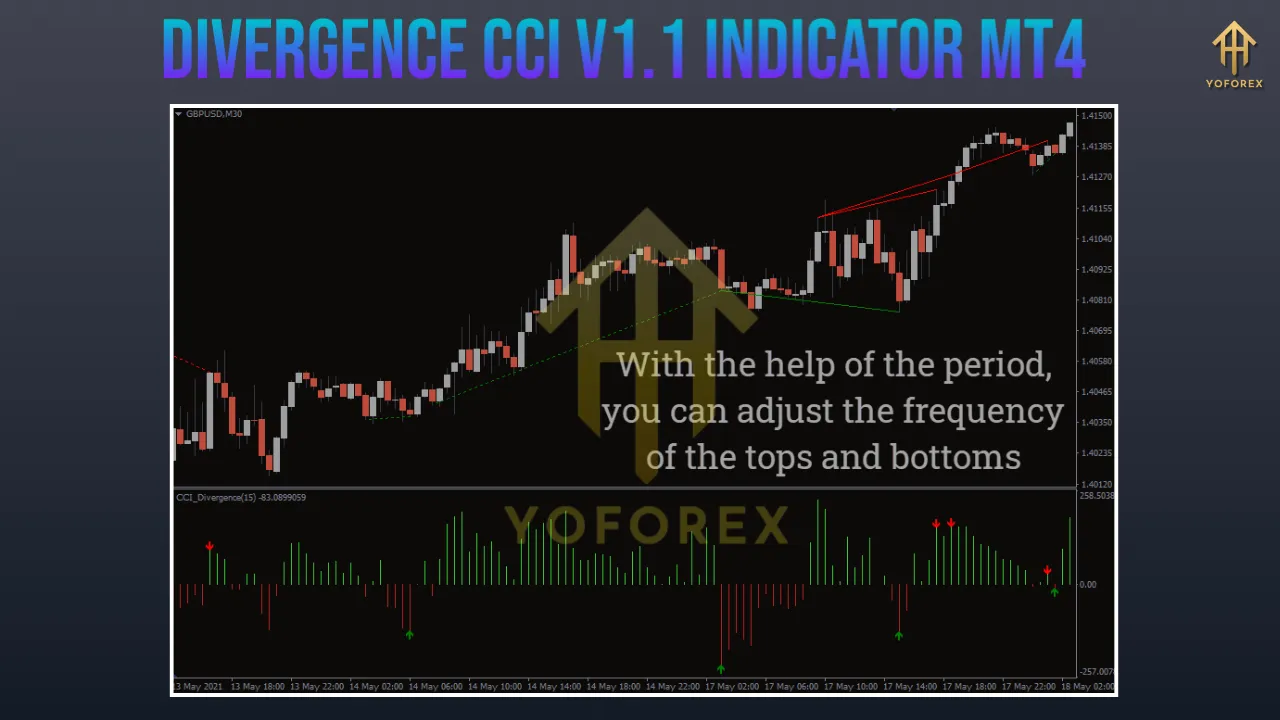
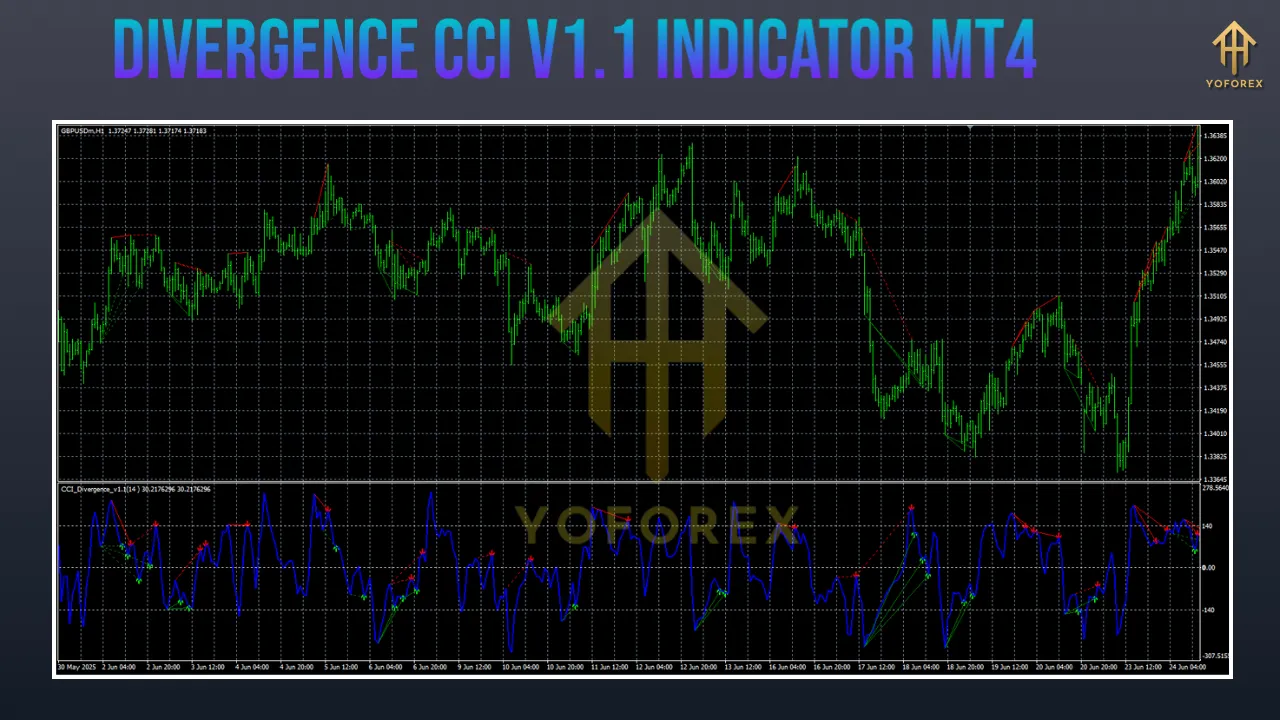
The indicator provides clear visual cues on the chart to highlight areas of divergence. These visual markers typically take the form of colored arrows or lines, with different colors used to distinguish between bullish and bearish divergences. This visual representation makes it easy for traders to quickly identify potential trading opportunities at a glance.
Backtesting Capabilities
Some versions of the indicator include backtesting functionalities, enabling traders to test their strategies on historical data. This feature is invaluable for refining trading approaches and understanding how the indicator would have performed in past market conditions.
How the Indicator Works
The Divergence CCI Indicator V1.1 operates by continuously comparing price action with CCI values over a specified period. It looks for instances where these two elements move in opposite directions, indicating a potential divergence.
When such a divergence is detected, the indicator signals this by displaying specific visual markers on the chart. These markers can be in the form of colored arrows or lines, with distinct colors used to differentiate between bullish and bearish divergences.
For example, a bearish divergence might be indicated by a red arrow, suggesting that despite price reaching new highs, the CCI is failing to follow suit—a potential warning of weakening upward momentum and an impending trend reversal.
Traders can then use these signals to make informed decisions about when to enter or exit trades. For instance, a detected bearish divergence might suggest it’s time to take profit on a long position or consider opening a short position, depending on the trader’s strategy.
The indicator’s ability to automate this detection process is particularly valuable in today’s fast-paced trading environment, where quick identification of market patterns can be crucial to successful trading decisions.
Technical Specifications and Parameters
To effectively utilize the Divergence CCI Indicator V1.1 MT4, traders must understand its technical specifications and the various parameters that can be adjusted to optimize its performance based on individual trading strategies and market conditions.
CCI Period
The CCI period parameter determines the number of bars used to calculate the CCI. This setting has a direct impact on the sensitivity of the indicator:
- A shorter period makes the CCI more sensitive to recent price changes, potentially generating more frequent signals but also increasing the risk of false positives.
- A longer period makes the CCI less sensitive to short-term fluctuations, potentially reducing the number of signals but providing a smoother, more stable reading.
Traders often adjust this parameter based on their trading timeframe. For instance, a shorter period might be more appropriate for intraday trading, while a longer period could be better suited for swing trading or longer-term market analysis.
CCI Deviation
The CCI deviation parameter measures how far the price has deviated from the average price. This setting influences how the CCI interprets and quantifies market movements:
- A higher deviation value indicates greater price volatility or a larger deviation from the average price.
- Adjusting this parameter can help filter out noise or insignificant price movements, depending on the trader’s preference for signal quality over quantity.
Bars Back
This parameter specifies how many bars back the indicator should look to detect divergence. It determines the historical scope of the indicator’s analysis:
- A higher number means the indicator will consider a larger portion of the chart for divergence detection, potentially identifying more comprehensive patterns.
- A lower number focuses on more recent price action, which might be useful for short-term trading strategies.
Traders might increase this parameter to get a better view of historical price movements and potential divergence patterns, helping them understand longer-term market trends and potential reversals.
Minimum Box Size for Valid Swing
This parameter sets the minimum size of a price swing required to be considered valid for divergence detection:
- A larger minimum box size means only more significant price movements will be considered, helping to filter out small, insignificant divergences.
- A smaller minimum box size will detect even minor divergences, which might be useful for scalping strategies but could also increase the risk of false signals.
Adjusting this parameter allows traders to focus on divergences that meet their criteria for significance, based on their trading approach and risk tolerance.
By understanding and appropriately adjusting these parameters, traders can tailor the Divergence CCI Indicator V1.1 to their specific needs and improve its effectiveness in their trading strategy.
How to Install and Use the Divergence CCI Indicator V1.1 MT4
To start using the Divergence CCI Indicator V1.1 on MetaTrader 4, traders need to follow a few simple steps to install and configure the indicator. This process is straightforward and can be completed in a matter of minutes.
Installation Process
-
Download the Indicator – The first step is to download the indicator from a trusted source. The indicator is typically available as a .zip file containing the necessary files for MetaTrader 4.
-
Extract the Files – Once downloaded, extract the contents of the .zip file to a temporary location on your computer.
-
Copy to MT4 Directory – Copy the extracted files to the appropriate directory in your MetaTrader 4 installation. Specifically, the files should be placed in the
MQL4/Indicatorsfolder within your MT4 installation directory. -
Restart MT4 – After copying the files, restart the MetaTrader 4 platform to load the new indicator.
Attaching the Indicator to a Chart
-
Open a Chart – Launch MetaTrader 4 and open the chart of the instrument you wish to analyze.
-
Insert the Indicator – Right-click on the chart area and select “Insert” from the context menu. From the subsequent menu, choose “Indicators” and then navigate to the appropriate category where the indicator is located.
-
Configure Settings – When you select the Divergence CCI Indicator V1.1, a configuration window will appear where you can adjust various parameters such as CCI period, bars back, and minimum box size for valid swing. These settings should be tailored according to your trading strategy and market conditions.
-
Apply and View – After configuring the desired settings, click “OK” to apply the indicator to the chart. The indicator will then begin displaying signals based on the price action and CCI values.
Navigating the Indicator’s Interface
Once the indicator is attached to your chart, you will see visual signals indicating areas of divergence between price and CCI. These signals are typically represented by colored arrows or lines:
- Bullish Divergence Signal – Usually indicated by a green arrow or line, suggesting a potential bullish trend reversal.
- Bearish Divergence Signal – Typically shown as a red arrow or line, indicating a potential bearish trend reversal.
The exact visual representation may vary depending on the specific version of the indicator and the settings chosen.
It’s important to note that while the indicator automates the detection of divergence, it’s up to the trader to interpret these signals correctly and decide on the appropriate trading action based on their strategy and market analysis.
Interpreting Signals from the Divergence CCI Indicator
The true value of the Divergence CCI Indicator V1.1 lies in its ability to generate visual signals that alert traders to potential market reversals or changes in momentum. Understanding these signals and knowing how to interpret them is crucial for effective trading.
Bullish Divergence Signal
A bullish divergence signal is typically indicated by a green arrow or line on the chart. This signal suggests that while the price is making lower lows (LL), the CCI is making higher lows (HL). This contradictory behavior indicates that the downward momentum is weakening, potentially signaling the emergence of a bullish trend.
In practical terms, this might look like price forming a series of successively lower lows while the CCI forms higher lows. Such a pattern can be an early warning of a potential bullish reversal, suggesting that buyers may be entering the market despite continued price declines.
Traders might consider entering a long position when they see a bullish divergence signal, especially if it’s confirmed by other indicators or analysis methods. However, it’s important to remember that divergence signals, particularly bullish ones, can be more reliable in oversold conditions or after a significant price decline.
Bearish Divergence Signal
Conversely, a bearish divergence signal is usually shown as a red arrow or line on the chart. This indicates that while the price is making higher highs (HH), the CCI is making lower highs (LH). This pattern suggests that upward momentum is diminishing, potentially foreshadowing a bearish trend.
Visually, this might appear as price reaching new highs while the CCI fails to match those highs, creating a peak that is lower than the previous one. Such a pattern can signal that selling pressure is increasing, even as prices continue to rise.
In response to a bearish divergence signal, traders might consider entering a short position or closing existing long positions to avoid potential losses from a downward trend. Bearish divergences are often considered more reliable than bullish ones, particularly in overbought conditions or after a significant price rally.
Neutral or Indecisive Signals
It’s also possible for the indicator to show signals that are not clearly bullish or bearish. These could occur in situations where the divergence is weak or the market is trending strongly in one direction. In such cases, traders should be cautious and look for additional confirmation from other indicators before making trading decisions.
It’s important to note that divergence signals can be misleading, especially in strong trending markets. During a robust uptrend or downtrend, false divergence signals are relatively common. Therefore, it’s always recommended to use the Divergence CCI Indicator in conjunction with other technical analysis tools to filter out false signals and confirm potential trading opportunities.
Reading Market Context
When interpreting signals from the Divergence CCI Indicator, it’s crucial to consider the broader market context. For example:
- Trending Markets – In a strong trending market, divergence signals can be less reliable as the trend tends to persist despite apparent signals of weakening momentum.
- Ranging Markets – During ranging conditions, divergence signals may be more reliable as the market lacks a clear trend direction.
- Volume Considerations – Signals accompanied by significant volume changes may carry more weight than those without notable volume shifts.
- Other Indicators – Confirmation from other indicators such as moving averages, RSI, or Bollinger Bands can add confidence to the signals generated by the Divergence CCI Indicator.
By taking these factors into account, traders can develop a more nuanced understanding of the signals provided by the indicator and make more informed trading decisions.
Strategies for Using the Divergence CCI Indicator
The Divergence CCI Indicator V1.1 MT4 is a powerful tool, but its true potential is realized when it’s incorporated into a comprehensive trading strategy. Here are several effective approaches for using this indicator to enhance trading performance.
Strategy 1: Divergence with Confirmation
One of the most effective strategies is to use the Divergence CCI Indicator in conjunction with another indicator to confirm signals. This approach helps reduce false signals and increases the accuracy of trading decisions.
For example:
- The Divergence CCI Indicator detects a bearish divergence, signaling potential weakening upward momentum.
- Confirmation is sought from another indicator, such as a moving average crossover or a trend line break.
- Only when both indicators agree on the signal does the trader enter the trade.
This confirmation-based approach is particularly useful in trending markets, where divergence signals can be misleading. By requiring multiple indicators to align, traders can filter out many false signals and focus on more reliable opportunities.
Strategy 2: Risk Management with Divergence
The Divergence CCI Indicator can also be effectively utilized for risk management purposes:
- If you are in a long position and the indicator shows a bearish divergence, it might be prudent to close the position or adjust your stop-loss level to lock in profits.
- Similarly, if you are in a short position and the indicator shows a bullish divergence, consider closing the position or adjusting your take-profit level.
By incorporating divergence into your risk management plan, you can protect your capital and maximize potential gains. This approach is particularly valuable in volatile markets where trend reversals can occur quickly and with significant impact.
Strategy 3: Divergence in Conjunction with Support and Resistance Levels
Combining divergence analysis with support and resistance level analysis can create a powerful trading strategy:
- Identify key support and resistance levels on the chart.
- Look for divergence signals near these levels.
- When a divergence signal occurs at or near a significant support or resistance level, it can indicate a potential break through that level or a reversal at that level.
For example:
- A bearish divergence at a resistance level might suggest that the price will fail to break through that level and reverse direction.
- A bullish divergence at a support level might indicate that the price will hold that level and potentially reverse upwards.
This strategy leverages the power of both technical analysis tools to identify high-probability trading opportunities.
Strategy 4: Divergence in Different Timeframes
Using the Divergence CCI Indicator across multiple timeframes can provide a more comprehensive view of market conditions:
- Analyze the indicator on a higher timeframe (e.g., daily or weekly) to identify major trend directions and potential reversals.
- Use lower timeframes (e.g., hourly or 15-minute) for more precise entry and exit points.
This multi-timeframe approach helps traders stay aligned with the overall market direction while taking advantage of shorter-term opportunities that align with the broader trend.
Strategy 5: Divergence as a Filter
Perhaps one of the most straightforward uses of the Divergence CCI Indicator is as a filter for other trading signals:
- Establish a primary trading signal system (e.g., based on moving averages or oscillators).
- Use the Divergence CCI Indicator as a filter, only acting on signals when they are confirmed by divergence.
- This significantly reduces the number of trades taken but increases the quality of those trades.
This filtering approach is particularly useful for traders who might otherwise be overwhelmed by too many trading signals.
By integrating the Divergence CCI Indicator into these strategies, traders can enhance their decision-making process, improve risk management, and potentially increase the profitability of their trading activities.
Common Mistakes to Avoid When Using the Divergence CCI Indicator
While the Divergence CCI Indicator V1.1 MT4 is a powerful tool, it’s important to approach its use with a clear understanding of potential pitfalls. By recognizing and avoiding common mistakes, traders can maximize the effectiveness of this indicator in their trading strategy.
Overreliance on a Single Indicator
One of the most common errors is relying solely on the Divergence CCI Indicator for making trading decisions. No single indicator is perfect, and the Divergence CCI Indicator is no exception. Market conditions are complex and multifaceted, requiring a comprehensive approach to analysis.
To avoid this mistake, traders should use the Divergence CCI Indicator in conjunction with other technical indicators or analysis methods. For example, confirming divergence signals with moving averages, trend lines, or other oscillators can significantly improve the accuracy of trading decisions.
Misinterpreting Divergence Signals
Another frequent mistake is misinterpreting the signals generated by the indicator. Divergence can be subtle and requires a solid understanding of what constitutes a valid bullish or bearish divergence.
Traders should take time to study what constitutes a reliable divergence pattern. For instance, understanding that bearish divergences (price making higher highs while CCI makes lower highs) are generally more reliable than bullish divergences, particularly in trending markets. Also, recognizing that the strength of the divergence (how pronounced the difference is between price and CCI movements) can influence the reliability of the signal.
Not Adjusting Settings Properly
The Divergence CCI Indicator offers various adjustable parameters, but many traders use the default settings without considering whether they are appropriate for their specific trading strategy or market conditions.
To maximize the indicator’s effectiveness, traders should experiment with different parameter settings to find those that best suit their needs. For example, adjusting the CCI period or the number of bars back the indicator considers can help tailor the signals to match the trader’s timeframe and risk tolerance.
Ignoring Market Context
Perhaps the most critical mistake is interpreting divergence signals without considering the broader market context. Divergence signals can be more or less reliable depending on factors such as market trending strength, volume levels, and overall market conditions.
Traders should always assess the market environment when evaluating divergence signals. For instance, divergence in a strongly trending market might be less reliable than in a ranging market. Similarly, signals accompanied by significant volume changes may carry more weight than those without notable volume shifts.
Acting on Weak Divergence Signals
Another common error is acting on weak or inconclusive divergence signals. Sometimes, the indicator may show a very slight divergence that might not be significant enough to indicate a meaningful market reversal.
Traders should establish clear criteria for what constitutes a valid divergence signal and only act on signals that meet those criteria. This might include considering the strength of the divergence, the timeframe it occurs on, and whether it’s confirmed by other indicators.
Overtrading Based on Frequent Signals
Some versions of the Divergence CCI Indicator can generate frequent signals, leading to overtrading if not managed properly. Taking too many trades, especially in quick succession, can erode trading capital even if individual trades have a high success rate.
To avoid this, traders should consider implementing filters or additional confirmation requirements before acting on signals. This might include waiting for confirmation from other indicators or looking for signals that occur at significant support/resistance levels.
By recognizing and avoiding these common mistakes, traders can significantly improve their use of the Divergence CCI Indicator and enhance their overall trading performance.
Comparison with Other Divergence Detection Tools
While the Divergence CCI Indicator V1.1 MT4 is a specialized tool for detecting divergence between price and CCI, it’s worth comparing it with other divergence detection tools to understand its unique strengths and limitations.
General Divergence Indicators
Many trading platforms offer general divergence indicators that can detect divergence between price and a variety of oscillators, not just CCI. These indicators provide flexibility but may lack the specific insights that come from focusing on CCI.
Compared to general divergence indicators, the Divergence CCI Indicator offers the advantage of deep integration with CCI, including specific settings and parameters tailored to optimize detection of CCI-price divergence. However, this specialization means it may not capture divergence with other important oscillators like RSI or Stochastic.
Moving Average Divergence
Another common form of divergence is between price and moving averages. Indicators that detect this type of divergence can be valuable for trend analysis but operate on different principles than CCI divergence.
CCI is more sensitive to recent price changes and can be more volatile than moving averages, which smooth out price data. This means that divergence between price and CCI might occur more frequently but could also be less significant than divergence between price and moving averages.
MACD Divergence
The Moving Average Convergence Divergence (MACD) indicator itself is based on the concept of divergence between two moving averages. Indicators that detect divergence in MACD can be useful for trend analysis but again operate on different principles than CCI divergence.
MACD is primarily a trend-following indicator, while CCI is more of a momentum oscillator. This means that divergence in MACD might indicate a change in trend direction, whereas divergence in CCI might signal overbought or oversold conditions or a change in market momentum.
Volume-based Divergence Indicators
Some indicators detect divergence between price and volume, which can provide insights into the strength and sustainability of price movements.
While volume-based divergence can be very informative, it’s fundamentally different from CCI divergence. CCI incorporates both price and volume data in its calculation, making it a more comprehensive indicator than simple price-volume analysis.
The Unique Value Proposition of CCI Divergence
The Divergence CCI Indicator V1.1 MT4 offers a unique combination of features:
-
Specialized Focus – By concentrating specifically on CCI, it can offer more nuanced and accurate detection of CCI-price divergence than general divergence indicators.
-
Momentum Insights – CCI’s focus on momentum provides different insights compared to trend-based indicators like moving averages or MACD.
-
Overbought/Oversold Signals – The indicator can help identify when markets might be overextended, which can be valuable for contrarian trading strategies.
-
Automated Detection – The indicator automates the process of detecting divergence, saving time and reducing the risk of missing important signals.
When compared to other divergence detection tools, the Divergence CCI Indicator offers a specific perspective on market conditions that can complement other analysis methods. The most effective approach is often to use multiple indicators in conjunction, allowing each to provide insights based on its unique calculation and focus.
Advanced Techniques for Maximizing the Indicator’s Utility
For experienced traders, the Divergence CCI Indicator V1.1 MT4 offers several advanced techniques that can be employed to maximize its utility and enhance trading performance. These strategies go beyond basic signal interpretation and involve more sophisticated analysis and integration with other tools.
Multi-Indicator Confirmation
While the Divergence CCI Indicator is powerful on its own, its signals can be significantly enhanced by confirming them with other indicators. This multi-indicator approach creates a more robust decision-making framework:
-
Oscillator Confirmation – Confirm CCI divergence signals with other oscillators like RSI or Stochastic. For example, a bearish divergence in both CCI and RSI would be a stronger signal than divergence in CCI alone.
-
Trend Filter – Use a trend-following indicator like moving averages or ADX to determine the overall market direction. Then, only trade divergence signals that align with the dominant trend. For instance, look for bearish divergence in an uptrend or bullish divergence in a downtrend.
-
Volume Confirmation – Examine volume patterns when divergence occurs. Significant volume changes accompanying divergence can indicate more substantial market sentiment shifts and potentially stronger signals.
This confirmation approach filters out many false signals and increases the reliability of the remaining ones.
Timeframe Analysis
Analyzing divergence across multiple timeframes provides a more comprehensive view of market conditions:
-
Major Trend Identification – Use higher timeframes (daily or weekly) with the Divergence CCI Indicator to identify the major market trend and potential reversals.
-
Entry/Exit Optimization – Use lower timeframes (hourly or 15-minute) for more precise entry and exit points, again with the Divergence CCI Indicator.
-
Timeframe Convergence – Look for situations where divergence signals appear across multiple timeframes, indicating a high-probability trading opportunity.
This multi-timeframe analysis helps traders stay aligned with the overall market direction while taking advantage of shorter-term opportunities that align with the broader trend.
Support and Resistance Integration
Combining divergence analysis with support and resistance level analysis can create powerful trading opportunities:
-
Key Levels Identification – Identify significant support and resistance levels on the chart.
-
Divergence at Levels – Watch for divergence signals that occur near these key levels. For example, a bearish divergence at a resistance level might suggest that the price will fail to break through that level and reverse direction.
-
Breakout Confirmation – If the price does break through a key level, check if there is corresponding divergence in CCI to confirm the validity of the breakout.
This integration of divergence with support/resistance analysis provides both predictive insights (potential reversals) and confirmatory signals (valid breakouts).
Sentiment Analysis Enhancement
The CCI can be interpreted as an indicator of market sentiment, with high positive values indicating strong buying pressure and high negative values indicating strong selling pressure. Divergence in CCI can thus be seen as a shift in market sentiment:
-
Bullish Divergence as Buying Pressure – A bullish divergence (price making lower lows while CCI makes higher lows) can indicate increasing buying pressure despite falling prices, potentially signaling a market bottom.
-
Bearish Divergence as Selling Pressure – A bearish divergence (price making higher highs while CCI makes lower highs) can indicate waning buying pressure despite rising prices, potentially signaling a market top.
By interpreting divergence through a sentiment lens, traders can gain deeper insights into market psychology and make more informed trading decisions.
Backtesting and Optimization
For traders comfortable with more advanced techniques, backtesting the Divergence CCI Indicator on historical data can provide valuable insights:
-
Parameter Optimization – Test different parameter settings to find those that generate the most reliable signals historically.
-
Strategy Refinement – Use backtesting to refine entry and exit rules based on the indicator’s signals.
-
Risk/Reward Assessment – Analyze historical performance to understand the risk/reward profile of trades based on the indicator’s signals.
While forward performance is never guaranteed, backtesting can help traders develop a more robust strategy based on the indicator’s signals.
By employing these advanced techniques, traders can transform the Divergence CCI Indicator from a basic signal generator into a sophisticated analytical tool that enhances their overall trading performance.
Conclusion: Leveraging the Power of Divergence CCI Indicator V1.1 MT4
The Divergence CCI Indicator V1.1 for MetaTrader 4 represents a powerful addition to any trader’s analytical toolkit. By automating the detection of divergences between price action and the Commodity Channel Index, this indicator provides valuable insights into potential market reversals and changes in momentum that might otherwise go unnoticed.
When used correctly, the Divergence CCI Indicator can significantly enhance trading performance by:
-
Identifying Potential Trend Reversals – Detecting early warning signals of weakening trend momentum through divergence patterns.
-
Improving Signal Quality – Reducing the risk of acting on false signals through automated detection and visual confirmation.
-
Enhancing Decision Making – Providing clear visual cues that make it easier to identify and act upon potential trading opportunities.
However, it’s important to remember that no single indicator is perfect. The most effective trading approach involves using multiple tools and analysis methods to confirm signals and make informed decisions. The Divergence CCI Indicator should be integrated into a comprehensive trading strategy that considers various aspects of market analysis, including fundamental factors, other technical indicators, and risk management principles.
Traders are advised to:
-
Practice with Historical Data – Test the indicator on past market conditions to understand its performance and develop confidence in its signals.
-
Start with Default Settings – Use the indicator’s default parameters initially and adjust them gradually based on personal trading experience and market conditions.
-
Use Confirmation Tools – Combine the indicator’s signals with other analysis methods to filter out false signals and increase the reliability of trading decisions.
-
Adapt to Market Conditions – Recognize that different market environments may require adjustments to how the indicator is interpreted and applied.
By understanding the capabilities and limitations of the Divergence CCI Indicator V1.1 MT4 and integrating it thoughtfully into a comprehensive trading strategy, traders can enhance their analytical capabilities and potentially improve their trading performance in the dynamic world of financial markets.
Support & Disclaimer
Got questions or need help? Reach out anytime:
- WhatsApp: https://wa.me/+443300272265
- Telegram: https://t.me/yoforexrobot
Disclaimer: Past performance is no guarantee of future results. All trading carries risk. Always demo-test the Divergence CCI Indicator V1.1 MT4 in a risk-free environment before deploying on a live account.