Fractals 3TF Indicator MT4: A Comprehensive Guide for Traders
Introduction to Fractals in Financial Markets
Fractals, a concept originating from mathematics and geometry, have found significant application in financial markets due to their ability to identify recurring patterns across varying time frames. In trading, fractals represent self-similar price structures that repeat themselves at different scales, reflecting the inherent cyclicality of market behavior. Popularized by trader and author Bill Williams in his 1998 book Trading in the Zone, fractal analysis helps traders recognize potential reversals or continuations in price trends. The core idea is that market movements are not random but structured around identifiable geometric patterns.
A fractal in trading is defined as a sequence of five consecutive price bars where the middle bar marks a significant high or low relative to its neighbors. For instance, a bullish fractal occurs when the middle bar’s low is lower than the lows of the two preceding and two succeeding bars, signaling a potential bottom. Conversely, a bearish fractal forms when the middle bar’s high is higher than the highs of the surrounding bars, indicating a possible top. These patterns are particularly valuable because they provide visual cues about market sentiment and potential inflection points.
The relevance of fractals in trading lies in their ability to simplify complex price action into actionable insights. Unlike other technical indicators that rely on mathematical formulas or moving averages, fractals are based on raw price data, making them less prone to lag and more responsive to real-time market changes. This characteristic makes fractals a popular tool among swing traders, day traders, and scalpers who seek to capitalize on short- to medium-term price movements.
The Fractals Indicator in MetaTrader 4
MetaTrader 4 (MT4), one of the most widely used trading platforms globally, includes a built-in fractal indicator that automates the identification of these patterns. The MT4 fractal tool scans price charts to detect bullish and bearish fractals, marking them with arrows or symbols. By default, the indicator uses five-bar sequences to identify fractals, though traders can adjust the sensitivity by modifying the number of bars analyzed.
Key Features
- Visual Identification: The indicator plots green arrows for bullish fractals (potential buy signals) and red arrows for bearish fractals (potential sell signals).
- Dynamic Adjustment: Fractals are automatically recalculated as new price data arrives, ensuring that traders always have the latest information.
- Customization: Users can adjust the fractal period (number of bars analyzed) and color schemes to suit their trading style.
Practical Applications
Traders often use the MT4 fractal indicator in conjunction with other tools like moving averages, trendlines, or oscillators (e.g., RSI, MACD) to confirm signals. For example, a bullish fractal near a key support level combined with a bullish crossover in the RSI could signal a strong buy opportunity. Similarly, a bearish fractal near resistance paired with a bearish divergence in the MACD might indicate an impending sell-off.
Limitations
While powerful, the MT4 fractal indicator has limitations:
- False Signals: In ranging markets, fractals may form frequently without leading to sustained reversals.
- Lagging Nature: Since fractals require five consecutive bars to confirm, signals may appear slightly after the actual price action.
To address these issues, traders often combine fractals with volume analysis or price action confirmation techniques, such as waiting for a breakout above/below the fractal level before entering a trade.
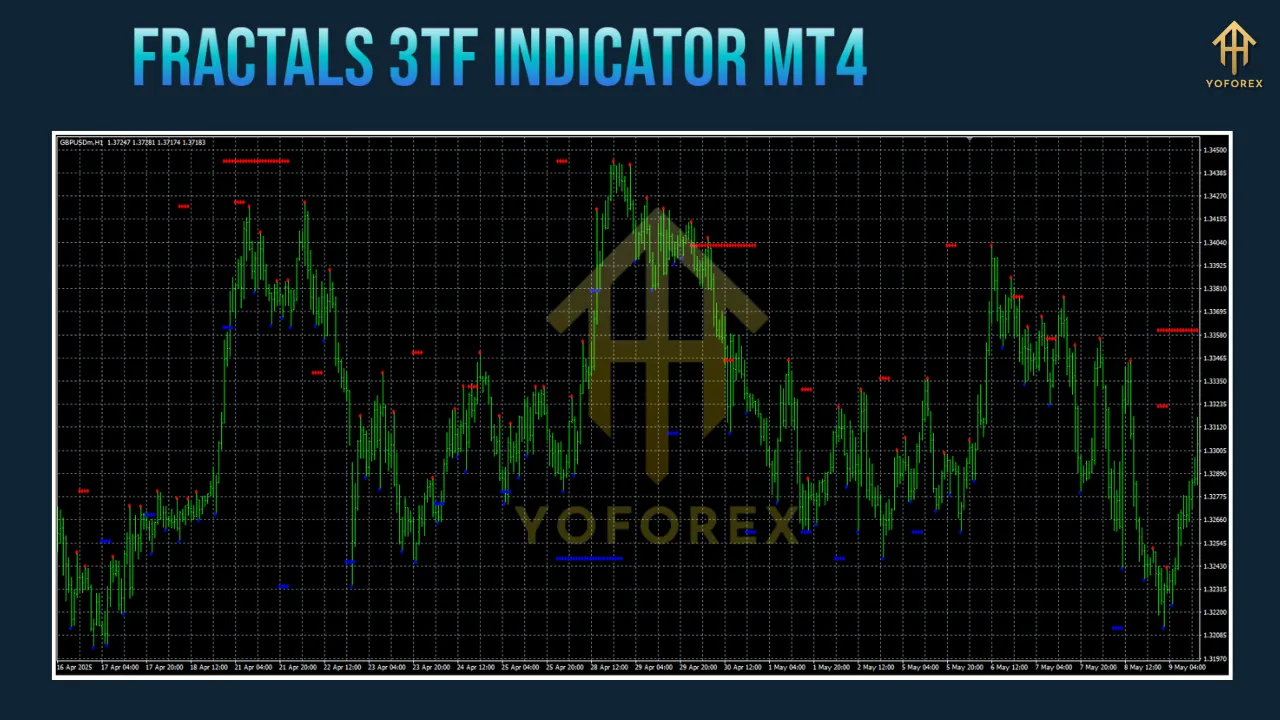
Multi-Time Frame Analysis: A Strategic Advantage
Multi-time frame (MTF) analysis involves evaluating price action across different time frames to gain a holistic view of market trends. While a daily chart might show a long-term uptrend, a 15-minute chart could reveal short-term consolidation or pullbacks. This approach helps traders avoid false signals by aligning short-term trades with the broader trend.
Why MTF Analysis Matters
- Trend Confirmation: Higher time frames (e.g., H4, D1) provide a clearer picture of the primary trend, reducing the risk of trading against the market direction.
- Entry Precision: Lower time frames (e.g., M15, M30) offer detailed insights into entry and exit points.
- Risk Management: MTF analysis allows traders to set stop-loss and take-profit levels based on key levels identified across multiple charts.
For instance, a trader might identify a bullish fractal on the H1 chart but wait for confirmation from the H4 chart before executing a trade. If the H4 chart shows a clear uptrend with higher highs and higher lows, the H1 fractal becomes a more reliable signal.
The Fractals 3TF Indicator: Bridging Time Frames
The Fractals 3TF Indicator is a specialized tool designed to integrate fractal analysis across three distinct time frames into a single chart. This eliminates the need to manually switch between time frames, streamlining the decision-making process. The “3TF” in its name refers to the three time frames it analyzes simultaneously, which can be customized (e.g., M15, H1, H4).
How the 3TF Indicator Works
- Data Aggregation: The indicator fetches price data from the selected higher time frames and overlays fractal signals onto the current chart.
- Signal Prioritization: It highlights fractals that align across all three time frames, filtering out weak or conflicting signals.
- Visual Cues: Different colors or symbols are used to distinguish fractals from each time frame (e.g., blue for H4, orange for H1).
Advantages Over Single-Time Frame Analysis
- Reduced Noise: By focusing on multi-time frame confirmed fractals, traders avoid overtrading on minor price fluctuations.
- Enhanced Accuracy: Signals that appear on all three time frames are statistically more reliable.
- Efficiency: Saves time by consolidating information from multiple charts into one view.
Installation and Configuration
To use the Fractals 3TF Indicator on MT4:
- Download the indicator file (.mq4 or.ex4) from a trusted source.
- Copy the file to the MT4
Experts/Indicatorsfolder. - Restart MT4 and apply the indicator to a chart via the “Navigator” window.
- Adjust settings:
- Time Frames: Select three time frames (e.g., M15, H1, H4).
- Colors: Assign distinct colors for each time frame’s fractals.
- Alerts: Enable notifications for new fractal formations.
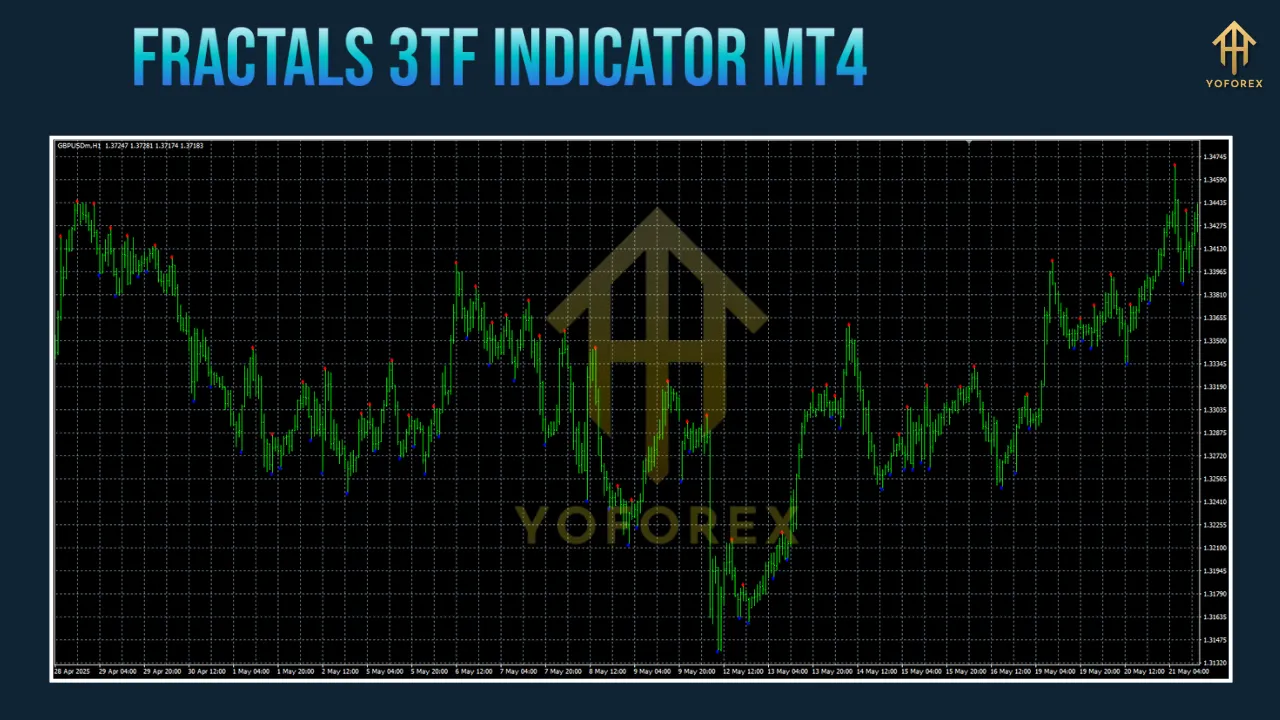
Trading Strategies with the Fractals 3TF Indicator
Strategy 1: Reversal Confirmation
This strategy identifies potential trend reversals by combining fractals with candlestick patterns and momentum indicators.
Steps:
- Identify a Fractal: Look for a bullish fractal (green arrow) on the lower time frame (e.g., M15) near a key support level.
- Confirm on Higher Time Frames: Ensure the same fractal appears on the H1 and H4 charts.
- Validate with Momentum: Check if the RSI or Stochastic Oscillator shows bullish divergence (rising lows amid falling prices).
- Execute Trade: Enter a long position once price breaks above the fractal’s high.
- Set Stops: Place a stop-loss below the fractal’s low and target a risk-reward ratio of 1:2 or higher.
Example:
On a USD/JPY M15 chart, a bullish fractal forms at 109.20, coinciding with a H1 fractal at the same level. The H4 chart shows an uptrend, and the RSI is rising from oversold territory. A trader enters a long position, setting a stop-loss at 108.80 and a take-profit at 109.60.
Strategy 2: Trend Continuation
This approach trades in the direction of the primary trend using fractals as entry signals.
Steps:
- Determine the Trend: Use a higher time frame (e.g., H4) to identify the dominant trend.
- Look for Fractal Breakouts: On the lower time frame (e.g., M15), wait for price to break above a bullish fractal in an uptrend or below a bearish fractal in a downtrend.
- Confirm with Volume: Ensure the breakout is accompanied by increasing volume to validate the move.
- Manage Trade: Trail the stop-loss behind the most recent swing low/high and exit when the trend shows signs of exhaustion.
Example:
The EUR/GBP H4 chart is in a downtrend. On the M15 chart, price breaks below a bearish fractal at 0.8500 with rising volume. A trader enters a short position, targeting 0.8450 with a stop-loss at 0.8530.
Strategy 3: Scalping with Fractal Alignments
For scalpers, the 3TF indicator can identify micro-trend opportunities lasting minutes.
Steps:
- Set Up Time Frames: Use M5, M15, and H1 for rapid signal generation.
- Wait for Alignment: Look for fractals that form simultaneously on all three time frames.
- Execute Quickly: Enter trades within seconds of the fractal confirmation to capitalize on small price moves.
- Exit Swiftly: Aim for 5-10 pips per trade with tight stop-losses (2-5 pips).
Risk Note: Scalping requires fast execution and low-latency trading conditions.
Advanced Techniques for Optimal Performance
1. Customizing Fractal Parameters
The default five-bar fractal detection can be adjusted to suit specific markets or trading styles:
- Shorter Periods (3-4 bars): Ideal for scalpers in volatile markets.
- Longer Periods (7-8 bars): Better for swing traders in sideways markets.
How to Adjust:
In the indicator settings, modify the FractalPeriod variable. Test different values on historical data to find the optimal setting.
2. Combining with Candlestick Patterns
Fractals can be paired with patterns like pin bars, hammers, or engulfing candles for higher-confidence entries.
Example:
A bullish fractal coincides with a hammer candlestick at a support level. This combination suggests buyers are regaining control, increasing the likelihood of a reversal.
3. Using Fractals with Trend Lines
Trend lines drawn on higher time frames can act as dynamic support/resistance for fractal-based trades.
Application:
If a bullish fractal forms near an ascending trend line on the H4 chart, the line becomes a stronger support level, reducing the risk of false breakouts.
4. Incorporating Fibonacci Retracement
Fibonacci levels (e.g., 38.2%, 61.8%) often align with fractal zones, providing precise entry and exit points.
Workflow:
- Identify a fractal near the 61.8% Fibonacci retracement level.
- Confirm with a candlestick pattern (e.g., bullish engulfing).
- Enter a trade with a stop-loss below the fractal’s low and a take-profit at the next Fibonacci level.
Risk Management and Money Management
1. Position Sizing
Always calculate position size based on risk tolerance and account balance. A common rule is to risk no more than 1-2% of capital per trade.
Formula:
Position Size = (Risk Amount / Stop-Loss Pips) * Contract Size
2. Stop-Loss and Take-Profit Strategies
- Fractal-Based Stops: Place stops just beyond the fractal’s high/low to account for potential false breakouts.
- Dynamic Trailing: Move stops to break-even after a certain profit threshold is reached.
3. Avoiding Overtrading
The 3TF indicator can generate multiple signals daily. Stick to a predefined trading plan to avoid emotional decisions.
Tip: Limit trades to 2-3 setups per day, focusing on high-probability opportunities.
Common Pitfalls and How to Avoid Them
1. Ignoring Market Context
Fractals work best when aligned with the broader market trend. Always analyze the economic calendar and macroeconomic trends before trading.
2. Over-Reliance on Fractals
No indicator works in isolation. Combine fractals with fundamental analysis, volume data, and sentiment indicators for robustness.
3. Misinterpreting False Breakouts
Price often tests fractal levels before reversing. Use additional confirmation (e.g., candlestick patterns, volume spikes) to distinguish between genuine breakouts and traps.
4. Neglecting Risk-Reward Ratios
Aim for trades with a minimum 1:2 risk-reward ratio. Avoid chasing setups with unfavorable ratios, even if they appear strong.
Case Studies: Real-World Applications
Case Study 1: EUR/USD Long Trade
- Time Frame: M15, H1, H4
- Signal: Bullish fractal at 1.0850 on all three time frames.
- Confirmation: RSI bullish divergence on H1.
- Outcome: Price rose to 1.0900 (+50 pips), hitting the take-profit.
Case Study 2: GBP/JPY Short Trade
- Time Frame: M5, M15, H1
- Signal: Bearish fractal at 152.40 on all three time frames.
- Confirmation: Break below a descending trend line on H1.
- Outcome: Price dropped to 151.80 (-60 pips), achieving the target.
Conclusion: Mastering the Fractals 3TF Indicator
The Fractals 3TF Indicator is a versatile tool that empowers traders to navigate complex markets with confidence. By integrating multi-time frame fractal analysis, it addresses the limitations of single-time frame indicators and reduces the risk of false signals. However, its effectiveness depends on disciplined application, continuous learning, and integration with other analytical methods.
Key Takeaways
- Multi-Time Frame Alignment: Prioritize fractals confirmed across three time frames for higher accuracy.
- Signal Confirmation: Always validate fractals with candlestick patterns, momentum indicators, or volume analysis.
- Risk Management: Use strict stop-losses, position sizing, and risk-reward ratios to protect capital.
- Adaptability: Customize the indicator’s parameters and combine it with other tools to suit evolving market conditions.
Final Advice
- Practice: Test strategies on a demo account before committing real capital.
- Learn Continuously: Stay updated on market trends, indicator updates, and new trading techniques.
- Stay Disciplined: Stick to your trading plan, even during periods of market volatility or emotional stress.
By mastering the Fractals 3TF Indicator and integrating it into a well-rounded trading strategy, you can enhance your ability to identify high-probability opportunities and achieve consistent results in the financial markets.
Support & Disclaimer
Got questions or need help? Reach out anytime:
- WhatsApp: https://wa.me/+443300272265
- Telegram: https://t.me/yoforexrobot
Disclaimer: Past performance is no guarantee of future results. All trading carries risk. Always demo-test the Fractals 3TF Indicator MT4 in a risk-free environment before deploying on a live account.