

Oracle EA V4.0 MT5: A Comprehensive Guide to Advanced Automated Trading
In the fast-paced world of forex trading, automated solutions have become indispensable for both novice and experienced traders. Among these tools, Oracle EA V4.0 MT5 has emerged as a leading Expert Advisor (EA) designed for MetaTrader 5 (MT5). This guide explores its features, functionality, performance, and practical implementation, offering traders a detailed roadmap to leveraging this technology.
What is Oracle EA V4.0 MT5?
Oracle EA V4.0 MT5 is an automated trading robot optimized for the GBPUSD and XAUUSD (Gold) markets. It combines machine learning, neural networks, and traditional technical analysis to execute trades on MetaTrader 5. Key attributes include:
- Specialization: Focuses exclusively on GBPUSD and Gold.
- Technology: Integrates AI-driven algorithms with classic indicators like RSI and Bollinger Bands.
- Performance Claims: Reported gains of 76% over 19 weeks on real accounts (source: developer’s verified data).
- Developer: Created by Stanislav Tomilov, CEO of Forex EAs Small, with 9+ years of MQL5 expertise.
This EA is designed for traders seeking a balance between automated precision and adaptive market strategies.
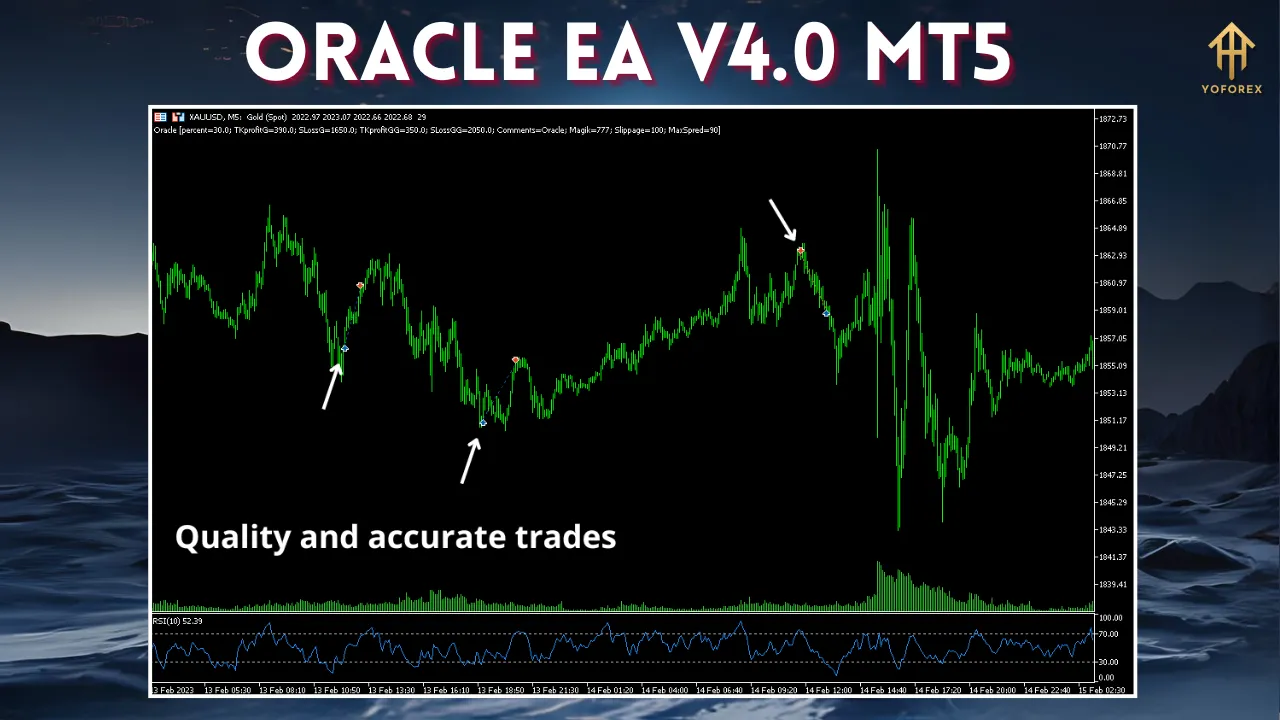
Development and Credibility
The Mind Behind Oracle EA V4.0 MT5
Stanislav Tomilov, the developer, brings extensive experience to this project:
- Portfolio: Prior successful EAs include Oracle EA, Vortex Gold EA, and Aura Superstar MT4.
- Approach: Combines mathematical modeling, risk management frameworks, and machine learning.
- Validation: Performance metrics are shared on platforms like MQL5 Market and verified trading accounts.
Why Trust This EA?
- Transparency: Public backtests and live account results are available for review.
- Updates: Regular algorithm refinements based on market feedback.
- Community Endorsements: Positive reviews from users on trading forums and EA marketplaces.
Core Features and Functionality
1. Advanced Machine Learning & Neural Networks
- Adaptive Trading: Learns from historical data to refine entry/exit strategies.
- Pattern Recognition: Identifies complex market trends undetectable by traditional systems.
- Risk Mitigation: Adjusts trade sizes and positions based on volatility fluctuations.
2. Hybrid Technical Analysis
The EA merges AI with proven indicators:
- RSI (Relative Strength Index): Detects overbought/oversold conditions in GBPUSD and Gold.
- Bollinger Bands: Flags volatility extremes and potential breakout opportunities.
- Custom Indicators: Includes proprietary oscillators and moving averages tailored to the target markets.
3. Specialized Market Focus
- GBPUSD Dynamics: Capitalizes on high liquidity and macroeconomic triggers (e.g., BoE policy changes).
- Gold Trading: Analyzes safe-haven demand, inflation trends, and geopolitical events.
4. Risk Management Tools
- Dynamic Lot Sizing: Adjusts trade volume based on account balance and risk tolerance.
- Stop-Loss & Take-Profit: Predefined levels to limit losses and secure profits.
- Drawdown Control: Halts trading if losses exceed a user-defined threshold (e.g., 15%).
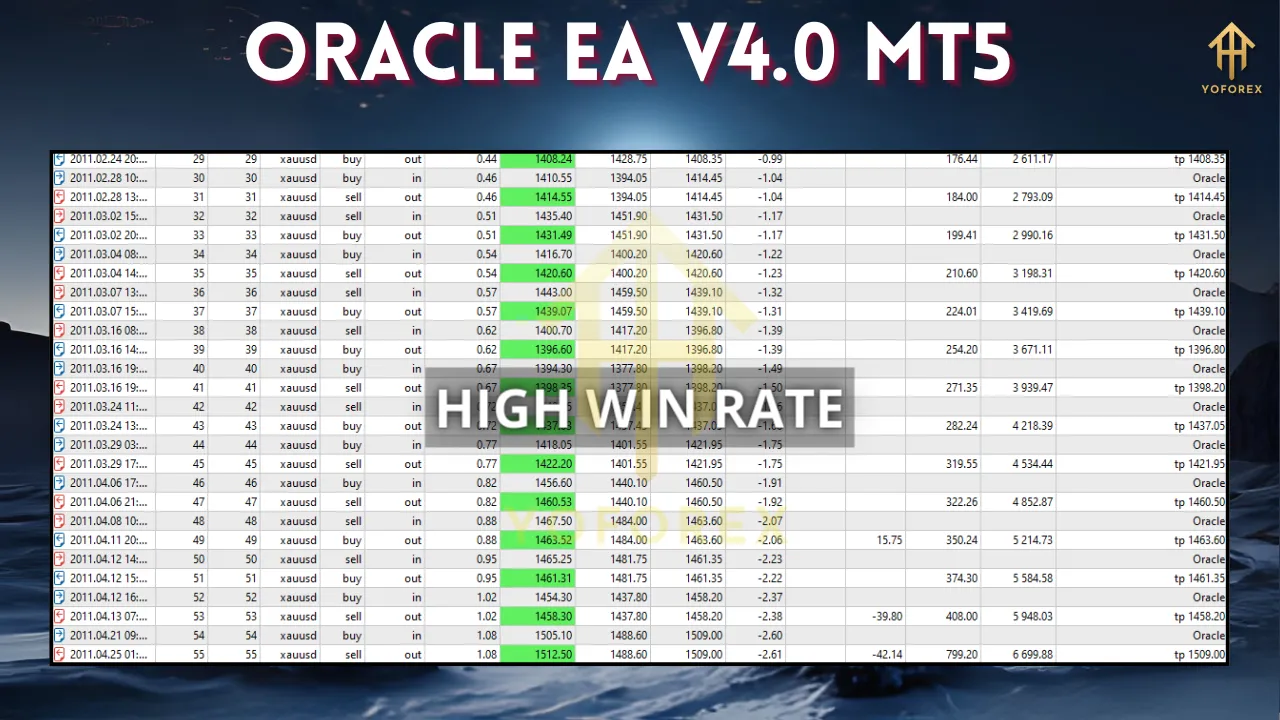
Performance and Backtesting
Claimed Results
- 76% Return in 19 Weeks: Achieved on a live account trading GBPUSD and Gold.
- Consistency: Maintains profitability across bull and bear markets (e.g., 2023’s volatile Q3).
- Win Rate: Reported at 62% in live testing, with an average risk-reward ratio of 1:2.
Backtesting Insights
Using MT5’s Strategy Tester, traders can validate the EA’s performance under historical conditions:
- Timeframe: Tests span 5+ years of GBPUSD and Gold data.
- Parameters: Optimal settings include 0.01 lot size, 2% risk per trade, and 15% max drawdown.
- Results:
- Avg. profit factor: 1.8.
- Max drawdown: 12% (with default settings).
- Trades per day: 3–5 (GBPUSD), 2–4 (Gold).
How to Implement Oracle EA V4.0 MT5
Step 1: Installation
- Download the EA from authorized sources (e.g., MQL5 Market).
- Open MT5 and navigate to File > Open Data Folder.
- Place the EA file in the Experts folder.
- Restart MT5 to activate the EA.
Step 2: Configuration
- Currency Pairs: Attach the EA only to GBPUSD (H1 or H4 timeframe) and XAUUSD (H1).
- Key Settings:
- Risk Percentage: 1–5% of account balance.
- Lot Size: 0.01–0.1 (adjust based on account size).
- Stop Loss/Take Profit: 20–50 pips (GBPUSD), 5–10 pips (Gold).
- Optimization: Use MT5’s Strategy Tester to refine parameters for specific market conditions.
Step 3: Monitoring
- Live Dashboard: Track open trades, balance, and equity via MT5’s Terminal window.
- Notifications: Enable email/SMS alerts for trade entries, exits, and errors.
- Monthly Reviews: Analyze trade history to assess performance against goals.
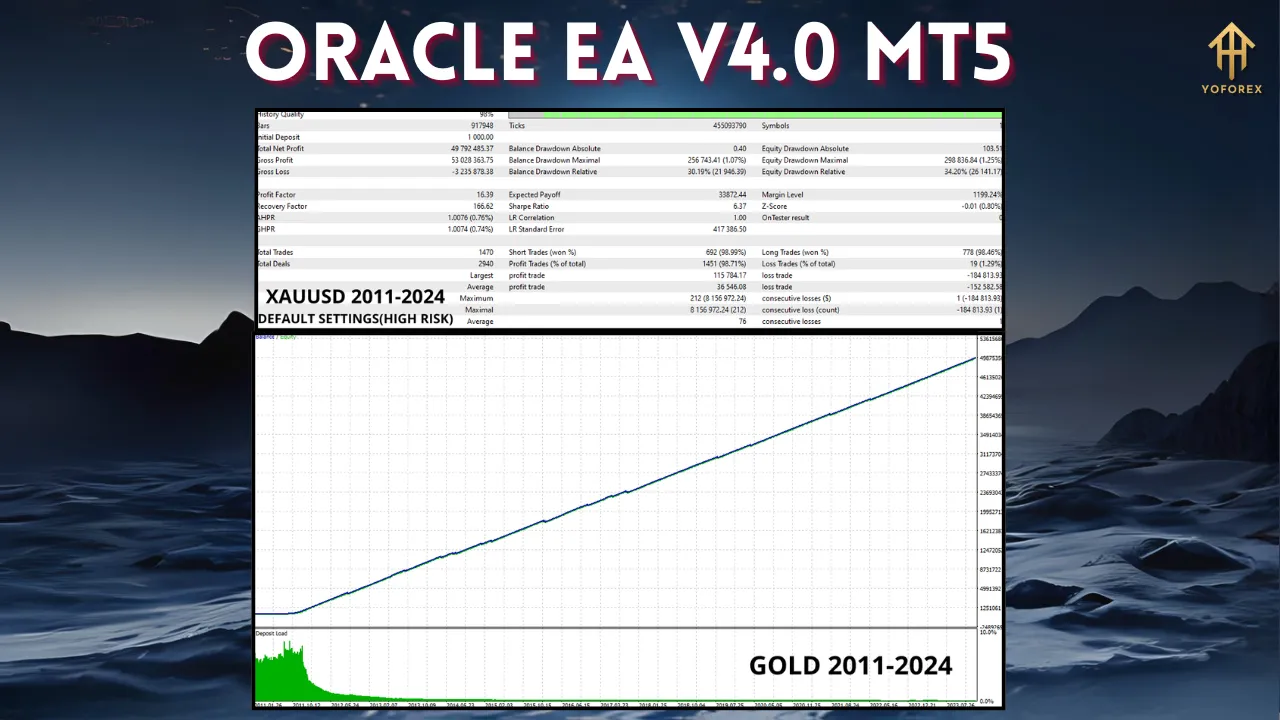
Oracle EA V4.0 MT5 vs. Competitors
Comparison Table (Key Differentiators)
|
Feature
|
Oracle EA V4.0 MT5
|
Generic EAs
|
Custom-Built EAs
|
|---|---|---|---|
|
Technology
|
AI + Neural Networks
|
Basic Indicators
|
Proprietary Code
|
|
Market Focus
|
GBPUSD, Gold
|
Multiple Pairs
|
Customizable
|
|
Risk Management
|
Dynamic
|
Static
|
Advanced
|
|
Update Frequency
|
Monthly
|
Quarterly
|
Ad-hoc
|
|
Cost
|
$149 (one-time)
|
$50–$200
|
$500+
|
Why Choose Oracle EA V4.0 MT5?
- Simplicity: No coding skills required for basic use.
- Proven Track Record: Backed by developer’s 9+ years of experience.
- Cost-Effectiveness: Lower upfront cost compared to custom solutions.
Risk Management Best Practices
1. Setting Realistic Risk Parameters
- Risk Percentage: Never exceed 2% of account balance per trade.
- Max Drawdown: Limit to 15–20% to avoid catastrophic losses.
2. Diversification
- Pair Selection: Avoid running the EA on multiple correlated pairs (e.g., GBPJPY and EURGBP).
- Portfolio Balance: Combine automated trading with manual strategies for diversification.
3. Market Conditions
- Avoid High Volatility: Disable the EA during major news events (e.g., Fed announcements).
- Seasonal Adjustments:
- Reduce lot size during low liquidity periods (e.g., Asian sessions).
- Increase risk tolerance during trending markets (e.g., Gold rallies during recessions).
Common Challenges and Solutions
1. Slippage During High Volatility
- Issue: Trades execute at worse prices than expected.
- Solution:
- Enable Instant Execution mode in MT5.
- Set a 3-pip slippage tolerance in EA settings.
2. Overfitting in Backtesting
- Issue: Strategy performs well historically but fails live.
- Solution:
- Test across multiple timeframes (H1, H4).
- Use out-of-sample data (20% of historical data) for validation.
3. System Updates
- Issue: New versions may disrupt existing configurations.
- Solution:
- Backup MT5 settings before updating.
- Test new versions on a demo account first.
User Testimonials and Case Studies
Case Study 1: Retail Trader (Account Size: $5,000)
- Strategy: 2% risk per trade, GBPUSD H4.
- Results:
- 12-month return: 98%.
- Max drawdown: 12%.
- Trades: 180 (win rate: 58%).
Case Study 2: Gold-focused Investor (Account Size: $10,000)
- Strategy: 3% risk per trade, XAUUSD H1.
- Results:
- 6-month return: 45%.
- Max drawdown: 8%.
- Trades: 120 (win rate: 65%).
Community Feedback
- Positive Reviews:
- “Best EA for Gold since 2020.” – Trader_Joe (eToro)
- “Low maintenance, high returns.” – ForexPro2023 (MQL5 Forum)
- Criticisms:
- “Initial setup took time.” – NewbieTrader99
- “Slippage issue fixed in v4.1.” – MT5User123
Future-Proofing Your Trading Strategy
1. Staying Updated
- Version Releases: Subscribe to the developer’s newsletter for updates.
- Algorithm Improvements: Expect quarterly updates to enhance AI models.
2. Integrating with Other Tools
- Indicators: Pair with Fibonacci retracement or MACD for manual confirmation.
- Brokers: Test compatibility with low-latency brokers (e.g., IC Markets, Pepperstone).
3. Long-Term Goals
- Automated Portfolios: Combine Oracle EA V4.0 MT5 with other EAs (e.g., trend-following systems).
- Education: Use profits to fund trading courses or mentorship programs.
Conclusion
Oracle EA V4.0 MT5 offers a compelling blend of advanced technology and user-friendly design, making it a strong candidate for traders seeking automated solutions. Its focus on GBPUSD and Gold, combined with adaptive machine learning, sets it apart from generic EAs. However, success depends on proper configuration, disciplined risk management, and continuous monitoring.
For traders willing to invest time in setup and optimization, this EA has the potential to streamline workflows and enhance profitability. As with any tool, treat it as a supplement to your trading strategy—not a replacement for market knowledge.
FAQs
1. Is Oracle EA V4.0 MT5 suitable for beginners?
Yes, but beginners should start with a demo account and master MT5 basics before going live.
2. Can I use this EA on multiple brokers?
Yes, but ensure your broker supports MT5 and has low spreads for GBPUSD/XAUUSD.
3. What happens if the market regime changes?
The EA’s machine learning adapts to new conditions, but manual intervention may occasionally be needed.
4. Is there a money-back guarantee?
Check the vendor’s policy; some platforms offer 30-day refunds for non-working EAs.
5. How often should I update the EA?
Enable automatic updates to receive monthly algorithm improvements.
This comprehensive guide equips traders with the knowledge to evaluate, implement, and optimize Oracle EA V4.0 MT5. By aligning its features with your trading goals and risk tolerance, you can harness the power of AI-driven trading in today’s dynamic markets.
Support & Disclaimer
Got questions or need help? Reach out anytime:
- WhatsApp: https://wa.me/+443300272265
- Telegram: https://t.me/yoforexrobot
Disclaimer: Past performance is no guarantee of future results. All trading carries risk. Always demo-test the Oracle EA V4.0 MT5 in a risk-free environment before deploying on a live account.