
Hoffman System Indicator V1.0 MT4 — Precision Entries from Smart Pullbacks
Looking for a clean, rules-based way to catch high-probability pullbacks and disciplined breakouts without sitting through every candle? The Hoffman System Indicator V1.0 for MT4 is built to identify inventory-style retracements, momentum re-engagement, and structure flips across any forex pair and any timeframe. It blends trend context, volatility awareness, and level interaction so you can trade fewer signals—but with higher quality.
Pairs: Multi-pair (majors, minors, gold, indices via MT4 CFDs)
Timeframes: Multi (from M5 scalping to D1 swing)
What the Indicator Does (In Plain Terms)
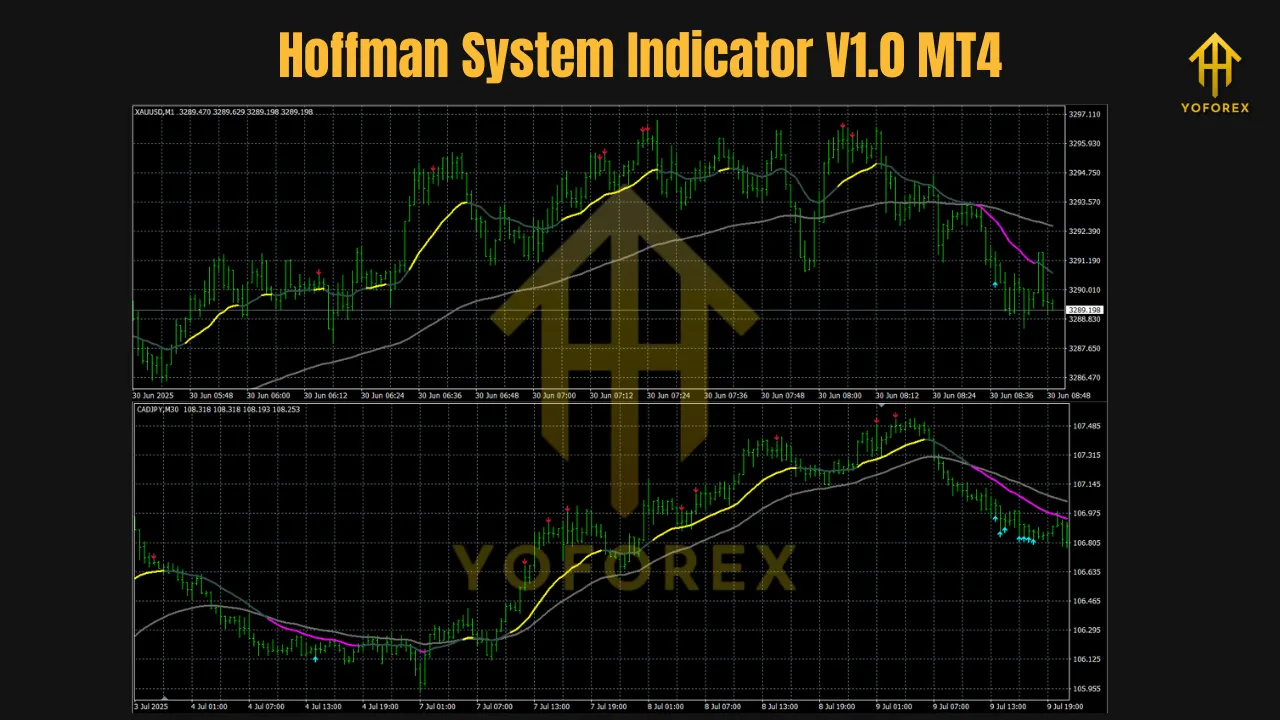
The Hoffman System Indicator scans recent price action to find retracement bars/zones where professional money often reloads into trend after a controlled pullback. It then validates those areas with trend alignment, volatility filters, and level interaction (session highs/lows or prior swing zones) before printing actionable signals:
- Continuation Long/Short: Trend pullback completes and momentum resumes.
- Breakout + Retest: Level breaks, first pullback confirms a structure shift.
- Exhaustion-to-Reclaim: Brief counter move into a volatility box, then immediate reclaim.
Each signal includes suggested stop/TP scaffolding based on ATR and recent structure so risk decisions are easier and repeatable.
Core Components
- Trend Map: Adaptive bias using a composite of moving averages and swing structure (you can choose EMA-only or swing-confirmed mode).
- Inventory Pullback Detection: Flags bars and micro-zones where price retraces just enough to shake weak hands but not enough to break trend logic.
- Level Engine: Tracks prior swing highs/lows, round numbers, and optional session open/high/low—because signal quality improves at decision points.
- Volatility Box (ATR): Builds dynamic zones that scale with volatility so your stops and re-entry logic aren’t one-size-fits-all.
- Signal Confidence Meter: On-chart tag (e.g., “Confidence 2/3”) summarizing trend, level, and momentum agreement.
- Alerts: Pop-up, push, or email on confirmed bar close to avoid intrabar noise.
How Signals Are Generated
- Identify Bias: Price relative to the Trend Map + swing orientation.
- Locate Pullback: Detect retracement into a volatility box or pre-marked level.
- Confirm Re-Engagement: Momentum or structure trigger (close beyond micro swing, engulf, or range break).
- Print Setup Type: Continuation, Breakout + Retest, or Exhaustion-to-Reclaim with a confidence tag.
- Risk Framework: Suggest stop beyond invalidation (zone edge or ATR multiple) and project conservative/progressive targets.
No single element is the “magic.” The edge comes from stacked confluence with clear invalidation.
Recommended Settings
Intraday (M5–M15)
- Trend Map: EMA-only (fast/slow)
- ATR Period: 14
- Volatility Box: 0.8–1.2 × ATR(14)
- Level Engine: Prior day high/low + round numbers on
- Signal Confidence Threshold: 2/3
- Alerts: Bar-close only
Day Trading (M30–H1)
- Trend Map: Swing-confirmed mode
- ATR Period: 14–20
- Volatility Box: 1.0–1.5 × ATR
- Level Engine: Session open/high/low + prior swing zones
- Signal Confidence Threshold: 2/3 or 3/3 for stricter entries
Swing (H4–D1)
- Trend Map: Swing-confirmed + long MA filter (e.g., 200 EMA)
- ATR Period: 20
- Volatility Box: 1.5–2.0 × ATR
- Level Engine: Weekly highs/lows and major swing levels
- Signal Confidence Threshold: 3/3 (patience pays)
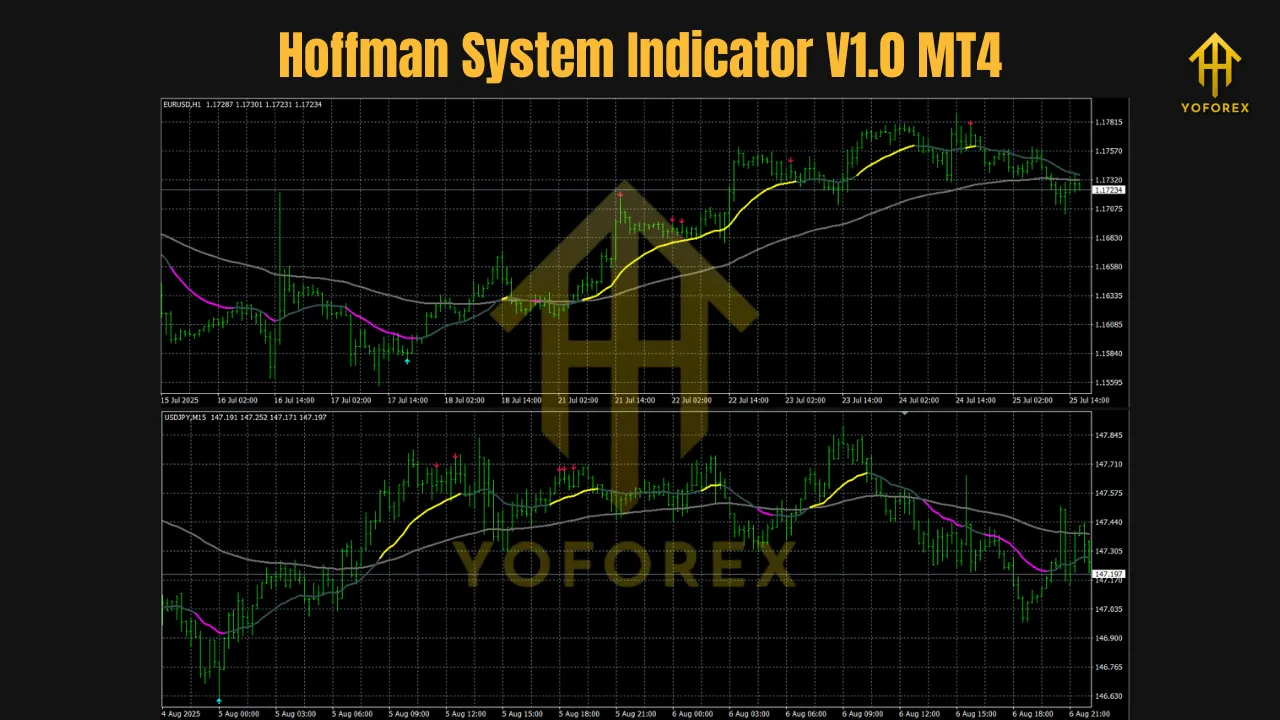
Quick start: EURUSD H1 — Confidence ≥2, bar-close alerts, Volatility Box 1.2 × ATR, Level Engine ON (prior swing + round numbers).
Three Proven Playbooks
1) Trend Pullback – “Inventory Reload”
- Context: Higher-timeframe trend is up; price dips into the Volatility Box near a prior swing or round number.
- Trigger: Bullish close reclaiming the pullback zone with Confidence ≥2.
- Stop: Below the zone edge or 1× ATR(14), whichever is wider.
- Targets: 1R at prior micro-high; 2R at next resistance; optional trailer using a rising short EMA or the volatility box edge.
- Works Best On: EURUSD/GBPUSD M15–H1.
2) Breakout + First Retest – “Structure Flip”
- Context: Repeated rejections at a level; the level finally breaks with a decisive close.
- Trigger: The first clean retest prints a continuation signal (Confidence ≥2).
- Stop: Beyond the retest wick or zone edge.
- Targets: Nearest mapped level; scale partials at 1R/2R.
- Works Best On: USDJPY, XAUUSD H1–H4.
3) Exhaustion-to-Reclaim – “Trap & Go”
- Context: Counter-trend push extends into the outer Volatility Box boundary, then snaps back and closes through the intraday mean or micro-structure.
- Trigger: Reclaim bar close (Confidence ≥2) in the direction of the dominant higher-timeframe trend.
- Stop: Past the exhaustion wick by 1× ATR.
- Targets: Mid-range → opposite boundary / next level.
- Works Best On: NAS100/US30 H1; EURUSD M30–H1 during London/NY.
Risk Management (The Part That Saves Careers)
- Size to the Stop: Risk a fixed fraction (0.5–1% per trade). Larger ATR = smaller lots.
- Structure-First Stops: Place stops beyond invalidation (zone edge or swing), not in the middle of noise.
- One Idea per Chart: Don’t run conflicting strategies simultaneously on the same symbol/TF.
- No Martingale: Scale out when structure fails. The system is about selective entries, not bigger bets.
- News Discipline: Stand aside +/- 10–15 minutes around high-impact releases; signals are less reliable.
Backtesting & Optimization Roadmap
- Pick One Market + TF: e.g., GBPUSD H1.
- Gather 75–100 signals: Label them by setup type (Pullback, Breakout + Retest, Exhaustion-to-Reclaim).
- Track Metrics: Win rate, average R, max drawdown, MAE/MFE, and time-in-trade.
- Tune in This Order: Confidence threshold → Volatility Box multiple → Level Engine components.
- Cross-Validate: Re-run on a correlated pair (EURUSD) and an adjacent timeframe (M30/H4).
- Forward-Test: 2–4 weeks live-sim or micro-lots before scaling.
Best Pairs & Timeframes
- Majors (EURUSD, GBPUSD, USDJPY): M15–H1 for clean pullbacks and retests.
- Gold (XAUUSD): H1–H4 for structure flips; use wider volatility boxes.
- Indices (NAS100/US30): H1 for Breakout + Retest and Trap & Go patterns.
- Crypto CFDs: H4–D1 only; volatility can distort intraday signals.
Installation & First Session Workflow
- Copy the indicator file into MQL4/Indicators and restart MT4.
- Attach to your chart and select a Preset (Intraday / Day Trade / Swing).
- Turn on the Level Engine and choose which levels to display (prior swing, session, round numbers).
- Set Confidence ≥2 and bar-close alerts to begin.
- Journal every signal with a screenshot and brief notes. Patterns repeat—your notes become edge.
Pro Tips & Common Mistakes
Do:
- Align with a longer timeframe bias (trade longs on lower TFs if H4/D1 trend is up).
- Keep the chart clean—only show levels that matter now.
- Use session filters (London/NY overlap) for intraday.
Don’t:
- Chase the breakout candle—wait for the first retest when possible.
- Place stops inside the volatility box—give trades room to breathe.
- Over-optimize to history—forward-test your baseline.
Final Thoughts
The Hoffman System Indicator V1.0 MT4 translates smart-money style pullbacks and structure shifts into a repeatable, rules-based workflow. Use the trend map for bias, the volatility box for risk geometry, and the level engine for timing. When you insist on confidence-based entries and ATR-aware stops, you’ll trade with more clarity—and less stress.
Join our Telegram for the latest updates and support