
Karazon Secret Indicator V1.0 MT4 – The Practical Trader’s Guide
Introduction
Karazon Secret Indicator V1.0 for MetaTrader 4 is designed for traders who want clean chart signals, objective rules, and a workflow that avoids guesswork. It focuses on trend alignment, momentum confirmation, and session-aware volatility so you can focus on execution instead of second-guessing entries. This guide explains how the indicator works, how to configure it, and three proven ways to use it—without hype. Backtest first, forward-test next, and go live only when you have data and discipline.
What Is Karazon Secret Indicator?
Karazon Secret is a signal-and-filter tool that blends three ideas most discretionary traders already use:
- a trend baseline to keep you on the right side of momentum,
- a structure pulse that reacts to higher highs/lows or breaks of recent swing points, and
- a light volatility gate to avoid dead or chaotic markets.
When conditions align, the indicator prints clear on-chart markers and can trigger alerts. It’s simple enough for beginners and configurable enough for experienced traders who want to fine-tune signal sensitivity.
How It Works (Under the Hood)
While the exact formula is proprietary, the logic follows a practical workflow:
- Trend Baseline: A smoothed moving baseline (length adjustable) defines directional bias. Signals against the baseline are filtered or sized down.
- Structure & Momentum Check: Recent swing structure and a momentum pulse (derived from price range expansion) validate that the move isn’t just noise.
- ATR Volatility Gate: The indicator checks whether current ATR meets a minimum threshold (user-defined). If volatility is too low or too erratic, it reduces or withholds signals.
- Optional MTF Confluence: You can require the higher timeframe trend baseline to match the lower timeframe signal direction.
Key Features
- Directional Filter: Minimizes counter-trend trades in trending conditions.
- Sensitivity Control: Tailor signal frequency for scalping (more reactive) or swinging (smoother).
- ATR/Volatility Filter: Avoids flat phases and reduces whipsaw entries.
- Multi-Timeframe Confirmation (optional): Align entries with a higher timeframe.
- Session Awareness: Limit signals to specific sessions (London/NY) if preferred.
- Alerts Suite: Desktop pop-up, sound, and push/email notifications.
- Clean Visuals: Minimalist arrows/labels and a compact status panel.
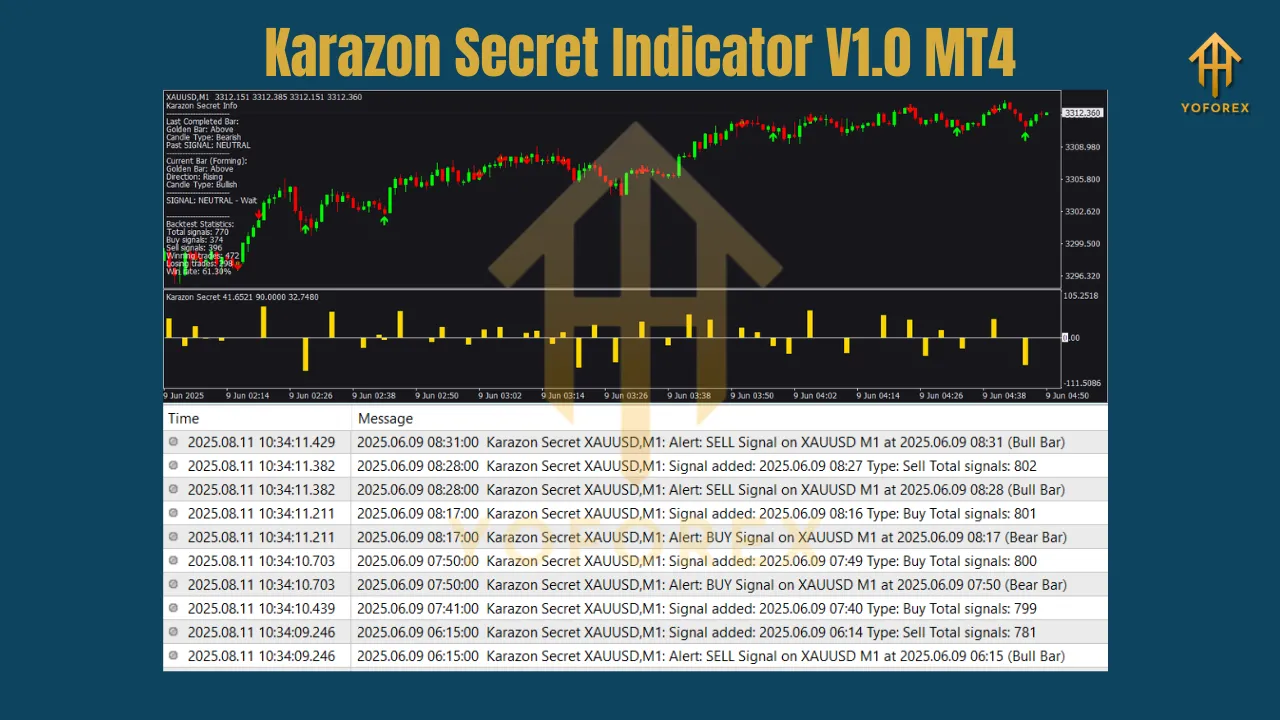
Installation & First Setup (MT4)
- Copy File: Place the
.ex4/.mq4inMQL4 > Indicators. - Restart/Refresh: Restart MT4 or refresh Navigator.
- Attach to Chart: Drag Karazon Secret Indicator V1.0 onto your symbol/timeframe.
- Inputs: Start with the defaults provided below; save your template for reuse.
- Alerts: Configure MT4 notifications if you want push/email alerts.
Recommended Markets & Timeframes
-
Pairs: Major FX pairs (EURUSD, GBPUSD, USDJPY), XAUUSD (Gold); some indices if your broker offers them.
-
Timeframes:
-
Scalping: M5–M15
-
Intraday: M15–H1
-
Swing: H1–H4
Begin with one instrument you know well to learn the indicator’s rhythm.
-
Suggested Starter Settings
Use these as a foundation—optimize later with testing.
- Trend Baseline Period: 80–100 (shorten for scalping; lengthen for swing).
- Signal Sensitivity: Medium (a balance between frequency and quality).
- ATR Filter Period/Threshold: ATR(14); set minimum threshold based on the pair’s typical range (e.g., for EURUSD, a small threshold; for Gold, larger).
- MTF Confirmation: On; one higher timeframe (M15→H1, H1→H4).
- Session Filter: Enable hours that match your trading availability (e.g., London open to early NY).
- Alerts: On; push when away from desk.
Three Ways to Trade Karazon Secret
1) Trend Continuation (“Karazon Flow”)
Idea: Trade pullbacks in the direction of the trend baseline.
Setup:
- Timeframe: M15 or H1.
- Entry (Buy): Trend baseline is up; price pulls back without breaking the baseline; a fresh Karazon buy signal prints.
- Stop-Loss: Below recent swing low or 1× ATR(14).
- Take-Profit: 1.5×–2× risk; consider trailing with a short moving average or an ATR-based stop.
Why it works: Strong trends often resume after shallow pullbacks. The filter keeps you aligned; the signal times the re-entry.
2) Reversal at Structure (“Karazon Flip”)
Idea: Catch early reversals when structure flips and momentum confirms.
Setup:
- Timeframe: M15–H1.
- Entry (Sell example): Price forms a lower high near resistance; the baseline starts rolling down; a sell signal prints after a minor retest.
- Stop-Loss: Above the retest high or 1–1.5× ATR.
- Take-Profit: Scale out at 1× risk; trail the rest behind lower highs.
Notes: Best when a higher timeframe has reached a key level or divergence is visible. If MTF disagrees, trade smaller or skip.
3) Session Breakout (“Karazon Pulse”)
Idea: Focus on the volatility burst at session opens.
Setup:
- Timeframe: M5–M15.
- Filters: ATR above your minimum; session filter enabled for London/NY.
- Entry: Take the first valid signal in the session that aligns with MTF direction.
- Stop-Loss: Tight (around 1× ATR for your timeframe).
- Take-Profit: Partial at 1× risk; let the rest trail during the session.
Risk & Money Management
- Per-Trade Risk: 0.5–1% for new users; advanced traders rarely exceed 2%.
- Daily Guardrails: A daily loss cap (e.g., 2–3%) and a daily win cap (lock gains and stop trading).
- Position Sizing: Use ATR to normalize stops across pairs; don’t use the same pip stop on EURUSD and XAUUSD.
- Event Risk: Consider pausing before high-impact news if your strategy requires stable conditions.
- Journal: Screenshot entries/exits; log settings and context. Consistency scales results.
Backtesting & Optimization Blueprint
- Pick One Pair/TF: Start with EURUSD M15 or XAUUSD M15 to collect enough trades quickly.
- Define Metrics: Win rate, average R, max drawdown, and profit factor.
- Run a Baseline Test: Default settings for 6–12 months of data.
- Iterate One Variable at a Time: Trend period (±20), then sensitivity, then ATR threshold.
- Forward Test: At least two weeks live market observation on demo.
- Codify Rules: Once stable, write a 1-page playbook you can follow without hesitation.
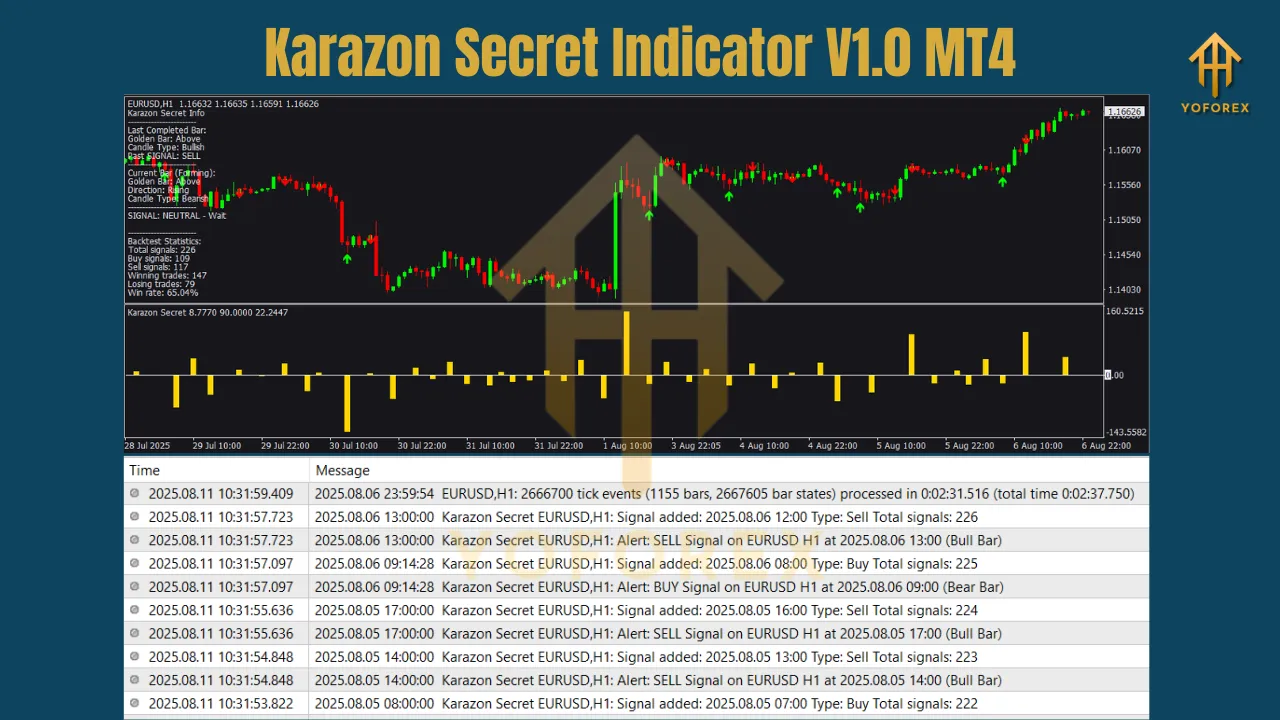
Example Playbook (Step-by-Step)
- Chart: EURUSD M15; MTF confirm with H1.
- Inputs: Trend 90, Sensitivity Medium, ATR(14), session London→NY overlap.
- Pre-Trade Check: Trend up on H1; ATR above minimum; no major news in next 30 minutes.
- Trigger: Price pulls back to near baseline; Karazon prints a fresh buy marker.
- Order: Market or stop order a few points above signal candle high.
- Stop: Swing low minus ATR buffer.
- Targets: TP1 at 1.5R; move stop to breakeven; trail remainder behind a short MA or 1× ATR.
- Exit: Opposite signal + baseline flattening, or session end.
- Journal: Note spread, slippage, session, and your state (were you rushed or calm?).
Common Mistakes to Avoid
- Chasing Late Signals: If the move already traveled beyond your typical stop distance, skip it.
- Ignoring MTF: Lower timeframe signals against higher timeframe bias tend to underperform.
- Trading All Sessions: Overtrading across quiet Asian hours can erode gains from London/NY.
- Static Stops on Volatile Symbols: Gold and indices need wider, adaptive stops.
- Changing Rules Mid-Trade: Follow your plan; modify only after a batch of trades, not during one.
Conclusion
Karazon Secret Indicator V1.0 MT4 won’t replace a trading plan—but it can simplify your plan by highlighting moments when trend, structure, and volatility align. Start with the default settings, focus on one market, and track every trade. As you gather data, refine sensitivity, ATR thresholds, and session filters to fit your personality and schedule. The edge comes from consistent rules and disciplined execution, not from taking every signal that flashes.
Join our Telegram for the latest updates and support