
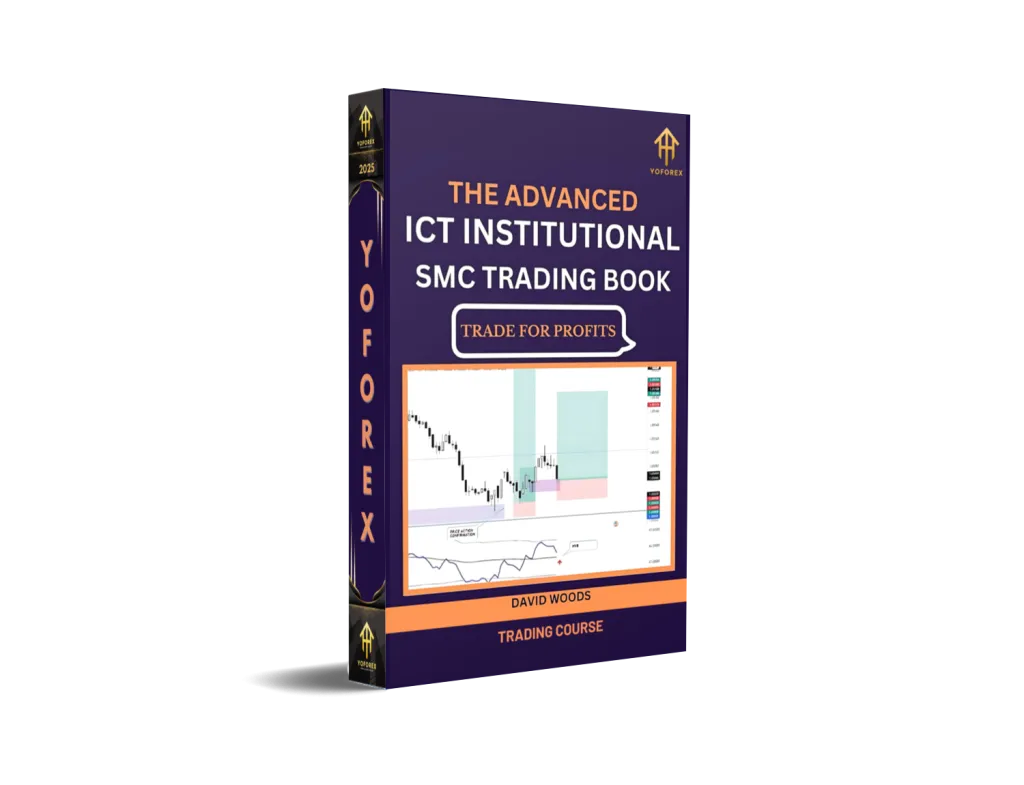
Unlock Institutional Trading Secrets: A Deep Dive into David Woods’ Advanced ICT SMC Trading Book
In the high-stakes world of financial markets, retail traders often feel like small fish in an ocean dominated by institutional giants. The elusive “smart money” seems to move markets with precision, leaving individual traders struggling to decipher the code. Enter David Woods’ “The Advanced ICT Institutional SMC Trading Book“ – a comprehensive course designed to bridge this gap, empowering traders with the sophisticated concepts once reserved for institutional desks. If you’re serious about elevating your trading beyond basic strategies and understanding the real forces driving price action, this course demands your attention. Let’s explore why it’s generating buzz and whether it holds the key to transforming your trading performance.
What Exactly is “The Advanced ICT Institutional SMC Trading Book”?
At its core, this course is a deep dive into the fusion of two powerful trading methodologies: ICT (Inner Circle Trader) concepts and SMC (Smart Money Concepts). David Woods, a seasoned trader and educator, has meticulously compiled his advanced understanding of institutional order flow, market structure, and price manipulation into a structured learning program. It’s not just another indicator-based system; it’s a paradigm shift focused on why the market moves the way it does and how to anticipate the next move by tracking the footprints of institutional capital.
The “book” format implies a comprehensive, text-based and visual guide, often supplemented with video tutorials, charts, and practical exercises. It aims to provide traders with a complete framework for analyzing markets through the lens of institutional behavior, moving beyond simplistic retail patterns to a more profound understanding of market dynamics.
Decoding the Core: Key Concepts You’ll Master
This course isn’t for beginners; it’s for traders ready to tackle advanced material. Here’s a breakdown of the foundational pillars you’ll encounter:
1. Institutional Order Flow: The Engine of the Market
Forget lagging indicators. The course drills down into the real-time flow of institutional orders. You’ll learn to:
- Identify Order Blocks: Discover specific price zones where large institutions have placed significant buy or sell orders, acting as powerful magnets for future price action.
- Understand Fair Value Gaps (FVGs) / Imbalances: Recognize areas where price has moved too quickly, leaving an “inefficiency” that institutions are likely to target for reversal or continuation.
- Track Liquidity Grabs: Learn how institutions intentionally trigger stop-losses (liquidity) above key highs or below key lows to fuel their own positions – and how to spot this happening in real-time.
- Intermittent Premium & Discount: Grasp how institutions manipulate price between overbought (premium) and oversold (discount) zones to accumulate or distribute positions efficiently.
2. Smart Money Concepts (SMC) Decoded: Seeing Through the Noise
SMC is the practical application of understanding institutional behavior. The course provides a structured approach:
- Market Structure Shifts (MSS): Master the art of identifying when the dominant trend (bullish or bearish) is genuinely reversing or continuing, based on institutional activity, not just price breaks.
- Change of Character (CHoCH): Learn to recognize the precise moment when the market’s behavior fundamentally shifts, signaling a potential trend change or acceleration.
- Liquidity Pools & Sweeps: Understand how institutions hunt for liquidity at key levels (like previous highs/lows, or areas dense with stop orders) and how to position yourself before the sweep happens or after liquidity is taken.
- Premium & Discount Arrays: Develop a keen eye for identifying institutional accumulation and distribution zones, allowing you to align your trades with the “smart money.”
3. Advanced Price Action & Confluence: Precision Entry & Exit
The course integrates ICT/SMC principles with sophisticated price action analysis:
- Candlestick Patterns in Context: Move beyond basic patterns. Learn how institutional footprints (like FVGs, Order Blocks) give classic reversal or continuation patterns their true power and reliability.
- Fibonacci & Institutional Levels: Discover how institutional traders often use Fibonacci retracements/extensions in conjunction with their key liquidity zones and order blocks for high-probability targets.
- Multiple Time Frame Analysis (MFTA) on Steroids: Learn to align institutional signals across different time frames (e.g., identifying a daily Order Block, a 4-hour FVG, and a 1-hour CHoCH) to find high-conviction, low-risk entries.
- Confluence is King: Understand that the strongest signals occur when multiple ICT/SMC concepts align at a specific price level (e.g., an Order Block coinciding with a major liquidity pool and a 50% Fibonacci retracement).
4. Risk Management & Trading Psychology: The Institutional Discipline
Even the best strategy fails without discipline. Woods emphasizes:
- Institutional Position Sizing: Learn how professionals calculate risk based on market structure and volatility, not arbitrary percentages.
- Stop-Loss Placement: Discover where institutions expect stops to be (and thus where they hunt them) and how to place your stops strategically outside these zones.
- Managing Expectations: Develop the patience to wait for high-probability setups aligned with institutional flow, avoiding the trap of overtrading.
- Emotional Control: Techniques to maintain objectivity and stick to the plan, especially when the market appears chaotic (which is often when institutions are most active).
Why David Woods’ Course Stands Out in a Crowded Market
The trading education space is saturated. Here’s why this advanced ICT/SMC book/course is gaining traction:
- Deep Institutional Focus: It goes far beyond surface-level SMC explanations. Woods delves into the mechanics of why institutions do what they do, providing a truly institutional-grade perspective rarely taught outside proprietary trading firms.
- Comprehensive Integration: It doesn’t just teach ICT or SMC; it masterfully weaves them together into a cohesive, actionable framework. You learn how these concepts interact and reinforce each other.
- Practical Application: The course is heavy on real chart examples, case studies, and practical exercises. It’s designed to move you from theory to live application.
- Advanced Nuance: Woods addresses complex scenarios, exceptions, and the subtle nuances that separate profitable traders from struggling ones. It respects the intelligence of experienced traders.
- Clarity in Complexity: Despite the advanced subject matter, the course is structured logically. Woods breaks down intricate concepts into digestible modules, building knowledge progressively.
- Focus on Confluence: It relentlessly emphasizes the power of multiple confirming signals, teaching traders to avoid low-probability setups and wait for the “A+” trades.
Who Is This Course Really For? (Target Audience)
This is not a beginner-friendly course. It assumes a solid foundation in trading basics. It’s ideal for:
- Intermediate Traders Stuck in a Rut: Traders who know the basics but struggle with consistency, entries, exits, or understanding why their setups fail.
- SMC/ICT Practitioners Seeking Depth: Traders already familiar with basic SMC/ICT concepts who want to deepen their understanding, refine their execution, and learn advanced institutional tactics.
- Price Action Purists: Traders who prefer clean charts over indicators and want to understand the underlying order flow driving price movements.
- Aspiring Professional Traders: Individuals aiming for a career in proprietary trading or fund management who need a robust, institutional-grade understanding of market microstructure.
- Traders Frustrated with “Retail” Systems: Those tired of lagging indicators, generic patterns, and systems that seem to stop working as soon as the market changes character.
Who Should Probably Avoid It?
- Absolute beginners needing foundational education (charts, basic terminology, risk management 101).
- Traders seeking a “push-button” system or guaranteed profits.
- Those unwilling to put in significant study and screen time to grasp complex concepts.
- Traders who heavily rely on numerous indicators and are unwilling to embrace a primarily price-action-driven approach.
The Tangible Benefits: What Can You Achieve?
Mastering the material in this course can lead to significant improvements in your trading:
- Enhanced Market Understanding: Gain a profound, almost “X-ray” vision of the market, seeing the institutional narrative behind price swings.
- Higher Probability Setups: Learn to identify confluence zones where multiple institutional signals align, drastically increasing your win rate and risk-reward ratio.
- Precision Entries & Exits: Enter trades before the crowd catches on (often near institutional entry points) and exit near institutional targets (liquidity pools).
- Reduced Overtrading: Develop the patience to wait for only the highest-conviction setups aligned with smart money flow.
- Improved Risk Management: Place stops strategically based on institutional logic, not arbitrary levels, significantly reducing unnecessary losses.
- Increased Confidence: Trade with conviction based on a deep understanding of market mechanics, not hope or guesswork.
- Adaptability: Learn a framework that works across various asset classes (Forex, Indices, Commodities, Crypto) and adapts to changing market conditions.
Maximizing Your Return: How to Get the Most Out of the Course
Simply buying the course isn’t enough. To truly benefit:
- Commit to Deep Study: Don’t skim. Dedicate focused time to each module. Take detailed notes.
- Backtest Relentlessly: Apply the concepts historically on thousands of charts. Prove to yourself they work and understand the nuances. Build a statistical edge.
- Paper Trade First: Implement the strategies in a simulated environment before risking real capital. Focus on execution and psychology.
- Join the Community (If Available): Engage with other students. Discuss charts, ask questions, share insights. Collective learning accelerates progress.
- Focus on Mastery, Not Speed: It takes time to internalize these complex concepts. Don’t rush the process. Aim for deep understanding, not quick profits.
- Keep a Detailed Trading Journal: Log every trade, the setup (which ICT/SMC concepts were present?), your reasoning, the outcome, and lessons learned. Review it religiously.
- Apply Disciplined Risk Management: Never deviate from the risk principles taught, even when a setup looks “perfect.” Capital preservation is paramount.
The Verdict: Is “The Advanced ICT Institutional SMC Trading Book” Worth It?
For the right trader – intermediate or advanced, committed, and seeking a truly institutional-level understanding of market dynamics – David Woods’ course represents a potentially transformative investment. It cuts through the noise of retail trading education and provides a rigorous, well-structured framework based on the actual behavior of the market’s most powerful participants.
The focus on deep integration of ICT and SMC, the emphasis on confluence and institutional logic, and the practical application through charts and exercises make it stand out. It’s not a magic bullet, but a sophisticated toolkit and mindset shift.
If you’re ready to move beyond guessing games and simplistic patterns, if you’re prepared to put in the hard work of mastering complex concepts, and if your goal is to trade with the precision and insight of an institutional professional, then “The Advanced ICT Institutional SMC Trading Book by David Woods” is unequivocally worth serious consideration. It could be the key that unlocks consistent profitability and elevates your trading to an entirely new level.
Frequently Asked Questions (FAQ)
Q1: Do I need prior knowledge of ICT or SMC before taking this course? A: While not strictly mandatory, a basic understanding of core SMC concepts (like market structure, order blocks, liquidity) or ICT principles will significantly help you grasp the advanced material faster. This course builds upon these foundations, it doesn’t start from scratch.
Q2: What trading style is this course best suited for (e.g., scalping, swing trading)? A: The concepts taught are primarily applicable to swing trading and intraday trading (timeframes like 15min, 1hr, 4hr, daily). The focus on institutional order flow and market structure shifts is less relevant for ultra-short-term scalping where noise dominates.
Q3: Does the course provide specific entry/exit rules or is it more conceptual? A: It provides a robust framework for identifying high-probability setups based on confluence. While it offers clear guidelines for entry triggers (e.g., specific price action at an Order Block/FVG) and exit targets (e.g., liquidity pools, Fibonacci extensions), it emphasizes understanding the context over rigid, mechanical rules. You learn to think like an institution.
Q4: Is there ongoing support or a community included? A: This varies depending on where you purchase the course. Some platforms include access to a private student community or forum for discussion and Q&A. Check the specific offering details when purchasing. The core material itself is comprehensive.
Q5: How long does it typically take to complete the course and become proficient? A: Completing the core material might take a few weeks of dedicated study. However, achieving true proficiency requires months of dedicated backtesting, paper trading, and live application. Mastery of institutional concepts is an ongoing journey, not a one-time event.
Q6: Are the strategies applicable to all markets (Forex, Stocks, Crypto, Futures)? A: Yes, the core principles of institutional order flow, market structure, and liquidity are universal across liquid financial markets. The examples might focus more on Forex or Indices, but the concepts translate well to Stocks, Crypto, and Futures.
Q7: What makes this different from other SMC courses available online? A: Its key differentiators are the depth of institutional focus, the seamless integration of advanced ICT concepts with SMC, the emphasis on confluence, and the practical, chart-heavy teaching style aimed at experienced traders. It avoids oversimplification and tackles the complex realities of institutional manipulation.
Conclusion
David Woods’ “Advanced ICT Institutional SMC Trading Book” demystifies the complex strategies of institutional trading, offering retail traders a rare glimpse into the mechanics of smart money. By mastering its integrated ICT/SMC framework, disciplined traders gain the precision to identify high-probability setups and execute with institutional-level confidence. This course isn’t just a learning resource—it’s a paradigm shift for those committed to rigorous discipline and achieving consistent market mastery.
Support & Disclaimer
Got questions or need help? Reach out anytime:
- WhatsApp: https://wa.me/+443300272265
- Telegram: https://t.me/yoforexrobot