
Suppose you’re looking for an automated trading system tailored to a single, well-defined market niche. In that case, Prodigy FX EA V9.105 (MT5) is built for the CADCHF currency pair and centres on an averaging approach guided by Bollinger Bands. Instead of promising to trade “all pairs, all timeframes,” this Expert Advisor takes a focused route and claims to be optimised using six years of historical data (2020–2025) on an IC Markets Standard account. It also layers adaptive risk controls—take-profit and stop-loss settings that adjust per position—to aim for steadier execution. According to its listing, the current version is 9.105, priced at $299 at the time of publication, with a staged price-increase model and a limited distribution plan.
In this review, we’ll walk through its strategy idea, setup recommendations, the “who is it for” question, risk considerations, and practical steps to get started—so you can decide if Prodigy FX belongs in your MT5 portfolio.
What Prodigy FX EA Tries to Do (In Plain English)
At its core, Prodigy FX EA uses Bollinger Bands as the primary indicator and an averaging methodology for trade management. Averaging strategies typically scale into positions—carefully and with rules—seeking to improve the average entry price during mean-reversion phases. The Bollinger Band framework supplies context for volatility and “stretched” conditions: price excursions outside the bands can signal potential reversion zones, while band width reflects volatility. The EA’s description emphasises adaptive TP/SL per position—an important distinction versus static, one-size-fits-all exits. Adaptability matters in CADCHF, a cross that often exhibits range-like behaviour and reacts to CAD vs CHF macro differentials (oil-sensitive CAD vs safe-haven-leaning CHF).
The developer further notes that backtesting and tuning were performed on IC Markets Standard (no-commission) and that while Raw accounts are “possible,” Standard is considered more optimal for this robot’s logic and cost structure. This may relate to the way spreads, commissions, and execution profiles affect both averaging and Bollinger-based entries/exits.
Key Features and Selling Points
-
Built for CADCHF: Narrow focus on a single pair can be a positive—rules and filters are tuned to one market’s behavior rather than spread thin across dozens of symbols.
-
Bollinger-Guided Averaging: Uses the bands to find mean-reversion opportunities and to guide scaling logic, with position-by-position risk controls.
-
Adaptive TP/SL: Each position carries adaptive take-profit and stop-loss rather than fixed values. In practice, that means exits can flex with volatility and context.
-
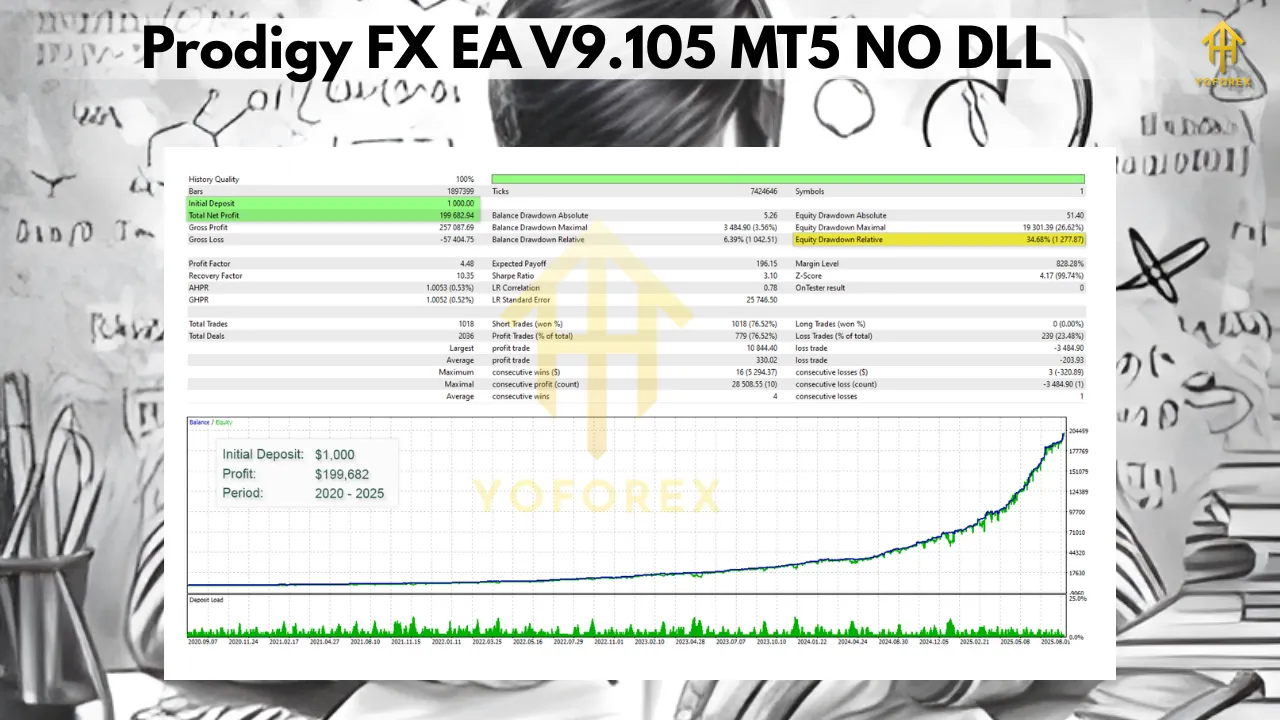
Backtested 2020–2025 on IC Markets Standard: The listing claims six years of data were used for tuning—useful for recent-regime testing (pandemic era, inflation cycle, policy shifts). Always validate with your own walk-forward/backtests.
-
Versioning and Limited Copies: Current version is 9.105; initial price $299 with a $100 price increase after every 10 sales, and a cap of roughly 200–300 copies. This staged distribution is positioned as a scarcity model.
Recommended Setup (From the Listing)
-
Pair: CADCHF
-
Minimum Deposit: $200
-
Account Type: Hedging
-
Timeframe: “Any” (the EA uses its internal timeframes coded into the advisor)
-
Broker Environment: Standard (no commission) preferred; Raw is “possible, but not optimal.” The listing specifically mentions IC Markets / IC Trading for best results.
These are the vendor’s own recommendations—you should still forward-test and confirm compatibility with your broker’s liquidity, spreads, and slippage.
Who Is Prodigy FX For?
-
Mean-Reversion and Range Traders: If you naturally gravitate toward pairs that oscillate and revert, CADCHF often fits that bill—especially outside high-impact news bursts.
-
Traders Comfortable with Averaging: Averaging can be effective in sideways regimes, but it’s not “fire and forget.” It requires discipline, sensible max-exposure rules, and capital allocation that respects tail-risk.
-
MT5 Users Seeking Single-Pair Specialization: If you prefer a clean, single-chart deployment and like the idea of a system honed for one cross, specialization can simplify monitoring and optimization.
Risk Profile and What to Watch
Averaging strategies—no matter how well built—carry path-dependency risk. If price trends persist unusually long or volatility shifts regimes (e.g., prolonged CHF strength/weakness tied to risk sentiment or SNB policy), scaling can accumulate exposure at the wrong time. The vendor’s use of adaptive stop-loss is a positive, but risk still compounds with multiple positions. Keep these controls in mind:
-
Max Positions / Max Drawdown: Decide on strict caps. If your equity or margin usage reaches a pre-defined threshold, the system should reduce exposure or stop trading.
-
News & Liquidity Filters: CADCHF can gap on SNB rhetoric, BoC decisions, or oil-linked CAD shocks. During major policy events, consider pausing or reducing risk.
-
Broker Choice Matters: The EA was tuned on IC Markets Standard; spreads/commissions and execution vary across brokers. If you deviate from the recommended environment, re-optimize or at least forward-test before going live.
Backtesting vs. Reality: Bridging the Gap
The listing highlights optimization on 2020–2025 data. That period includes pandemic volatility, inflation shocks, and evolving central bank regimes—excellent stress contexts. Still, every strategy faces the classic challenge: out-of-sample drift. The markets adapt; correlations and ranges change. To improve your odds:
-
Replicate the Vendor’s Testbed: Start by backtesting on CADCHF using MT5’s real tick data if available, aligned with a Standard account cost profile. Seek performance that at least resembles the listed claims.
-
Walk-Forward & Monte Carlo: Use walk-forward tests with rolling windows to see how stability holds when parameters aren’t re-fit every time. Apply trade-shuffle and volatility-shuffle Monte Carlo to test path sensitivity.
-
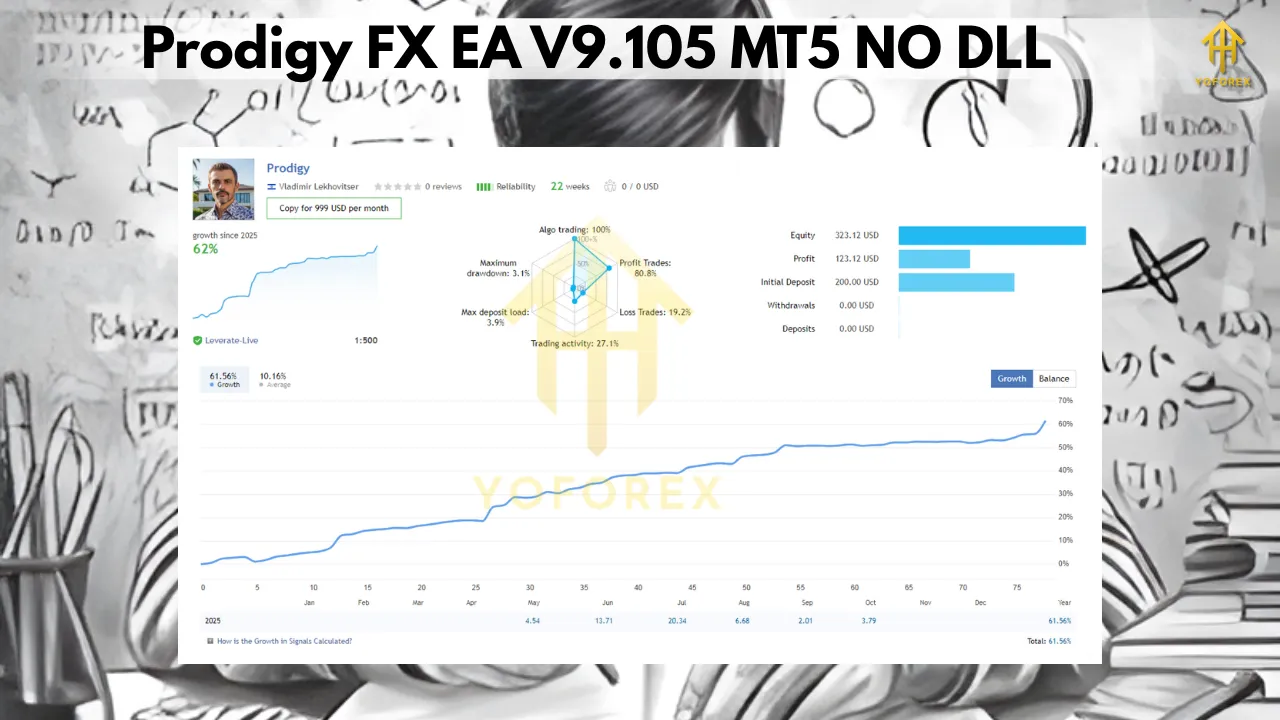
Forward-Test on a Small Live Account or Demo: The listing shows a Live signal link; regardless, your own forward-test is indispensable. Keep position sizes minimal until you validate behavior in your environment.
Practical Deployment Tips (MT5)
-
Start Conservative: Even if the listing states a $200 minimum deposit, treat that as the platform floor, not a risk mandate. If you plan to allow multiple entries (averaging), capital buffers help.
-
Lot Sizing & Exposure Ladder: Align lots with account size and define a maximum number of layers. Averaging without a hard cap is the quickest route to tail-risk.
-
Time-of-Day & Session Behavior: CADCHF liquidity can ebb during certain sessions. If your broker’s spread widens at roll or during illiquid hours, averaging entries can be disadvantaged—consider schedule filters.
-
Data Quality & VPS: If you plan to run 24/5, a reliable VPS reduces disconnect risk. The MQL5 ecosystem also promotes virtual hosting for robots; if you prefer custody elsewhere, make sure ping and stability are strong.
Strengths
-
Specialized, Not Generic: “One-pair focus” often beats “catch-all” promises. The logic and parameters can better reflect CADCHF’s rhythm.
-
Indicator + Money Management Co-Design: Bollinger triggers plus adaptive TP/SL can be a coherent framework if calibrated well.
-
Transparent Commercial Model: Price, version, and limited-copies policy are clearly stated (V9.105, $299, staged increases, ~200–300 copies).
Limitations
-
Averaging Requires Discipline: The very feature that improves entries can amplify exposure in persistent trends. Your risk plan must be explicit.
-
Broker Dependence: The vendor’s optimization environment is specific; results may deviate elsewhere. Standard (no-commission) is recommended for best alignment.
-
CADCHF Can Regime-Shift: Correlations with oil and CHF’s safe-haven flows mean phases of atypical behavior are always possible.
Verdict: A Focused CADCHF Robot with Clear Guardrails—If You Use Them
Prodigy FX EA V9.105 appeals to traders who value pair specialization and a structured Bollinger-based mean-reversion plan with adaptive exits. The developer’s specificity—CADCHF only, Standard account preference, six-year tuning window—gives you concrete anchors for replication and validation. But like any averaging-enabled system, the edge lives or dies with risk discipline. Respect hard caps, test in your environment, and keep capital buffers healthy. If you approach it methodically, Prodigy FX could become a niche workhorse for CADCHF exposure inside a diversified MT5 lineup.