

AI MEDUSA EA V2.95 is a premium MetaTrader 4 Expert Advisor that positions itself as an AI-assisted, multi-pair trading system designed for stability and risk control. The developer states it does not use martingale or grid, operates across 28 major and cross currency pairs, and is optimised to run on EURUSD, H1 (with auto-pickup of other pairs). It emphasises hard risk controls—Stop Loss, Take Profit, and automatic breakeven—and relies on live AI inference rather than backtests, which is why the seller explicitly notes that Strategy Tester backtesting is not supported. The EA is currently listed at a premium price point and offers a rental option for prospective users who want to trial the bot first.
What Is AI MEDUSA EA V2.95?
AI MEDUSA EA (version 2.95, published October 10, 2025) is an automated trading system for MetaTrader 4 authored by Aleksandr Makarov. The listing describes the system as “a real trading algorithm” designed to deliver a “stable growth curve,” with a strong focus on safety and reliability. The current license includes five activations, and the product is marketed as exclusively available on the MQL5 Market. At the time of writing, the purchase price is 2,800 USD.
Two positioning statements stand out in the official description:
-
It does not use dangerous methods such as grid or martingale.
-
It’s powered by external AI models (“DeepSeek + BlackBox.AI”), which is also why the developer discourages traditional backtesting.
Key Selling Points (As Stated by the Developer)
-
Non-martingale, non-grid execution: The EA claims to avoid risk-compounding tactics and instead trades with predefined risk controls (SL/TP/BE).
-
Multi-pair coverage: Although the recommended chart to attach is EURUSD (H1), the EA will automatically pick up 28 majors and crosses.
-
Hard risk parameters by default: Always sets Stop Loss, Take Profit, and Breakeven to help manage downside and lock in profits.
-
Real-time AI dependency: The EA needs live connectivity to the developer’s AI stack; hence no Strategy Tester backtests are meaningful or supported.
Minimum Requirements and Setup Guidance
-
Recommended pair & timeframe: EURUSD, H1. Attach the EA to EURUSD and allow it to handle additional pairs automatically.
-
Minimum deposit: $50 (developer guidance). In practice, traders may prefer more headroom for multi-pair exposure and to accommodate spreads/commissions.
-
Leverage: 1:100 or higher recommended.
-
Broker: Any low-spread broker is advised.
-
VPS: A 24/7 VPS is strongly suggested to maintain uninterrupted AI calls and execution.
The vendor also mentions a license activation flow: after purchase or rental, users must send their MT4 account number to receive confirmation and join a private chat. This indicates a server-side license/authentication layer to protect the product and coordinate access.
Can You Backtest AI MEDUSA?
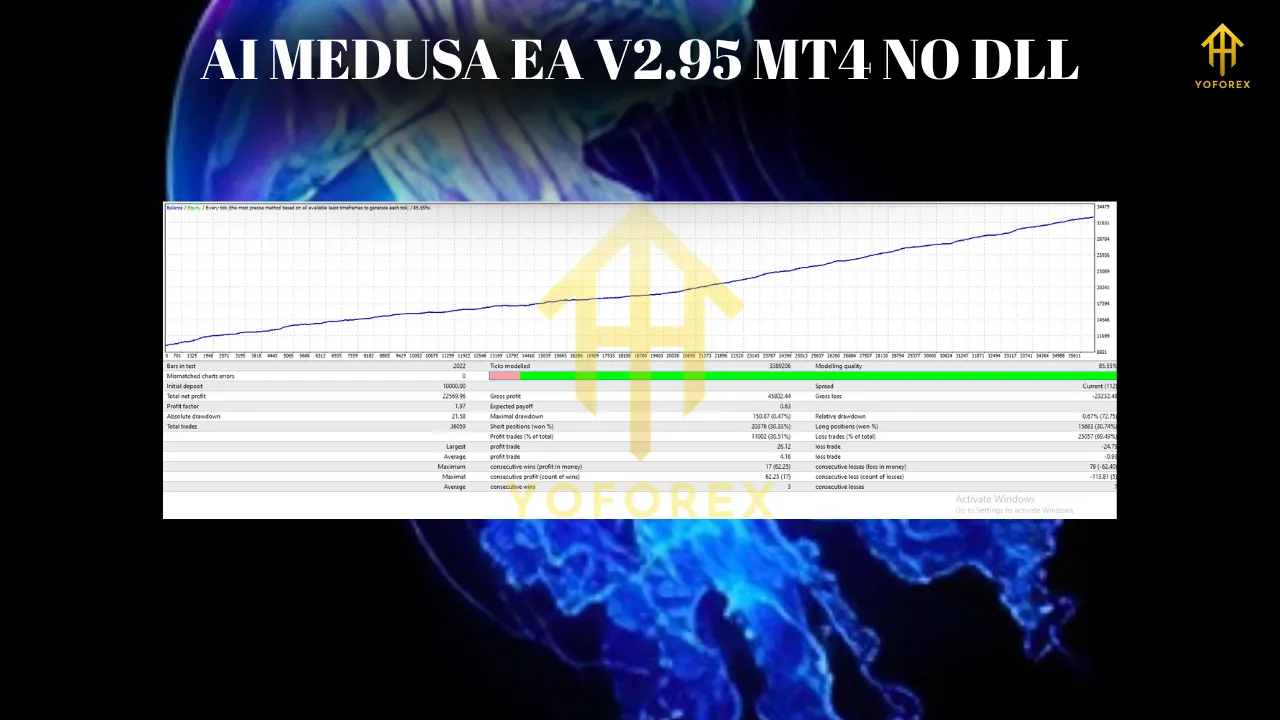
No, per the developer. The EA’s logic is partially offloaded to external AI models that respond only in real time, so the built-in Strategy Tester cannot emulate that behavior. As an alternative, the author offers a monthly rental so you can trial the product on a demo or live environment with real-time AI connectivity before committing to a lifetime license.
Prop Firm Compatibility
The listing says the EA is compatible with prop firms; however, the developer instructs users to download a special set file for prop-firm trading conditions. This suggests there are parameter profiles tuned for drawdown rules, daily loss limits, and broker conditions commonly found in evaluations.
Pricing and Access
At publication, AI MEDUSA EA V2.95 is listed at 2,800 USD with five activations and a rental option available for short-term evaluation. The rental is described as temporary, implying it might be removed later. Pricing may change; always verify on the product page at the time you purchase.
Live Performance Snapshot (Early Data)
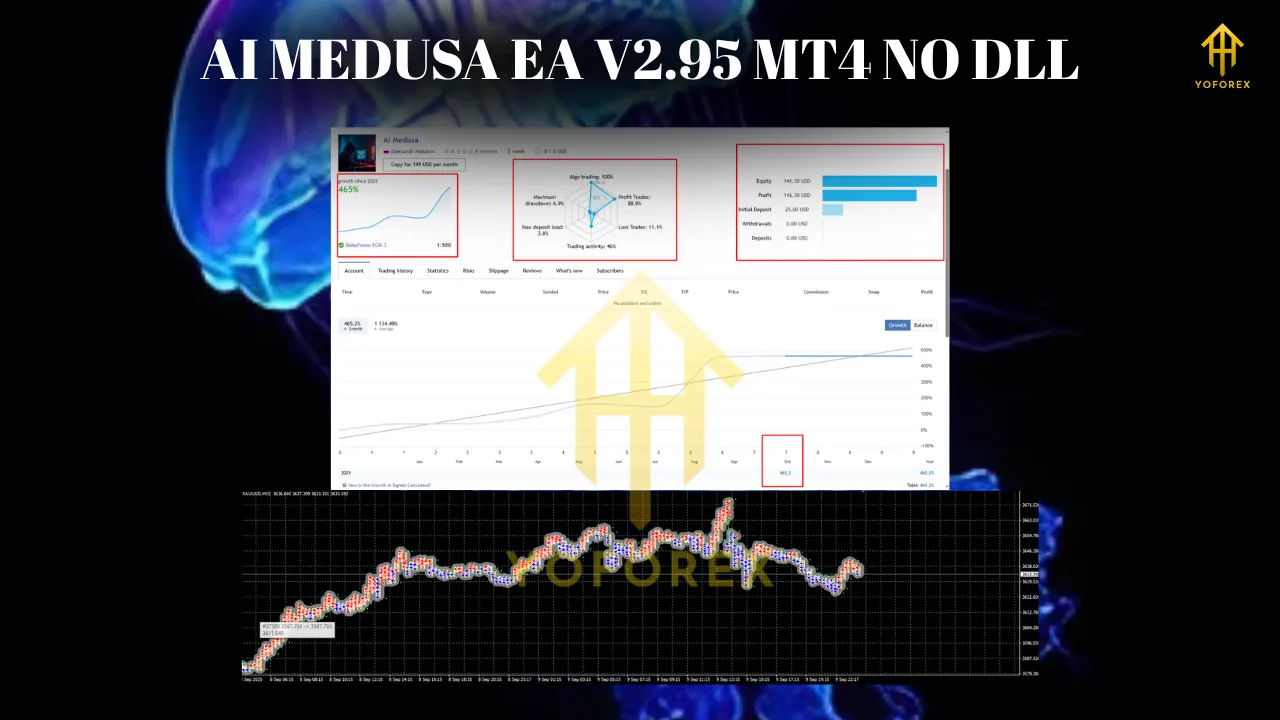
The product page links to a public MT4 signal named “Ai Medusa,” hosted on RoboForex ECN at 1:500 leverage. As of October 10–13, 2025, the signal shows ~444% growth in the last month from a small starting balance ($25 initial deposit), with 13 trades, ~61% win rate, a profit factor ~12, and relative drawdown by balance ~6.9%. However, the signal is brand new (≈1 week old) and even displays standard MQL5 risk disclaimers such as “too few trades to evaluate” and “high growth may indicate high risk.” Treat this as an early, non-conclusive sample rather than a long-term track record.
Practical Advantages
-
Risk-first execution: With SL/TP and BE enabled by design, users get a rules-based protective layer on every position. For multi-pair EAs, that kind of hard stop discipline is valuable.
-
Multi-asset reach from one chart: Attaching on EURUSD H1 while allowing the EA to auto-manage other pairs simplifies deployment for portfolio-style exposure (subject to margin and broker limits).
-
Backtest-proof strategy (by design): Because it relies on real-time AI, the developer pushes users toward forward testing, which—while inconvenient for quick due-diligence—avoids the trap of over-optimized backtests that don’t survive the future.
Trade-Offs to Consider
-
No Strategy Tester convenience: Many traders rely on backtests as a first filter. Here, you’ll have to evaluate via demo/live forward testing.
-
Licensing dependency: The server-side license and AI call requirement mean your trading depends on third-party infrastructure being online and responsive.
-
Early signal history: The linked signal looks promising but very young, with small sample size and risk flags. It’s too soon to draw statistical conclusions.
-
Premium pricing: The current tag places AI MEDUSA among high-ticket EAs, so due diligence and a measured test plan (rental → demo → small live) are essential.
Suggested Setup Plan (For Evaluation)
-
VPS + Broker Prep: Choose a low-spread, low-latency broker and a reliable VPS near your broker’s servers.
-
Rental First: Use the rental to forward test on a demo for at least a few weeks, then a small live account if results align with expectations.
-
Attach on EURUSD H1: Start as recommended; let the EA auto-detect other pairs. Monitor margin usage and symbol exposure.
-
Risk Controls: Even with built-in SL/TP/BE, enforce account-level risk (e.g., daily loss caps, per-trade % risk ceilings).
-
Prop-Firm Mode: If evaluating for prop firms, import the set file provided by the developer to align with daily drawdown and max loss rules.
-
Track Metrics, Not Just PnL: Record win rate, PF, avg win/loss, max adverse excursion, and equity vs. balance drawdown. Compare your stats with the public signal for context, keeping in mind its early stage.
Who Is AI MEDUSA For?
-
Traders seeking multi-pair diversification with a single MT4 attachment and centralized risk logic.
-
Users comfortable with forward testing and live AI dependencies, who value real-time adaptation over backtest convenience.
-
Prop-firm candidates who need strategy discipline and a non-martingale/grid approach that can be tuned with prop-specific set files.
Best Practices and Risk Notes
-
Start small: The official minimum is $50, but practical testing often benefits from a bit more capital to absorb spreads, commissions, and multi-pair swings without frequent margin alerts.
-
Execution matters: Slippage and spread can meaningfully alter outcomes. Place your VPS close to your broker’s trading servers.
-
Expect variance: Early signal outperformance can regress; prepare for normal drawdowns and strategy cyclicality. The MQL5 signal page itself warns about high recent growth and limited sample size.
-
Monitor infrastructure: Because MEDUSA calls external AI services and license servers, uptime and latency are part of the edge. If connectivity drops, your trading may pause or behave differently.
Verdict
AI MEDUSA EA V2.95 MT4 is an intriguing entry in the premium EA space, blending multi-pair H1 trading with strict risk controls and real-time AI decisioning. The non-grid, non-martingale stance, SL/TP/BE enforcement, and server-side AI logic will appeal to traders who prioritize controlled risk and forward-looking adaptability over historical backtest comfort. That said, the price is high, the evaluation must be forward-tested, and the public signal is still in its infancy—so an incremental test plan (rental → demo → limited live) is the sensible path.
If you want a portfolio-style EA that aims to stay risk-aware while leveraging live AI, MEDUSA is worth investigating—provided you’re comfortable with the dependency on external AI/servers and a disciplined evaluation process.