

Maximizing Trading Success with the ADX RSI Filter Indicator for MT5
Introduction
In the fast-paced world of forex trading, having the right tools to analyze market trends and make informed decisions is crucial. The Average Directional Index (ADX) and Relative Strength Index (RSI) are two powerful technical indicators that, when combined, create a robust trading strategy. The ADX RSI Filter Indicator for MT5 integrates these two indicators into a single tool designed for the MetaTrader 5 platform, helping traders identify strong trends and optimal entry points with greater precision. This blog explores the mechanics of the ADX RSI Filter Indicator, its application in trading, and how to leverage it effectively to enhance your trading performance.
Understanding the ADX Indicator
The Average Directional Index (ADX), developed by J. Welles Wilder, is a technical indicator used to measure the strength of a market trend, regardless of its direction. It consists of three lines:
-
ADX Line: Quantifies the strength of the trend (higher values indicate stronger trends).
-
+DI (Positive Directional Indicator): Measures the strength of upward price movement.
-
-DI (Negative Directional Indicator): Measures the strength of downward price movement.
The ADX value ranges from 0 to 100, with key thresholds:
-
Below 20: Weak trend or ranging market.
-
Above 25: Strong trend, ideal for trend-following strategies.
-
Above 50: Extremely strong trend, though rare.
The ADX does not indicate trend direction but focuses solely on its strength, making it a valuable tool for confirming whether a market is trending or consolidating.
Understanding the RSI Indicator
The Relative Strength Index (RSI) is a momentum oscillator that measures the speed and change of price movements, ranging from 0 to 100. It helps traders identify overbought or oversold conditions:
-
Above 70: Overbought, signaling potential price reversals or pullbacks.
-
Below 30: Oversold, indicating potential buying opportunities.
-
Between 30 and 70: Neutral zone, often used to confirm momentum within a trend.
The RSI is typically calculated over a 14-period setting, but traders can adjust this to suit their trading style. When combined with the ADX, the RSI serves as a filter to time entries and exits, ensuring trades align with both trend strength and momentum.
The ADX RSI Filter Indicator for MT5
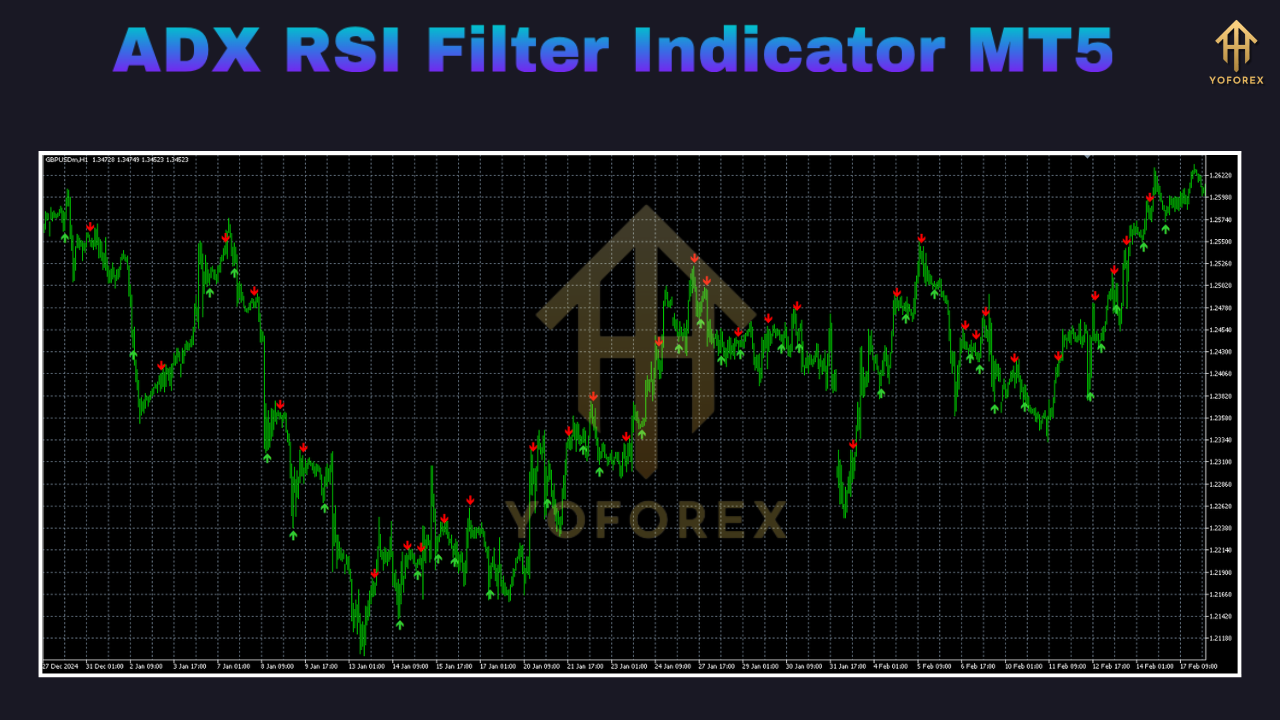
The ADX RSI Filter Indicator for MetaTrader 5 is a custom tool that combines the trend-strength analysis of the ADX with the momentum signals of the RSI. This indicator is designed to filter out weak or false signals, providing traders with clear buy and sell opportunities in trending markets. It typically plots the ADX and RSI values in a separate window below the price chart, often with visual cues like color-coded histograms or arrows to highlight trade signals.
Key Features of the ADX RSI Filter Indicator
-
Trend Confirmation: The ADX component ensures trades are taken only during strong trends (ADX > 25).
-
Momentum Confirmation: The RSI filters entry points by identifying overbought or oversold conditions or momentum shifts.
-
Customizable Settings: Traders can adjust the ADX period (default 14), RSI period (default 14), and overbought/oversold thresholds to match their trading style.
-
Visual Signals: Many versions of the indicator provide color-coded bars (e.g., green for uptrend, red for downtrend) or arrows to simplify signal interpretation.
-
Multi-Timeframe Support: Works across various timeframes (e.g., M5, H1, D1), suitable for scalping, day trading, or swing trading.
How It Works
The ADX RSI Filter Indicator generates signals based on the following logic:
-
Buy Signal:
-
ADX is above 25, indicating a strong trend.
-
+DI is above -DI, confirming an uptrend.
-
RSI dips below 30 (oversold) and rises back above it, signaling a pullback within an uptrend.
-
-
Sell Signal:
-
ADX is above 25, indicating a strong trend.
-
-DI is above +DI, confirming a downtrend.
-
RSI rises above 70 (overbought) and falls back below it, signaling a pullback within a downtrend.
-
This combination ensures that trades are entered only when a strong trend is confirmed by the ADX and momentum is favorable according to the RSI.
Setting Up the ADX RSI Filter Indicator on MT5
To use the ADX RSI Filter Indicator on MetaTrader 5, follow these steps:
-
Download the Indicator:
-
Obtain the indicator file (.mq5 or .ex5 format) from a reliable source, such as MQL5 Code Base or a trusted provider like IndicatorsPot.
-
Ensure the indicator is compatible with MT5.
-
-
Install the Indicator:
-
Open MetaTrader 5 and go to File > Open Data Folder.
-
Navigate to the MQL5 > Indicators folder.
-
Copy the indicator file into the Indicators folder.
-
Restart MetaTrader 5 or refresh the Navigator window (right-click and select “Refresh”).
-
-
Add to Chart:
-
Open a chart for your chosen currency pair or asset.
-
Go to Insert > Indicators > Custom and select the ADX RSI Filter Indicator.
-
Configure settings (e.g., ADX period, RSI period, overbought/oversold levels) and click OK.
-
-
Customize Settings:
-
ADX Period: Default is 14, but a lower period (7-10) is better for scalping, while a higher period (20-30) suits swing trading.
-
RSI Period: Default is 14, adjustable based on market volatility.
-
Alerts: Enable pop-up, email, or push notifications for trade signals if supported by the indicator.
-
Trading Strategy Using the ADX RSI Filter Indicator
Here’s a step-by-step strategy to trade effectively with the ADX RSI Filter Indicator on MT5:
Step 1: Identify the Trend
-
Monitor the ADX line. A value above 25 confirms a strong trend, while a value below 20 suggests a ranging market where the indicator may be less reliable.
-
Check the +DI and -DI lines:
-
+DI > -DI: Uptrend.
-
-DI > +DI: Downtrend.
-
Step 2: Confirm Momentum with RSI
-
In an uptrend (+DI > -DI), wait for the RSI to dip below 30 and then cross back above it, indicating a potential buying opportunity after a pullback.
-
In a downtrend (-DI > +DI), wait for the RSI to rise above 70 and then fall back below it, signaling a potential selling opportunity.
Step 3: Entry Rules
-
Buy Entry:
-
ADX > 25, +DI > -DI.
-
RSI crosses above 30 after being oversold.
-
Confirm with price action (e.g., a bullish candlestick pattern or support level).
-
-
Sell Entry:
-
ADX > 25, -DI > +DI.
-
RSI crosses below 70 after being overbought.
-
Confirm with price action (e.g., a bearish candlestick pattern or resistance level).
-
Step 4: Set Stop Loss and Take Profit
-
Stop Loss:
-
Place below the most recent swing low for buy trades or above the swing high for sell trades.
-
Alternatively, use the previous high/low where the ADX formed a peak before entry.
-
-
Take Profit:
-
Use a risk/reward ratio of 1:1.2 to 1:1.4, depending on market conditions.
-
Exit when the ADX falls below 25, indicating a weakening trend, or when RSI reaches an opposite extreme (e.g., overbought for a buy trade).
-
Step 5: Risk Management
-
Risk no more than 1-2% of your account per trade.
-
Avoid trading in low-volatility markets (ADX < 20) to reduce false signals.
-
Use additional confirmation tools like support/resistance levels or moving averages to enhance reliability.
Example Trade
-
Asset: EUR/USD, H1 timeframe.
-
Setup: ADX rises above 25, and +DI crosses above -DI, signaling a strong uptrend. RSI dips to 28 (oversold) and crosses back above 30.
-
Entry: Buy at 1.2000 after a bullish candlestick confirms the pullback.
-
Stop Loss: Set at 1.1950 (previous swing low).
-
Take Profit: Set at 1.2080 (1:1.4 risk/reward ratio).
-
Outcome: The trade is closed when ADX drops below 25 or RSI reaches 70, indicating a potential reversal.
Advantages of the ADX RSI Filter Indicator
-
Enhanced Signal Accuracy: Combining ADX’s trend strength with RSI’s momentum reduces false signals.
-
Versatility: Suitable for various markets (forex, stocks, indices) and timeframes.
-
User-Friendly: Visual cues like histograms or arrows simplify decision-making.
-
Customizability: Adjustable parameters allow tailoring to specific trading styles.
Limitations and Considerations
-
Lagging Nature: The ADX, based on exponential moving averages, may lag behind real-time price action. Confirm signals with price action or faster indicators like MACD.
-
Ineffective in Ranging Markets: The indicator performs poorly when ADX is below 20, as weak trends lead to choppy signals.
-
Overbought/Oversold Persistence: RSI can remain overbought or oversold in strong trends, delaying entry signals. Use ADX to confirm trend continuation.
-
Need for Confirmation: Relying solely on the indicator can lead to losses. Combine with price action, support/resistance, or other indicators for better results.
Tips for Maximizing the Indicator’s Potential
-
Backtest Thoroughly: Use MT5’s Strategy Tester to evaluate the indicator’s performance on historical data for your chosen asset and timeframe.
-
Combine with Other Tools: Pair the indicator with moving averages, Bollinger Bands, or Fibonacci retracement levels to confirm signals.
-
Adjust for Market Conditions: Use shorter periods for volatile markets or scalping, and longer periods for swing trading in stable markets.
-
Practice Risk Management: Always use stop losses and maintain a favorable risk/reward ratio to protect your capital.
-
Stay Disciplined: Avoid forcing trades in weak trends or overtrading based on unconfirmed signals.
Where to Find the ADX RSI Filter Indicator
The ADX RSI Filter Indicator is available from various sources, including:
-
MQL5 Code Base: Offers free and premium versions of custom indicators.
-
IndicatorsPot: Provides downloadable MT5 indicators with detailed instructions.
-
Forex Factory: A community-driven platform with user-shared indicators and setups.
-
Trusted Brokers: Some brokers, like Dominion Markets, offer MT5-compatible indicators and platforms for seamless integration.
Always verify the source’s reliability and test the indicator on a demo account before using it in live trading.
Conclusion
The ADX RSI Filter Indicator for MT5 is a powerful tool for traders seeking to capitalize on strong trends while timing entries with precision. By combining the ADX’s trend-strength analysis with the RSI’s momentum signals, this indicator helps filter out noise and identify high-probability trading opportunities. Whether you’re a scalper, day trader, or swing trader, the indicator’s customizable settings and visual cues make it adaptable to various strategies and market conditions. However, like all technical tools, it’s not infallible. Traders should use it alongside price action, risk management, and other indicators to maximize its effectiveness. By backtesting, practicing discipline, and staying adaptable, you can harness the ADX RSI Filter Indicator to elevate your trading success in 2025 and beyond.
Support & Disclaimer
Got questions or need help? Reach out anytime:
- WhatsApp: https://wa.me/+443300272265
- Telegram: https://t.me/yoforexrobot
Disclaimer: Past performance is no guarantee of future results. All trading carries risk. Always demo-test the ADX RSI Filter Indicator MT5 in a risk-free environment before deploying on a live account.