

Mastering the ATR HiLo TT Indicator MT4: A Comprehensive Guide
In the fast-paced world of forex trading, having reliable tools to measure market volatility and trend direction can mean the difference between profit and frustration. The ATR HiLo TT Indicator for MetaTrader 4 (MT4) combines two powerful concepts—the Average True Range (ATR) and High-Low Trend Trigger (HiLo TT)—into a single, user-friendly overlay. By blending volatility analysis with dynamic support and resistance levels, this indicator helps traders identify optimal entry and exit points while managing risk effectively. In this guide, we’ll dive deep into how the ATR HiLo TT Indicator works, outline its key features, and share best practices for integrating it into your trading strategies.
1. Understanding the Average True Range (ATR)
The ATR is a cornerstone of modern technical analysis, originally introduced by J. Welles Wilder as a measure of market volatility. Unlike standard indicators that focus on price direction, the ATR calculates the true range of price movement over a selected period, taking into account gaps and limit moves.
-
Calculation: The true range for each bar is the greatest of:
-
Current high minus current low
-
Absolute value of current high minus previous close
-
Absolute value of current low minus previous close
The ATR is then derived as an exponential moving average of these true range values over a user-defined period (commonly 14 bars).
-
-
Applications: Traders leverage ATR to set dynamic stop-loss levels, gauge breakout potential, and adjust position sizes based on market volatility. A rising ATR signals increasing volatility—ideal for breakout strategies—while a falling ATR suggests a contracting range, often preceding trend exhaustion.
2. The HiLo TT Overlay: Concept and Origins
The HiLo TT (High-Low Trend Trigger) is a variation of channel-based indicators that plot adaptive support and resistance lines around price action. Instead of fixed bands, HiLo TT constructs its upper and lower boundaries by tracking recent swing highs and lows, filtered through a smoothing mechanism.
-
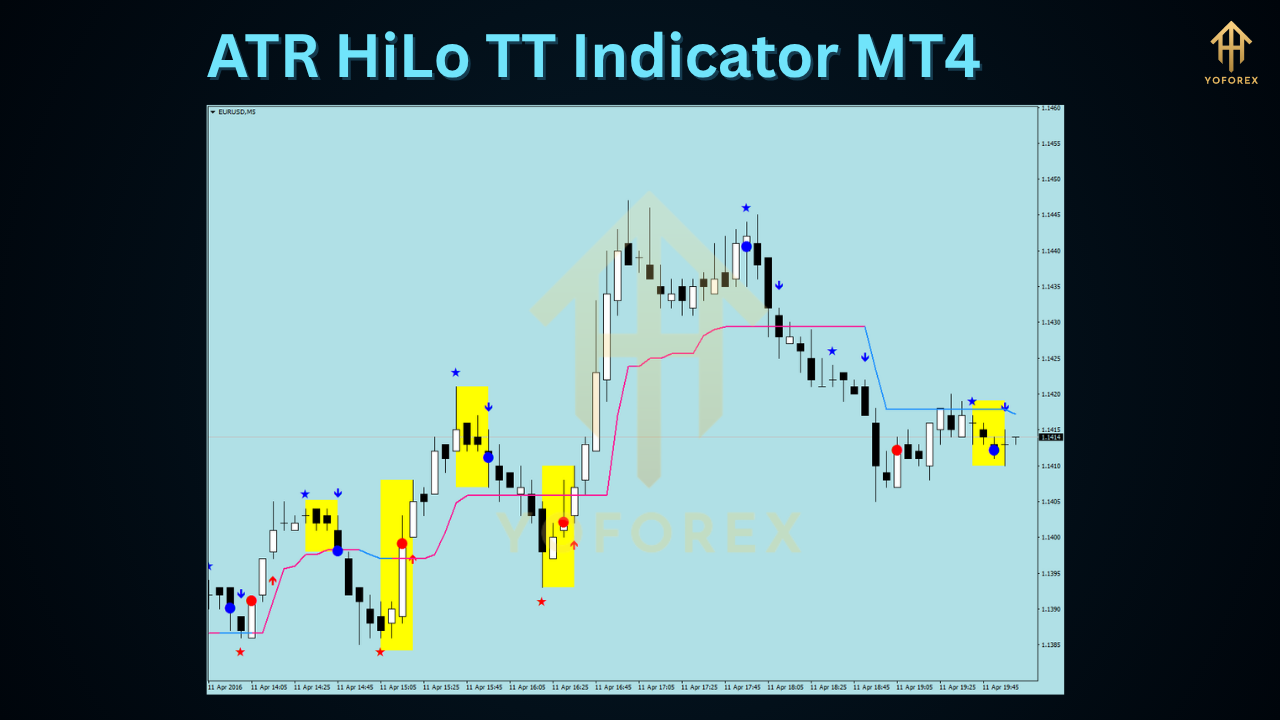
Trend Identification: When price closes above the upper HiLo line, the trend is deemed bullish; conversely, a close below the lower line indicates bearish momentum.
-
Flexibility: Unlike static support/resistance, the HiLo TT adapts to shifting price structures, making it suitable for trending and ranging markets alike.
3. ATR HiLo TT Indicator: How It Works
The ATR HiLo TT Indicator marries volatility insights from ATR with the dynamic channel boundaries of HiLo TT. Here’s a step-by-step look at its inner workings:
-
Volatility Scaling
The ATR value at each bar is used to adjust the width of the HiLo channel. When volatility spikes, channel bands expand, reducing false breakouts; during low volatility, bands contract, capturing tighter ranges. -
Dynamic Channel Construction
-
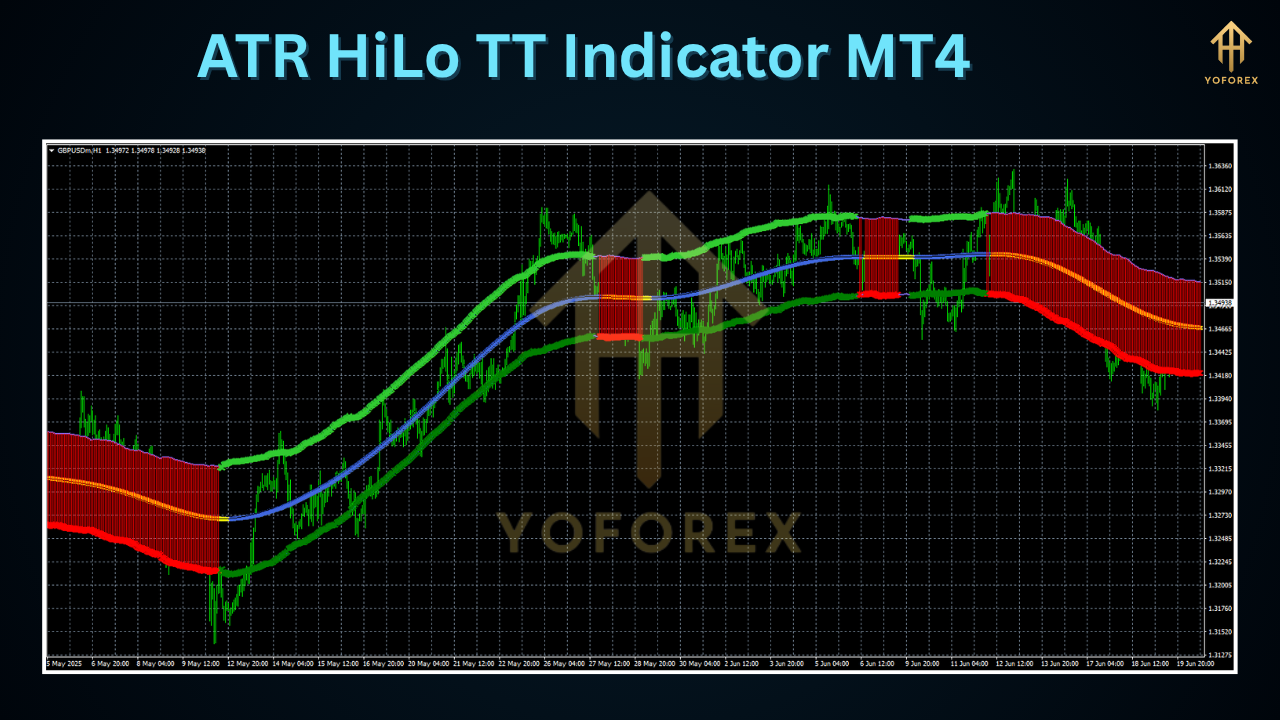
Upper Band: Calculated as the recent highest high minus a multiple of the current ATR.
-
Lower Band: Calculated as the recent lowest low plus a multiple of the current ATR.
Traders can customize the ATR multiplier to fine-tune sensitivity: a higher multiplier yields wider bands (smoother but slower), while a lower multiplier tightens the channel (more responsive but prone to noise).
-
-
Trend Trigger Logic
-
Bullish Trigger: Price closing above the upper ATR-adjusted HiLo line.
-
Bearish Trigger: Price closing below the lower ATR-adjusted HiLo line.
The indicator can optionally shade the area between bands or plot arrows to highlight trigger events.
-
-
Signal Confirmation
For more reliable entries, many traders wait for a candle close beyond the band and confirm with additional filters—such as RSI divergence or MACD crossovers—to avoid whipsaws.
4. Interpreting Signals Effectively
While the ATR HiLo TT Indicator provides clear visual cues, successful implementation depends on disciplined interpretation:
-
Breakout Continuation
In a strong trend, a close beyond the channel often indicates a continuation move. Traders can enter on the close, place stops near the opposite band, and trail stops using subsequent band shifts. -
False Breakout Avoidance
Sudden volatility spikes can trigger false signals. Combining the ATR HiLo TT with volume analysis or waiting for a retest of the broken band can filter noise. -
Range Trading
During low-volatility conditions, prices may oscillate within the bands. In this scenario, fading the extremes—selling near the upper band and buying near the lower band—can be effective if supported by overbought/oversold oscillators. -
Trend Reversal Alerts
A close back inside the channel after a sustained trend may hint at weakening momentum. Traders should monitor for reversal candlestick patterns in these zones.
5. Customizing Settings for MT4
One of the strengths of the ATR HiLo TT Indicator is its configurability. Here are key parameters to tailor it to your style:
-
ATR Period: Adjust this to capture short-term (e.g., 7 bars) or longer-term (e.g., 21 bars) volatility. Short periods respond quickly but may overreact; longer periods smooth more but lag.
-
ATR Multiplier: Common settings range from 1.5 to 3. Experiment to find a balance between responsiveness and noise reduction.
-
Channel Lookback: Defines the number of bars used to calculate swing highs and lows. A shorter lookback tightens bands; a longer lookback smooths but can delay signals.
-
Alert Options: Enable pop-ups, email alerts, or mobile notifications on crossover events to avoid missing key setups.
-
Visual Styles: Choose band colors and line thicknesses that stand out against your chart template for quick readability.
6. Best Practices and Strategy Integration
To harness the full potential of the ATR HiLo TT Indicator, consider these practical tips:
-
Multi-Timeframe Analysis: Confirm signals on a higher timeframe to align major trend direction with entries on your preferred chart.
-
Risk Management: Use the ATR value to size positions—larger ATR means wider stops, so reduce lot size accordingly to maintain consistent risk per trade.
-
Complementary Indicators: Pair ATR HiLo TT with momentum tools (RSI, Stochastic) or pattern recognition (candlestick formations) for confluence.
-
Backtesting and Demo Trials: Before going live, backtest settings across various currency pairs and market conditions. Then validate on a demo account to ensure comfort with signal frequency and drawdowns.
-
Regular Review: Volatility regimes change over time. Periodically reassess your ATR period and multiplier to ensure the indicator remains aligned with current market behavior.
Conclusion
The ATR HiLo TT Indicator MT4 is a versatile tool that bridges volatility measurement and dynamic trend channels, empowering traders to make more informed decisions. By adapting channel widths to market conditions and providing clear breakout triggers, it addresses common pitfalls of purely price-based or volatility-based systems. Whether you’re seeking breakout entries in trending markets or fading extremes during consolidation, mastering this indicator can enhance both your confidence and edge. Remember, no single tool guarantees success—combine ATR HiLo TT with sound risk management, thorough backtesting, and complementary analysis to build a robust trading approach.
With this comprehensive guide, you’re now equipped to integrate the ATR HiLo TT Indicator into your MT4 toolkit. Take time to fine-tune settings, develop a rules-based strategy, and adapt as market dynamics evolve.