
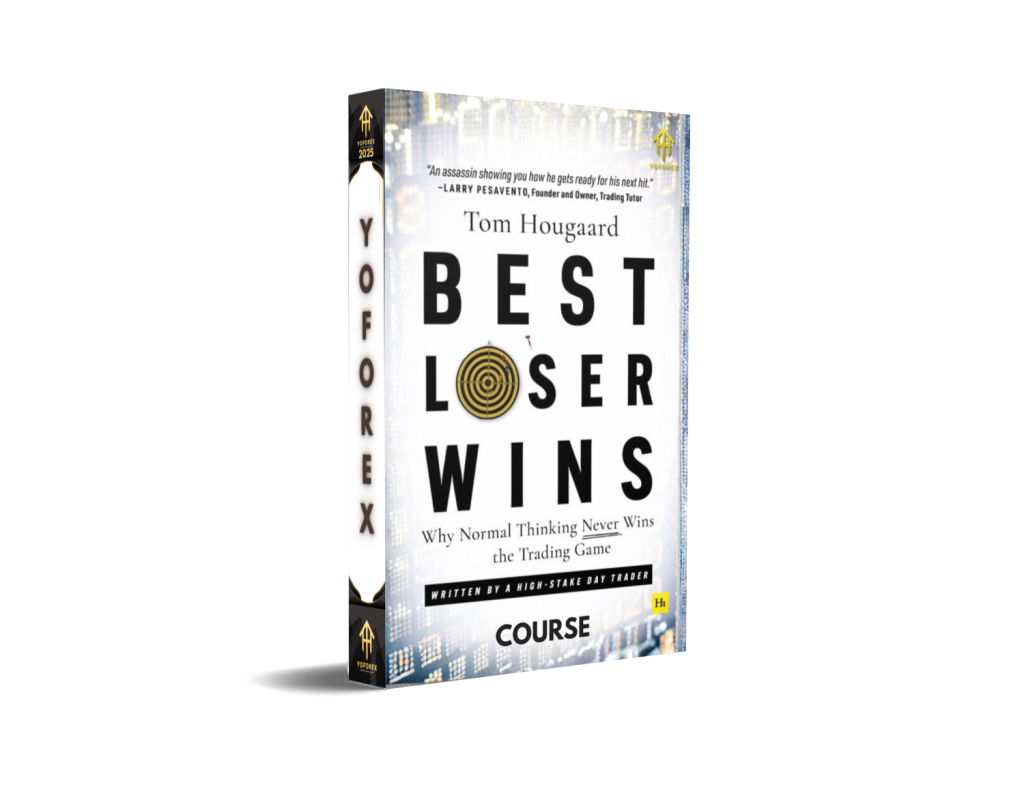
How you handle losing says way more about your future as a trader than any indicator on your chart. That’s basically the heart of Best Loser Wins by Tom Hougaard – and it hits hard, coz it calls out the uncomfortable truth most traders avoid: your relationship with failure is your real edge, not your “secret strategy.”
In this blog, we’ll break down the core idea behind Best Loser Wins, why the top 1% of traders think differently about losses, and how you can start shifting your mindset from “I hate losing” to “I’m built to survive losing.”
Why “being a great loser” actually wins in trading
Most new traders come into the markets obsessed with winning.
They want:
-
The best setup
-
The highest win-rate
-
The perfect indicator combo
And ironically, that’s why they stay stuck.
Tom Hougaard’s concept flips this:
The best traders aren’t the best winners. They’re the best losers.
In simple terms:
-
Losses are normal events, not personal attacks.
-
A losing trade is just one data point in a long series.
-
Emotional meltdown after a loss = broken edge, no matter how good your strategy is.
If every loss shakes you, you’ll constantly:
-
Revenge-trade
-
Double lot size to “get it back”
-
Abandon perfectly good strategies after a short losing streak
The 1% don’t avoid pain. They absorb it and keep executing the plan.
The 99% vs the 1%: What really separates them
Hougaard makes a strong point: almost everyone has access to the same technical tools—support/resistance, moving averages, indicators, fundamentals, news, etc. Yet 99% still blow accounts while 1% compound capital.
So what are the 1% doing differently?
1. They don’t worship knowledge – they worship execution
The majority keep buying courses, EAs, books, and indicators thinking “maybe this one will fix me.” But the truth is brutal:
-
Knowing is not the problem.
-
Doing the right thing at the right time is the problem.
The 1% accept that:
-
A setup with an edge will still lose often.
-
Following the plan in drawdown is where real growth happens.
-
Discipline beats information overload every single day.
2. They think in probabilities, not certainties
The average trader thinks:
“This trade should win.”
The elite trader thinks:
“This trade is one of the next 100. Some will win, some will lose. My job is to execute them all according to plan.”
That shift does two powerful things:
-
It disconnects your identity from any single trade.
-
It allows you to lose without emotional collapse.
3. Their emotional response to losing is trained
Tom describes conditioning himself to lose without anxiety, panic, or revenge energy. That doesn’t happen by accident – it’s built over time by:
-
Risking small enough so a loss doesn’t feel like a punch in the stomach
-
Reviewing losing trades objectively
-
Accepting that feeling discomfort doesn’t mean you’re doing something wrong
They don’t try to “feel good” all the time. They try to stay functional in uncomfortable conditions.
Why knowing yourself beats knowing the market
One of the most powerful ideas from Best Loser Wins is that Tom doesn’t claim to have god-tier technical skills. He openly says his technical analysis is “average at best.”
What sets him apart is:
-
Extreme self-awareness
-
Understanding his own emotional triggers
-
Building rules that protect him from… himself
For most traders, the real problem isn’t:
-
Bad indicators
-
Wrong broker
-
Market manipulation
It’s things like:
-
Breaking rules after one or two losses
-
Moving stop-losses “just a little more”
-
Adding to losers while calling it “position building”
-
Overtrading out of boredom
When you know your personal weaknesses, you stop pretending you’re a trading robot. You instead build a system that anticipates your flaws and keeps you in line.
How to become a “better loser” in practical steps
Let’s make this less theory and more real-life. If you want to move closer to that 1% mindset, here are some practical ways to start.
1. Shrink your risk until losing becomes boring
If every loss feels like trauma, you’re risking too much. Simple.
-
Start by risking 0.25%–0.5% per trade
-
Your aim is to feel like: “Meh, next setup,” even after a loss
-
Only increase size once you can execute 50–100 trades without breaking rules
2. Redefine what a “good trade” means
A “good” trade is not one that makes money.
A “good” trade is:
-
Taken according to your plan
-
Entered at the right place, with the right SL & TP
-
Managed according to your rules
You can lose money on a “good” trade and still win as a trader because you’re reinforcing discipline.
3. Track emotional mistakes, not just technical ones
Don’t just journal entry price, SL, and RR. Also write:
-
Why did I enter this trade?
-
How did I feel after entry?
-
Did I move SL or TP emotionally?
-
Did I add to the trade without a rule-based reason?
Over time you’ll see patterns like:
-
“I overtrade after a big win.”
-
“I widen stops after a news spike.”
-
“I always chase price after missing the first move.”
This is pure gold. It’s literally your personal psychological “map” pointing at where you leak money.
4. Stop chasing certainty, start trusting the math
You will never find a system that:
-
Wins every day
-
Has no drawdowns
-
Makes money in all conditions
What you can actually build is:
-
A strategy with a tested edge
-
A risk model that keeps you in the game
-
A mindset that accepts randomness without emotional collapse
That’s the “bridge” Tom talks about in the book – connecting what you know is possible for you with what you actually do in the market.
Failure as fuel: reframing your trajectory
One of the deepest lines in the text is that your attitude towards failure defines your life trajectory, not just your trading results.
Think about it:
-
If every failure makes you quit, you restart from zero again and again.
-
If every failure becomes data, you level up after each one.
Traders who grow are not the ones who avoid pain. They are the ones who process pain correctly:
-
They don’t deny it
-
They don’t dramatize it
-
They study it, adapt, and continue
That’s how your growth as a human and as a trader becomes linked: not by what you know, but by what you do with what you know.
Final thoughts: The real edge is inside you
Best Loser Wins isn’t just another trading psychology book full of cliches. It’s a mirror. It forces you to ask:
-
Do I really accept losing as part of the game?
-
Or am I still secretly dreaming of a “no-loss” strategy?
-
Am I training my mind, or only my chart patterns?
If you’re honest, you’ll probably notice that your biggest upgrades won’t come from downloading another indicator or EA. They’ll come from:
-
Reducing risk
-
Accepting uncertainty
-
Training yourself to lose well
-
Showing up consistently even when it sucks
The best loser wins – not because they love losing, but because they are emotionally strong enough to keep playing long enough for their edge to work.
And that’s where most traders never get to.