


Unveiling the GOLD Precision EA V1.10 MT4: A Deep Dive into this XAUUSD Buy-Only Expert Advisor
In the fast-paced world of Forex trading, particularly the alluring yet volatile gold market (XAUUSD), traders are increasingly turning to automated solutions to gain an edge. One such tool that has been making the rounds is the GOLD Precision EA V1.10 for MetaTrader 4, also known as the XAU_Buy_Advanced_EA. This expert advisor claims to be a powerful and precise buy-only system for gold, employing a multi-layered filter system to execute only high-probability trades. Designed for serious gold scalpers and swing traders, it operates on the H1 timeframe, leveraging five key technical conditions to identify its entry points.
This blog post will provide a comprehensive 1200-word analysis of the GOLD Precision EA V1.10, dissecting its core strategy, its purported benefits, and the critical factors traders should consider before deploying it in the live markets.
The Core Philosophy: A Multi-Layered Approach to Buying Gold
At its heart, the GOLD Precision EA V1.10 is a trend-following and momentum-based system. Its buy-only nature simplifies its operational focus, concentrating solely on capturing upward movements in the price of gold. This can be an advantage for traders who believe in the long-term bullish bias of the precious metal or for those who find shorting gold to be a more complex endeavor.
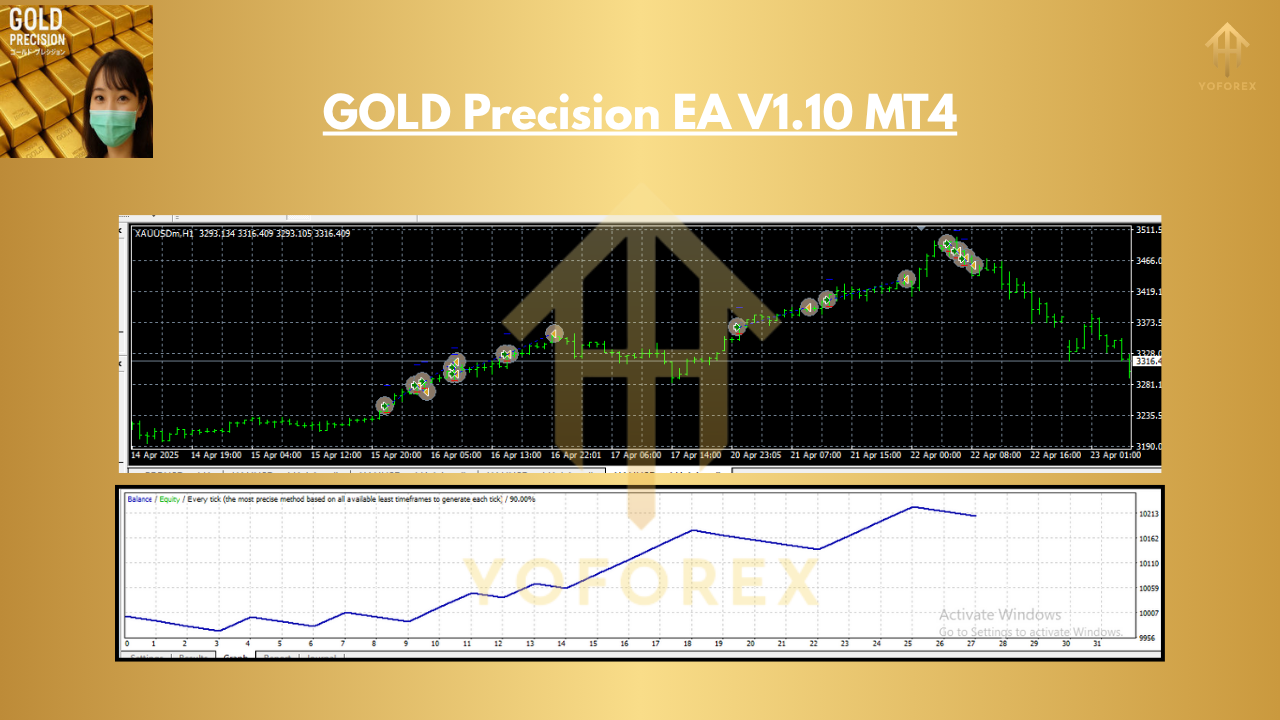
The developer’s central claim is that the EA’s strength lies in its “multi-layered filter system.” This is not just marketing jargon; the system is built upon five specific technical indicators that must align before a buy signal is generated. This confluence of signals is designed to filter out market noise and identify moments of strong bullish conviction.
Deconstructing the Five Pillars: The Technical Conditions for Entry
The effectiveness of any expert advisor hinges on the logic of its underlying strategy. The GOLD Precision EA V1.10 is transparent about its entry criteria, which involve a combination of trend, momentum, and volume indicators. Let’s break down each of the five conditions:
1. Short-Term Trend Confirmation: EMA(8) > EMA(21)
The first filter is a classic short-term trend indicator. The EA requires the 8-period Exponential Moving Average (EMA) to be trading above the 21-period EMA. The EMA gives more weight to recent price data, making it more responsive to changes in market direction than a Simple Moving Average (SMA). When the faster EMA (8) crosses above the slower EMA (21), it signals a potential shift to a bullish trend, indicating that recent buyers are more aggressive than those in the preceding periods.
2. Long-Term Bullish Bias: Price above EMA(200)
To avoid trading against the dominant market tide, the EA incorporates a long-term trend filter. The price of XAUUSD must be above the 200-period EMA on the H1 chart. The 200 EMA is a widely respected industry standard for gauging the overall long-term trend. By ensuring trades are only taken when the price is above this key moving average, the EA aims to align its entries with the broader bullish sentiment.
3. Positive Momentum: RSI(7) > 50
With the trend direction established, the EA then seeks confirmation of bullish momentum. For this, it employs the Relative Strength Index (RSI) with a 7-period setting. The RSI is an oscillator that measures the speed and change of price movements, ranging from 0 to 100. A reading above 50 indicates that bullish momentum is prevailing over bearish momentum. The use of a shorter period (7) makes the RSI more sensitive to recent price action, which is suitable for the H1 timeframe.
4. Bullish Acceleration: MACD Histogram > 0
The fourth layer of confirmation comes from the Moving Average Convergence Divergence (MACD) indicator. Specifically, the EA looks for the MACD histogram to be above the zero line. The MACD is composed of two moving averages and a histogram that represents the difference between them. When the histogram is positive, it signifies that the MACD line is above its signal line, indicating increasing upward momentum or bullish acceleration.
5. Strong Market Interest: Current Volume > 20-bar Average Volume
The final and arguably one of the most crucial filters is volume. The EA will only trigger a buy trade if the volume of the current H1 candle is greater than the average volume of the preceding 20 candles. This condition is designed to ensure that the bullish move is backed by significant market participation. A breakout or a trend continuation on low volume is often viewed with suspicion and can be a sign of a false move. By requiring higher-than-average volume, the EA seeks to confirm the conviction behind the price action.
The Complete Trade Picture: Entry, Stop Loss, and Take Profit
A trading strategy is incomplete without predefined exit rules. According to the available information, the GOLD Precision EA V1.10 utilizes a fixed stop loss and take profit for its trades:
- Take Profit: 30,000 points (which translates to a $30 profit on a 0.01 lot size, assuming a point value of $0.01)
- Stop Loss: 10,000 points (translating to a $10 risk on a 0.01 lot size)
This reveals a risk-to-reward ratio of 1:3, a favorable ratio that suggests the EA aims for larger winning trades than its losing ones. For scalpers and short-term swing traders, this can be an attractive proposition, as a single winning trade can offset multiple smaller losses.
Is the GOLD Precision EA V1.10 Right for You?
The suitability of this EA depends heavily on a trader’s risk appetite, trading style, and expectations.
For the Serious Gold Scalper: The focus on the H1 timeframe and a 1:3 risk-to-reward ratio might appeal to scalpers who are looking for a more patient and filtered entry system, rather than a high-frequency trading approach. The multi-layered confirmation process aims to improve the quality of setups, which is a key concern for any scalper.
For the Swing Trader: Swing traders who operate on the H1 chart will also find the logic of this EA intriguing. The combination of short-term and long-term trend filters aligns well with the swing trading philosophy of capturing larger moves within an established trend.
A Word of Caution: The Unseen Variables
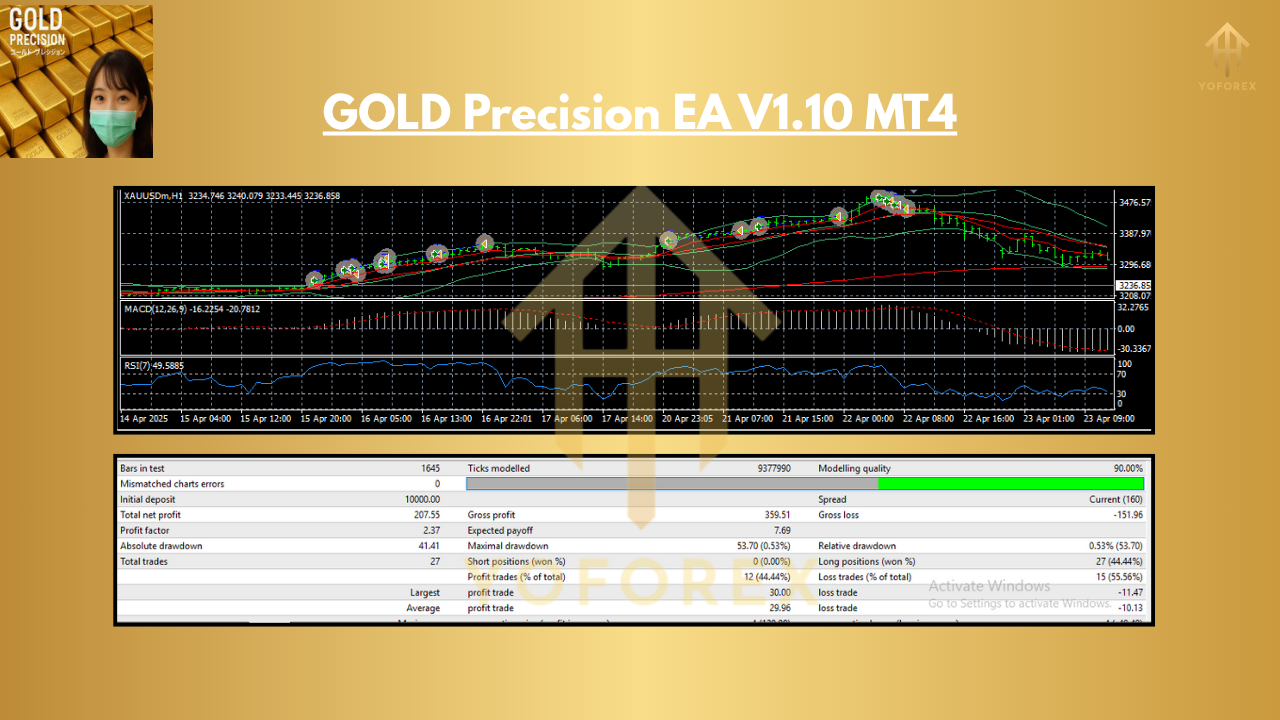
While the detailed strategy of the GOLD Precision EA V1.10 is a significant plus, prospective users must exercise caution. As of the time of writing, there is a limited amount of independent user reviews and forum discussions available for this specific expert advisor. This lack of a broader user base providing feedback means that its real-world performance across different broker conditions and market environments remains largely unverified.
Here are some critical points to consider:
- Backtesting is Not a Guarantee: While the vendor may provide impressive backtesting results, these do not always translate to live trading success. Market conditions change, and factors like slippage, spread widening, and commission costs can significantly impact performance.
- Broker Dependency: The performance of any EA can be heavily dependent on the broker it is used with. A broker with low spreads, fast execution speeds, and minimal slippage is crucial for automated strategies, especially those that trade a volatile instrument like gold.
- Market Regimes: The trend-following nature of this EA suggests it will likely perform best in trending markets. During periods of consolidation or sideways chop, the multiple filters may struggle to find valid setups, or worse, generate false signals.
- No “Set and Forget” Solution: No expert advisor should be treated as a “set and forget” money-making machine. Prudent traders will continuously monitor the EA’s performance, understand the market conditions it thrives in, and be prepared to intervene or disable it when necessary.
Conclusion: A Promising Concept That Demands Due Diligence
The GOLD Precision EA V1.10, or the XAU_Buy_Advanced_EA, presents a well-defined and logical trading strategy for those looking to automate their gold trading on the MetaTrader 4 platform. Its five-layered confirmation system, combining trend, momentum, and volume, is a theoretically sound approach to filtering for high-probability buy signals. The 1:3 risk-to-reward ratio is another attractive feature that will appeal to disciplined traders.
However, the lack of widespread independent reviews and performance data is a significant red flag that cannot be ignored. The road to successful algorithmic trading is paved with rigorous testing and a deep understanding of the tool being used.
Therefore, anyone considering the GOLD Precision EA V1.10 should proceed with a healthy dose of professional skepticism. The first step should be to conduct your own thorough backtesting on historical data. If the results are promising, the next logical step would be to run the EA on a demo account for an extended period to observe its performance in a live, simulated market. Only after it has proven its mettle in these controlled environments should a trader even consider deploying it on a live account, and even then, with a small and manageable amount of capital.