
In the vast marketplace of automated trading tools for the MetaTrader 4 (MT4) platform, few Expert Advisors (EAs) generate as much buzz as the Hydrang EA, particularly its V2.13. It circulates widely online, often as a free download, accompanied by sensational claims of “no-loss” trading and the ability to generate staggering profits, especially on volatile instruments like Gold (XAUUSD).
But as seasoned traders know, the world of automated trading is fraught with peril, and promises that sound too good to be true usually are. This comprehensive review cuts through the marketing hype to provide a realistic, critical analysis of the Hydrang EA V2.13 and what it likely means for your trading capital.
What is the Hydrang EA V2.13?
The Hydrang EA is a fully automated trading robot designed to run on the MT4 platform. It takes complete control of your trading activity, from market analysis to trade execution and management, operating 24/5 without manual intervention. It is primarily marketed towards traders looking to capitalize on the sharp movements of Gold, though it can theoretically be applied to other currency pairs.
The marketing materials and various online sources often highlight a “scalping” strategy. Scalping involves opening and closing trades very quickly to skim small profits from minor price fluctuations. When successful, this can lead to a high win rate and a smoothly rising equity curve, which looks fantastic on the surface. However, the real story often lies in how the EA handles the inevitable losing trades.
Deconstructing the “No-Loss” Claim: The Hidden Strategy
The most prominent—and most alarming—claim associated with the Hydrang EA is that it is a “no-loss” robot. In the zero-sum game of financial markets, this is an impossibility. Every trading strategy incurs losses. So, how do EAs like Hydrang create this illusion?
The answer, almost certainly, lies in a high-risk money management strategy known as the martingale system or a variation of it, such as a grid strategy. Here’s how it typically works:
- The EA enters a trade (e.g., a buy).
- If the trade moves into a loss, instead of closing it at a small stop-loss, the EA keeps it open.
- It then opens a new, larger trade in the same direction at a lower price, averaging down the entry point.
- If the market continues to move against the position, it will repeat this process, progressively increasing the trade size (e.g., doubling the lot size) with each new entry.
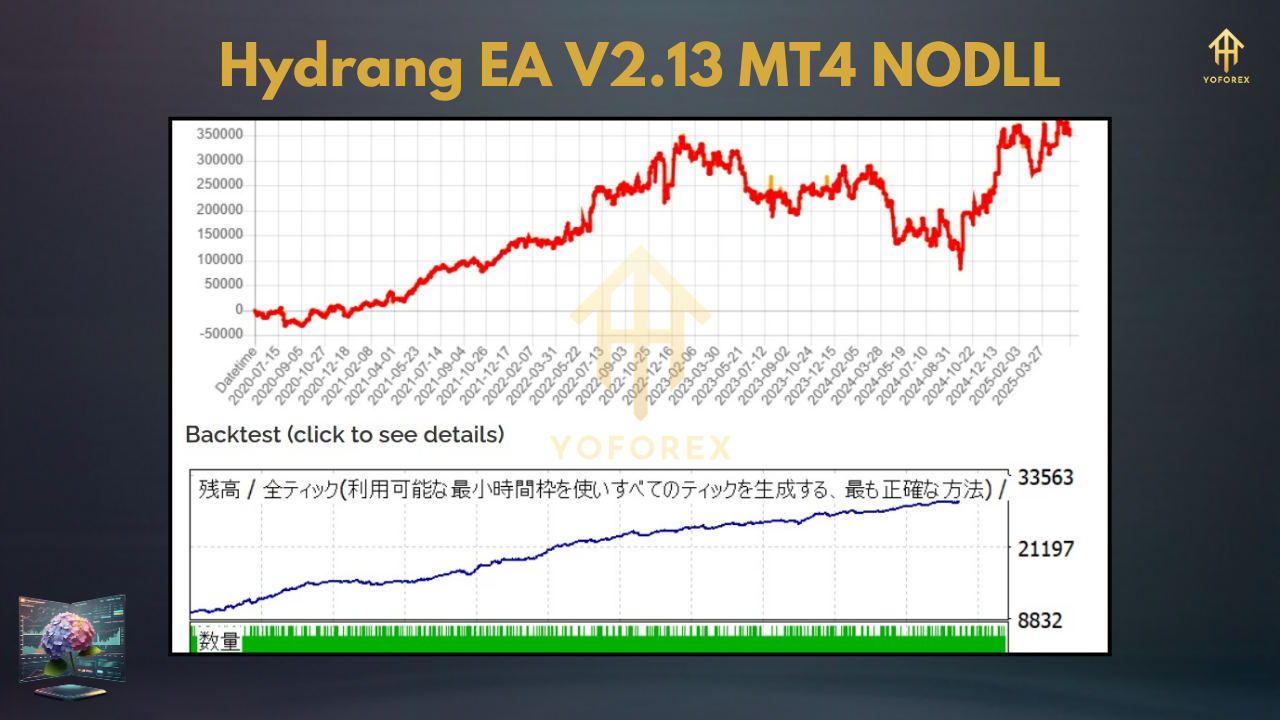
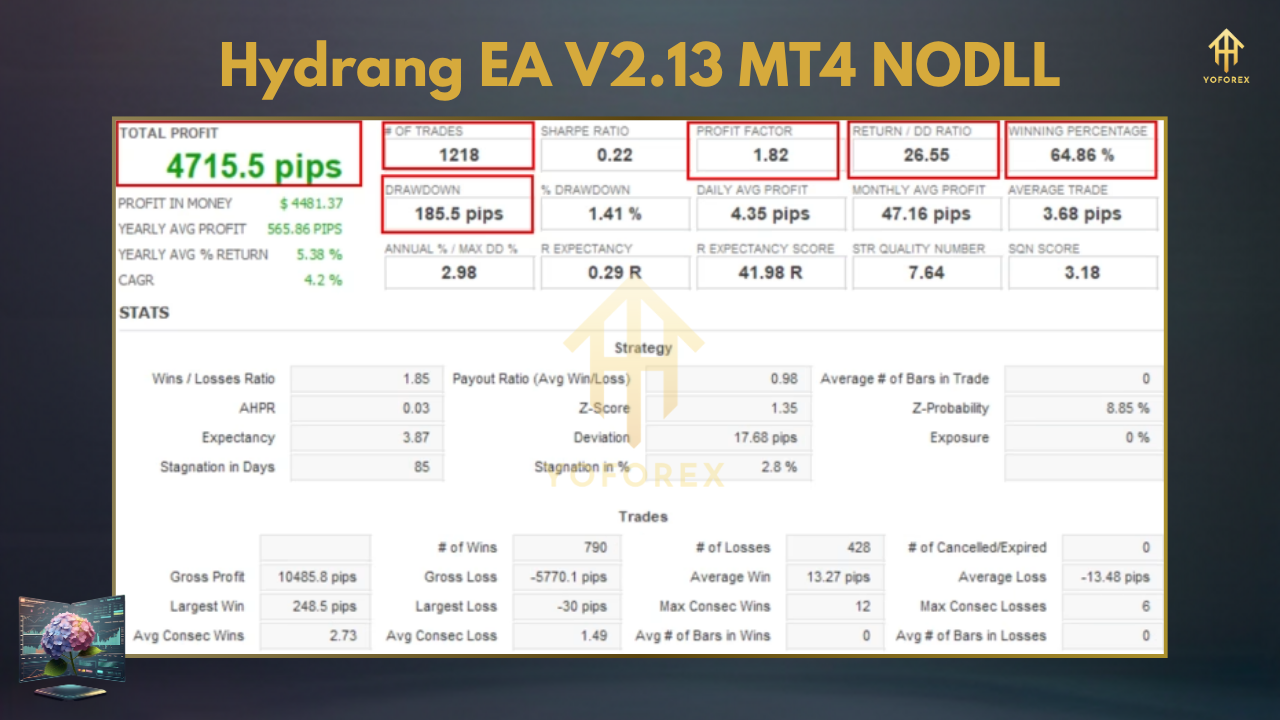
The goal is that a small price reversal in the desired direction will be enough to close all the open trades at once for a small net profit, thereby avoiding a registered loss. This creates an impressive-looking backtest with a near-perfect win rate.
The Inherent—and Catastrophic—Risks
While the martingale strategy can work for a while, producing a steady stream of small gains, it carries the risk of a single, catastrophic loss. The danger is a strong, sustained trend that moves against the EA’s open positions.
As the market continues its trend, the EA will keep opening larger and larger trades. This causes the required margin to swell and the floating loss (drawdown) to grow exponentially. Eventually, one of two things will happen:
- Margin Call: The account runs out of free margin, and the broker automatically closes all open positions, resulting in a devastating loss.
- Account Wipeout: The drawdown becomes so large that it consumes the entire account equity.
This is the dark side of “no-loss” EAs. They do not eliminate losses; they simply postpone and amplify them. A trader might enjoy weeks or even months of consistent profits, only to see it all disappear in a single adverse market event.
Why is Version 2.13 So Prevalent?
The specific mention of “V2.13” is likely a marketing tactic to suggest ongoing development and improvement. By versioning the software, promoters create a sense of legitimacy and imply that any flaws in previous versions have been fixed. However, without transparent developer notes or verified performance records, a new version number means very little. The underlying high-risk strategy almost always remains the same.
How to Approach the Hydrang EA V2.13
Given the significant red flags, approaching this EA requires extreme caution.
- Skepticism is Your Shield: Be deeply skeptical of any tool that promises guaranteed profits or no losses. Professional trading is about managing probabilities and risk, not finding a magic bullet.
- Demo Trading is Mandatory: Never run an EA like this on a live account without extensive testing on a demo account first. Run it for several weeks or months to understand its behavior in different market conditions (trending vs. ranging).
- Understand the Parameters: If you do test it, dive into the settings. Look for inputs related to lot sizing, multipliers, and trade distance. These will often confirm the presence of a martingale or grid system.
- Backtest with a Critical Eye: A backtest provided by the seller is often curve-fit to look perfect. Run your own backtests using high-quality tick data in MT4. Pay close attention to the maximum drawdown figure, as this reveals the true risk the EA took to achieve its profit.
Conclusion: A Tool of High Risk, Not High Reward
The Hydrang EA V2.13 is a classic example of a high-risk automated trading system wrapped in alluring marketing. While it may generate profits in the short term, its probable reliance on a martingale or grid strategy makes it an extremely dangerous tool for uninformed traders. The risk of blowing up an entire account is not just a possibility; it is a mathematical certainty over the long term if a strong trend goes against its positions.
Instead of searching for a “no-loss” robot, traders are far better served by investing their time in learning sound trading principles, risk management, and developing a robust strategy. The Holy Grail in trading isn’t a piece of software; it’s discipline, education, and a healthy respect for market risk. Use tools like the Hydrang EA as a case study in what to avoid, not as a solution for your portfolio.