

MD1 Indicator MT4: The Ultimate Guide to Mastering Market Momentum
In the fast-paced world of forex trading, having the right tools can make the difference between consistent profits and frustrating losses. Among the countless technical indicators available for MetaTrader 4 (MT4), the MD1 Indicator MT4 stands out as a powerful yet underutilized tool for identifying market momentum and potential trend reversals. This comprehensive guide will walk you through everything you need to know about this dynamic indicator, from installation to advanced trading strategies.
What is the MD1 Indicator MT4?
The MD1 Indicator is a custom technical analysis tool designed for the MetaTrader 4 platform. Unlike standard indicators that come pre-installed with MT4, the MD1 is a specialized oscillator that measures price momentum and helps traders identify overbought and oversold conditions in the market. Developed by professional traders, this indicator combines elements of momentum oscillators and trend-following systems to provide clear signals about market direction and potential turning points.
At its core, the MD1 Indicator calculates the relationship between price movements and volatility, presenting this information in an easy-to-interpret visual format. Traders of all experience levels can benefit from its signals, though it particularly shines when used as part of a comprehensive trading strategy.
How the MD1 Indicator Works
Understanding the mechanics behind the MD1 Indicator is crucial for using it effectively. The indicator operates on a few key principles:
Mathematical Foundation
The MD1 Indicator uses a proprietary algorithm that incorporates:
- Price momentum: Measures the rate of change in price movements
- Volatility analysis: Accounts for market volatility to normalize signals
- Trend detection: Identifies the prevailing market direction
The result is displayed as an oscillator that fluctuates between predefined levels (typically -100 to +100), with overbought and oversold zones marked for easy identification.
Visual Components
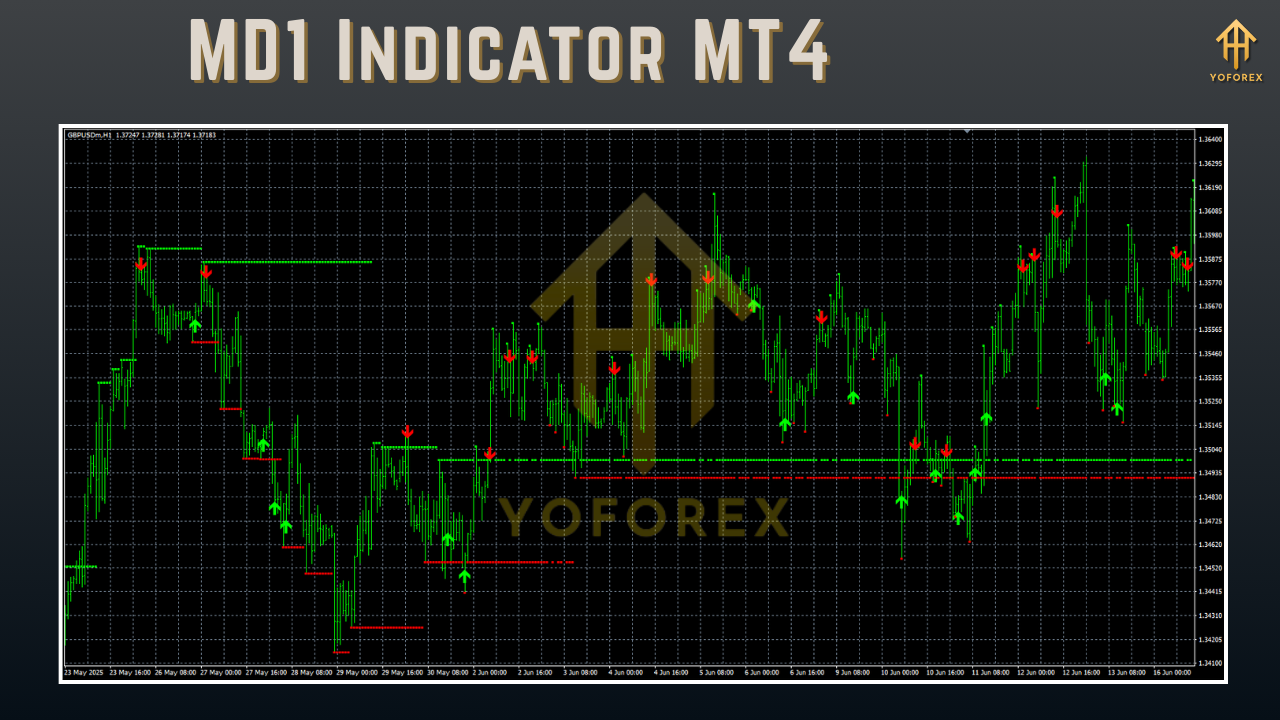
When applied to an MT4 chart, the MD1 Indicator displays:
- Main oscillator line: The primary signal line that fluctuates between extreme levels
- Signal levels: Horizontal lines marking overbought (e.g., +80) and oversold (e.g., -80) zones
- Divergence markers: Optional visual cues when price action diverges from indicator readings
- Color coding: Often changes color based on momentum direction (e.g., green for bullish, red for bearish)
How to Install the MD1 Indicator on MT4
Getting started with the MD1 Indicator is straightforward. Follow these simple steps:
Step 1: Download the Indicator File
First, obtain the MD1 Indicator file (usually in .ex4 or .mq4 format) from a reliable source. Ensure you’re downloading from a reputable provider to avoid malicious files.
Step 2: Locate Your MT4 Data Folder
- Open your MT4 platform
- Click on “File” in the top menu
- Select “Open Data Folder”
Step 3: Install the Indicator
- In the Data Folder, navigate to: MQL4 → Indicators
- Copy the downloaded MD1 Indicator file into this folder
- Restart MT4 or right-click on the Navigator window and select “Refresh”
Step 4: Apply to Chart
- Open the Navigator window (Ctrl+N if not visible)
- Expand the “Indicators” section
- Find “MD1” in the list
- Drag and drop it onto your desired chart
- Configure settings as needed (covered in the next section)
Configuring MD1 Indicator Settings
While the MD1 Indicator works well with default settings, optimizing it for your trading style can enhance performance. Access the settings by right-clicking the indicator on your chart and selecting “Properties” or “Inputs.”
Key Parameters to Adjust:
-
Period: The number of candles used in calculations (default: 14)
- Shorter periods (5-9) for scalping
- Longer periods (20-30) for swing trading
-
Overbought Level: Typically set between +70 to +90
- Lower values generate more signals but increase false positives
-
Oversold Level: Typically set between -70 to -90
- Higher values provide earlier signals but may miss strong trends
-
Smoothing Method: Choose between Simple, Exponential, or Smoothed Moving Averages
- Exponential often works best for responsiveness
-
Price Type: Select which price data to use (Close, Open, High, Low, etc.)
- Close price is most commonly used
-
Alert Settings: Configure email, sound, or push notifications for signal alerts
Pro Tip:
Test different settings using MT4’s Strategy Tester to find optimal parameters for your preferred currency pairs and timeframes.
How to Interpret MD1 Indicator Signals
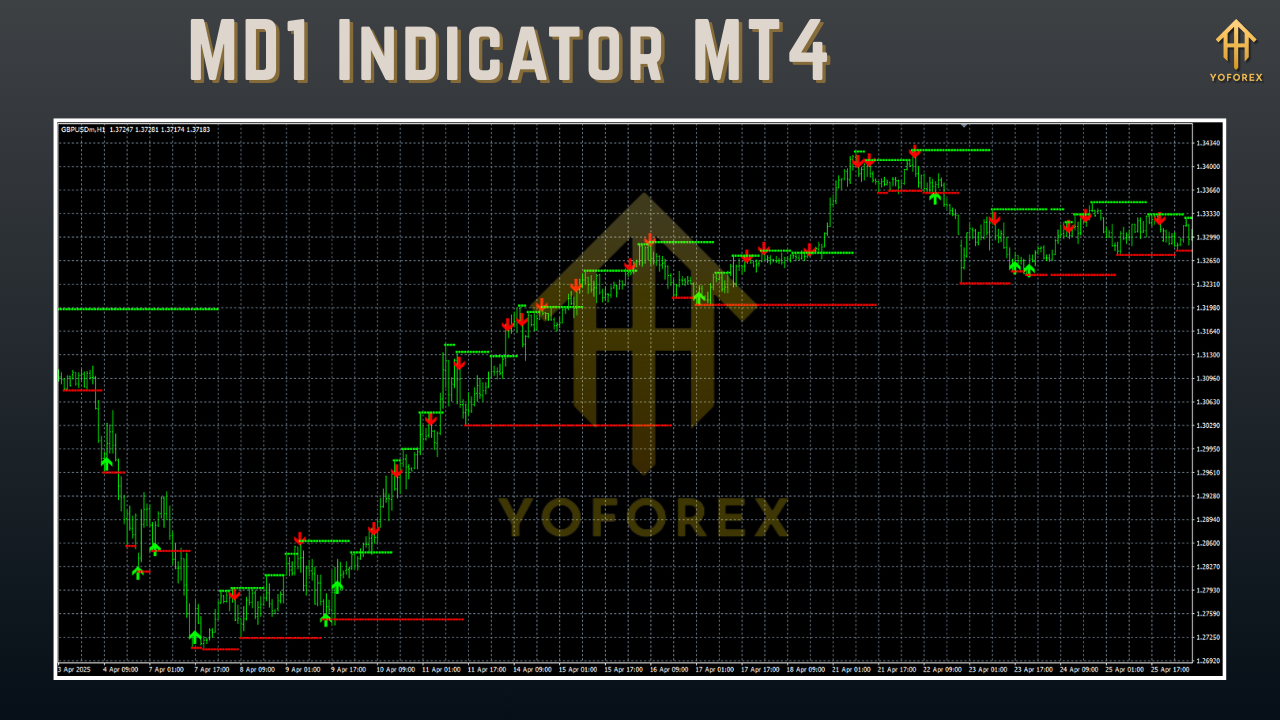
Mastering signal interpretation is where the MD1 Indicator truly shines. Here are the primary signals to watch for:
Overbought/Oversold Conditions
- Overbought Signal: When the oscillator rises above the overbought level (e.g., +80), it suggests the market may be overvalued and due for a downward correction.
- Oversold Signal: When the oscillator falls below the oversold level (e.g., -80), it indicates the market may be undervalued and poised for an upward reversal.
Momentum Divergence
Divergence occurs when price action and the indicator move in opposite directions:
- Bullish Divergence: Price makes lower lows while the MD1 makes higher lows. This often precedes upward reversals.
- Bearish Divergence: Price makes higher highs while the MD1 makes lower highs. This frequently signals impending downward moves.
Centerline Crossovers
The zero line (or centerline) is a critical reference point:
- Bullish Signal: Oscillator crosses above zero, indicating strengthening upward momentum.
- Bearish Signal: Oscillator crosses below zero, suggesting growing downward pressure.
Trend Confirmation
When the MD1 remains consistently above or below zero:
- Above Zero: Confirms an uptrend
- Below Zero: Confirms a downtrend
MD1 Indicator Trading Strategies
Now let’s explore practical trading strategies incorporating the MD1 Indicator:
Strategy 1: Mean Reversion with Confirmation
This strategy capitalizes on overbought/oversold conditions with trend filters.
Rules:
- Identify the overall trend using a 200-period moving average
- Wait for MD1 to reach overbought (> +80) in an uptrend or oversold (< -80) in a downtrend
- Enter trade when MD1 crosses back below +80 (for shorts) or above -80 (for longs)
- Place stop loss beyond recent swing high/low
- Take profit at the next significant support/resistance level
Example: In an uptrend (price above 200 MA), when MD1 drops below -80 and then crosses back above, enter long with a stop below the recent low.
Strategy 2: Divergence Breakout
This approach combines divergence signals with breakout confirmation.
Rules:
- Identify bullish or bearish divergence on MD1
- Mark the high/low of the divergence pattern
- Enter when price breaks beyond this level
- Place stop loss on the opposite side of the breakout level
- Target a risk-to-reward ratio of at least 1:2
Example: If you spot bearish divergence (higher highs in price, lower highs in MD1), enter short when price breaks below the most recent swing low.
Strategy 3: Momentum Trend Following
This strategy uses MD1 to ride strong trends while avoiding reversals.
Rules:
- Confirm trend with MD1 consistently above/below zero
- Enter on pullbacks where MD1 touches but doesn’t cross the opposite extreme
- Add to positions when MD1 makes new momentum extremes in trend direction
- Trail stop loss below recent swing lows (for longs) or highs (for shorts)
- Exit when MD1 crosses zero against your position
Example: In a strong uptrend (MD1 > 0), enter long when MD1 pulls back to +20 without crossing below zero.
Advantages
The MD1 Indicator offers several compelling benefits for traders:
- Versatility: Works across all timeframes, from 1-minute scalping to monthly charts
- Leading Signals: Often provides early warnings of trend changes before price action confirms
- Customizability: Highly adjustable parameters suit various trading styles
- Visual Clarity: Color-coded signals make interpretation intuitive
- Divergence Detection: Excels at spotting hidden momentum shifts
- Compatibility: Pairs well with other indicators like moving averages, Fibonacci, and support/resistance
- Low Resource Usage: Doesn’t significantly slow down MT4 performance
- No Repainting: Most versions provide fixed signals that don’t change retrospectively
Limitations and Considerations
While powerful, the MD1 Indicator isn’t without limitations:
- False Signals in Ranging Markets: Can generate whipsaws during sideways price action
- Lagging Nature: Like all indicators, it reacts to price rather than predicting it
- Parameter Sensitivity: Poor settings can lead to unreliable signals
- Not a Standalone Solution: Works best as part of a comprehensive trading system
- Over-Optimization Risk: Excessive curve-fitting can reduce real-world effectiveness
- Volatility Dependence: May require adjustment during high-impact news events
- Learning Curve: New users need time to master interpretation nuances
Best Practices for Using the MD1 Indicator
To maximize the effectiveness of the MD1 Indicator:
- Combine with Price Action: Always consider candlestick patterns and chart structure
- Use Multiple Timeframes: Confirm signals across higher and lower timeframes
- Employ Risk Management: Never risk more than 1-2% per trade
- Backtest Thoroughly: Validate strategies on historical data before live trading
- Keep a Trading Journal: Document all trades and indicator performance
- Stay Updated: Ensure you’re using the latest version of the indicator
- Avoid Signal Overload: Don’t clutter charts with too many indicators
- Practice Patience: Wait for high-probability setups rather than chasing every signal
Conclusion: Is the MD1 Indicator Right for You?
The MD1 Indicator MT4 represents a valuable addition to any trader’s toolkit, offering unique insights into market momentum that many standard indicators miss. Its ability to identify overbought/oversold conditions, spot divergences, and confirm trends makes it particularly useful for both trend-following and counter-trend strategies.
However, like all trading tools, its effectiveness ultimately depends on the user’s skill, discipline, and ability to integrate it into a comprehensive trading plan. The MD1 Indicator isn’t a “holy grail” that guarantees profits, but when used correctly, it can significantly enhance your market analysis and decision-making process.
For traders willing to invest the time to understand its nuances and test different strategies, the MD1 Indicator can become a cornerstone of their technical analysis approach. Whether you’re a day trader seeking precise entry points or a swing trader looking to catch major trend reversals, this versatile indicator has something to offer.
Remember to start with a demo account to familiarize yourself with the MD1 Indicator’s behavior before risking real capital. With practice and proper risk management, you may find that this powerful oscillator becomes an indispensable part of your trading arsenal.
Final Tip: The best indicator is one you understand thoroughly and can apply consistently. Take the time to master the MD1 Indicator, and it may just give you the edge you need in today’s competitive forex markets.
Support & Disclaimer
Got questions or need help? Reach out anytime:
- WhatsApp: https://wa.me/+443300272265
- Telegram: https://t.me/yoforexrobot
Disclaimer: Past performance is no guarantee of future results. All trading carries risk. Always demo-test the MD1 Indicator MT4 in a risk-free environment before deploying on a live account.