


MFI Update Indicator MT4: A Comprehensive Guide
The Money Flow Index (MFI) is a powerful technical indicator widely used by traders to gauge the strength of money flowing into and out of a financial instrument. When integrated into the MetaTrader 4 (MT4) platform, the MFI indicator becomes an invaluable tool for forex, stock, and crypto traders seeking to identify overbought or oversold conditions, potential reversals, and trend confirmations. This blog provides an in-depth exploration of the MFI indicator on MT4, its calculations, applications, trading strategies, and tips for maximizing its effectiveness in 2025.
What is the Money Flow Index (MFI)?
The Money Flow Index, developed by Gene Quong and Avrum Soudack, is a momentum oscillator that combines price and volume data to measure buying and selling pressure. Often referred to as the volume-weighted Relative Strength Index (RSI), the MFI oscillates between 0 and 100, providing insights into market sentiment and potential price movements. Unlike the RSI, which focuses solely on price, the MFI incorporates trading volume, making it particularly effective for assessing the strength of price trends and spotting divergences.
In the MT4 platform, the MFI is a standard indicator found under the “Volumes” folder in the “Indicators” section. Its default setting uses a 14-period calculation, but traders can customize this to suit their trading style and timeframe.
How the MFI Indicator Works
The MFI calculates the flow of money into and out of an asset by analyzing price and volume over a specified period. The calculation involves several steps:
-
Typical Price (TP): Calculate the average of the high, low, and closing prices for a given period:
TP = (High + Low + Close) / 3 -
Raw Money Flow: Multiply the typical price by the trading volume for the period:
Raw Money Flow = TP × Volume -
Positive and Negative Money Flow: If the current period’s typical price is higher than the previous period’s, the money flow is positive. If lower, it’s negative. Sum the positive and negative money flows over the specified period (e.g., 14 periods).
-
Money Flow Ratio: Divide the sum of positive money flow by the sum of negative money flow:
Money Flow Ratio = Positive Money Flow / Negative Money Flow -
Money Flow Index: Convert the ratio into an index value between 0 and 100:
MFI = 100 - (100 / (1 + Money Flow Ratio))
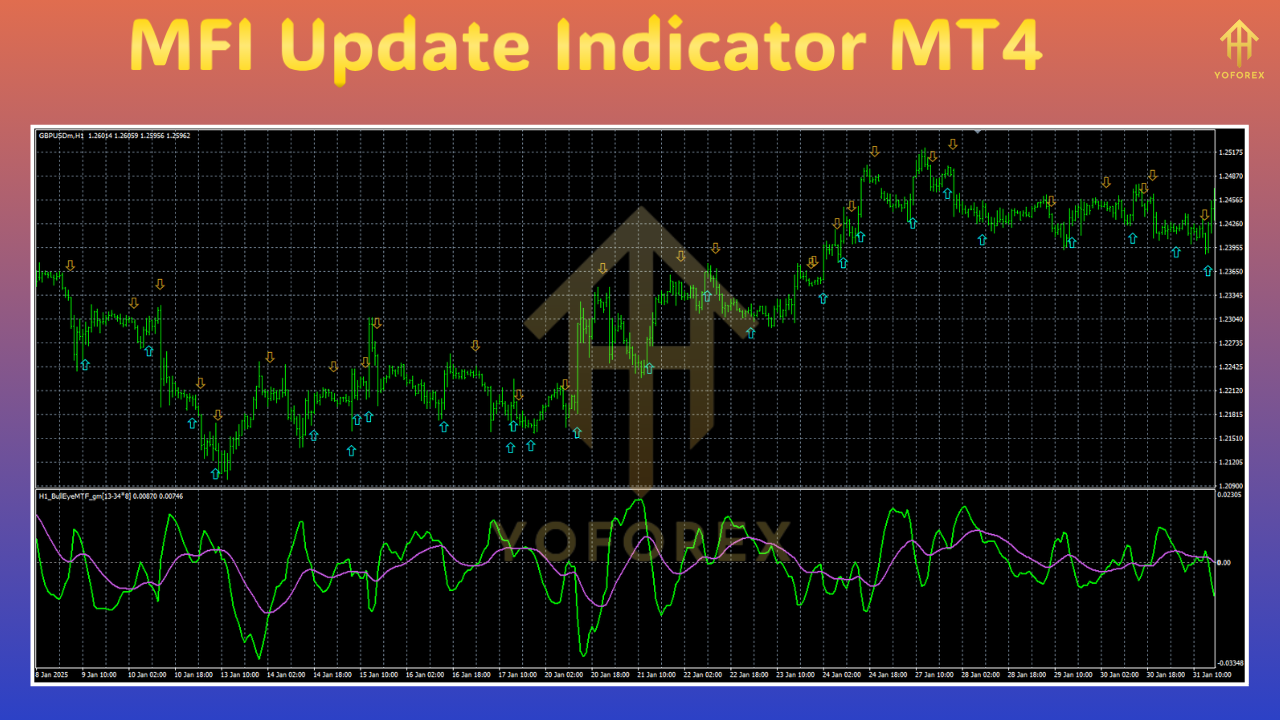
MT4 automates these calculations, displaying the MFI as a line graph below the price chart, with default overbought (80) and oversold (20) levels.
Setting Up the MFI Indicator in MT4
To add the MFI indicator to your MT4 chart, follow these steps:
-
Open MT4 and select a chart for the asset you wish to analyze.
-
Click Insert > Indicators > Volumes > Money Flow Index.
-
A settings window will appear. The default period is 14, but you can adjust it based on your trading strategy (e.g., shorter periods for scalping, longer for swing trading).
-
Customize the overbought and oversold levels if desired (e.g., some traders use 10 and 90 for stricter signals).
-
Click OK to apply the indicator, which will appear as a sub-chart below the main price chart.
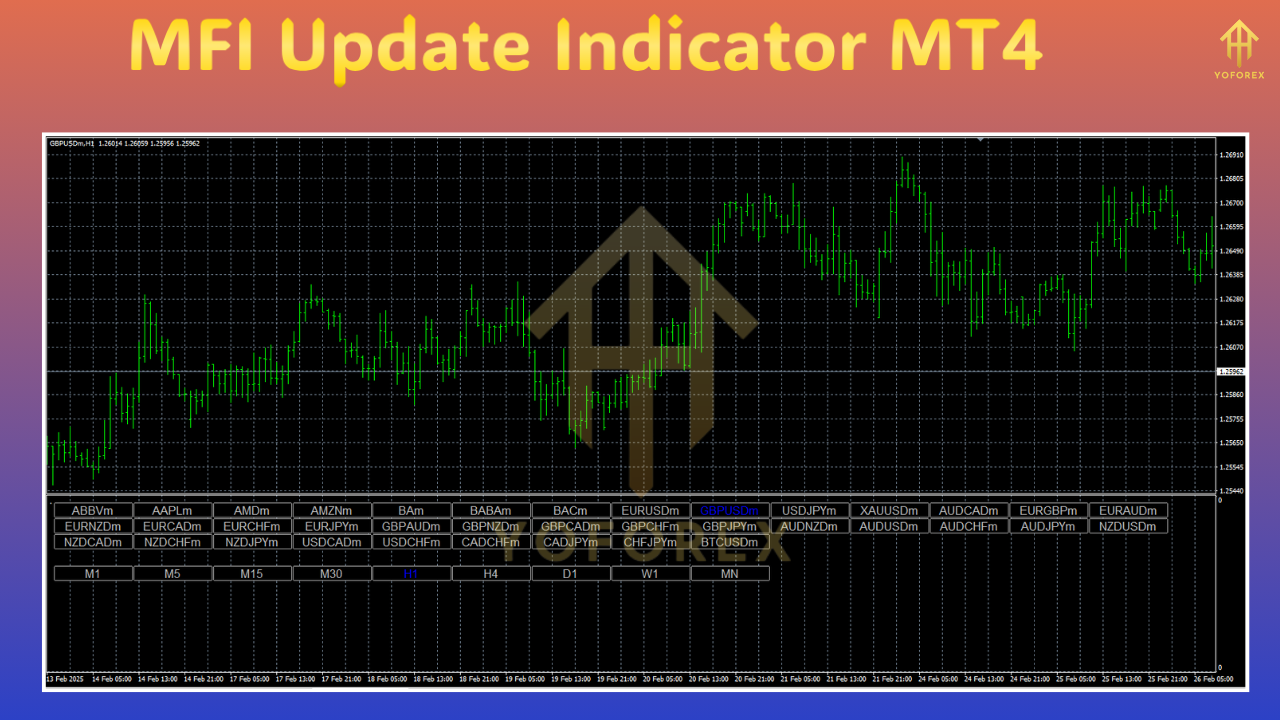
You can also tweak the line color and width for better visibility. For advanced users, custom MFI indicators (e.g., MTF MFI or MFI with alerts) can be downloaded from platforms like MQL5 or ForexRacer and installed by placing the .ex4 or .mq4 files in the MT4 “Indicators” folder.
Interpreting MFI Signals
The MFI provides several key signals for traders:
1. Overbought and Oversold Conditions
-
Above 80: Indicates overbought conditions, suggesting a potential price reversal to the downside. Traders may consider selling or shorting.
-
Below 20: Signals oversold conditions, indicating a potential upward reversal. This could be a buying opportunity.
-
Neutral Zone (20–80): Suggests balanced market conditions without strong buying or selling pressure.
However, overbought or oversold levels alone are not sufficient for trading decisions, as strong trends can keep the MFI above 80 or below 20 for extended periods. Always confirm signals with other indicators or price action.
2. Divergences
Divergences occur when the price and MFI move in opposite directions, often signaling a potential reversal:
-
Bullish Divergence: The price makes lower lows, but the MFI forms higher lows, indicating weakening selling pressure and a possible upward reversal.
-
Bearish Divergence: The price makes higher highs, but the MFI forms lower highs, suggesting diminishing buying pressure and a potential downward reversal.
Divergences are among the most reliable MFI signals, especially when combined with support/resistance levels or candlestick patterns.
3. Trend Confirmation
The MFI can confirm the strength of a trend:
-
Above 50: Indicates buying pressure, supporting an uptrend.
-
Below 50: Suggests selling pressure, reinforcing a downtrend.
Traders can use the MFI to time entries during trend pullbacks, entering when the MFI crosses back toward the trend direction after a retracement.
Trading Strategies Using the MFI Indicator
Here are three effective MFI-based trading strategies for MT4 users:
1. Overbought/Oversold Reversal Strategy
This strategy focuses on entering trades when the MFI signals overbought or oversold conditions:
-
Buy Signal: Wait for the MFI to drop below 20 (oversold) and then cross back above it. Confirm with a bullish candlestick pattern (e.g., hammer or engulfing) or a support level.
-
Sell Signal: Wait for the MFI to rise above 80 (overbought) and then cross back below it. Confirm with a bearish candlestick pattern or resistance level.
-
Stop-Loss: Place below the recent swing low for buys or above the swing high for sells.
-
Take-Profit: Target the next significant support/resistance level or use a risk-reward ratio (e.g., 1:2).
Example: On a GBP/USD H1 chart, the MFI drops to 15, indicating oversold conditions. A bullish engulfing candle forms at a key support level. Enter a buy trade, set a stop-loss below the support, and target the next resistance.
2. MFI and Moving Average Crossover Strategy
Combine the MFI with a moving average (MA) for trend-following trades:
-
Add a 30-period Simple Moving Average (SMA) to the MFI sub-chart (select “First Indicator’s Data” in the MA settings).
-
Buy Signal: When the MFI is below 50 and crosses above the 30-period SMA, enter a buy trade, indicating increasing buying pressure.
-
Sell Signal: When the MFI is above 50 and crosses below the 30-period SMA, enter a sell trade, signaling growing selling pressure.
-
Confirm entries with price action (e.g., break of a trendline) or another indicator like the MACD.
-
Set stop-loss and take-profit levels based on recent price swings or a fixed risk-reward ratio.
Example: On an EUR/USD H4 chart, the MFI crosses above the 30-period SMA while below 50, and the price breaks a descending trendline. Enter a buy trade with a stop-loss below the recent low.
3. MFI Divergence Strategy
This strategy uses divergences to anticipate reversals:
-
Bullish Divergence: Identify a price making lower lows while the MFI forms higher lows. Wait for a confirmation signal (e.g., RSI crossing above 30 or a bullish candlestick) before entering a buy trade.
-
Bearish Divergence: Spot a price making higher highs while the MFI forms lower highs. Confirm with a bearish signal (e.g., RSI below 70) before entering a sell trade.
-
Stop-Loss: Place below the recent low (bullish divergence) or above the recent high (bearish divergence).
-
Take-Profit: Target a key Fibonacci retracement level (e.g., 38.2% or 61.8%) or a previous swing point.
Example: On a BTC/USD daily chart, the price forms a higher high, but the MFI shows a lower high, indicating bearish divergence. A bearish pin bar forms at resistance, signaling a sell opportunity.
Enhancing MFI with Other Indicators
The MFI is most effective when used alongside other technical tools to filter false signals:
-
Fibonacci Retracement: Use Fibonacci levels to confirm MFI signals at key support/resistance zones. For example, an oversold MFI signal at the 61.8% retracement level strengthens a buy setup.
-
RSI: Pairing MFI with RSI can confirm overbought/oversold conditions or divergences. For instance, both indicators showing oversold conditions increase the reliability of a buy signal.
-
Moving Averages: Use MAs to identify the trend direction and filter MFI signals. Trade MFI crossovers in the direction of the prevailing trend for higher probability setups.
-
Price Action: Look for candlestick patterns (e.g., doji, engulfing) or chart patterns (e.g., double bottom) to confirm MFI signals.
Tips for Using the MFI Indicator Effectively
-
Avoid Relying Solely on MFI: The MFI can produce false signals, especially in strong trends. Always use it in conjunction with other indicators or price action.
-
Adjust Period Settings: Experiment with different MFI periods (e.g., 10 for short-term, 21 for long-term) to match your trading style and timeframe.
-
Practice on a Demo Account: Test MFI strategies on a demo account, available on platforms like AvaTrade, to refine your approach without risking capital.
-
Incorporate Risk Management: Use stop-losses and position sizing to manage risk. A robust risk management strategy is crucial, as MFI signals are not 100% accurate.
-
Monitor Volume Trends: Since MFI relies on volume, pay attention to volume spikes or declines, which can enhance the reliability of MFI signals.
Limitations of the MFI Indicator
While powerful, the MFI has limitations:
-
False Signals in Strong Trends: The MFI can remain overbought or oversold for extended periods during strong trends, leading to premature entries.
-
Lagging Nature: As a momentum oscillator, the MFI may lag behind price movements, missing rapid market shifts.
-
Platform Differences: The MFI on MT4 differs slightly from other platforms like TradingView due to calculation methods or data feeds. Ensure consistency in your analysis.
Custom MFI Indicators for MT4
For advanced traders, custom MFI indicators enhance functionality:
-
MTF MFI Indicator: Displays MFI values across multiple timeframes, allowing traders to align signals across short- and long-term charts.
-
MFI with Alerts: Generates alerts or arrows for overbought/oversold crossovers or divergences, available on platforms like ForexRacer or TrueTL.
-
MFI RSI Divergence Indicator: Combines MFI and RSI to highlight divergences with visual arrows, simplifying trade identification.
To install custom indicators, download the .ex4 or .mq4 file, place it in the MT4 “MQL4/Indicators” folder, and restart the platform. Access the indicator via Insert > Indicators > Custom.
Conclusion
The Money Flow Index (MFI) indicator on MT4 is a versatile tool for traders seeking to analyze market momentum and identify trading opportunities. By combining price and volume data, the MFI offers unique insights into overbought/oversold conditions, divergences, and trend strength. When used strategically with other indicators like moving averages, RSI, or Fibonacci retracement, the MFI can enhance trading accuracy. However, traders must remain mindful of its limitations and incorporate robust risk management to mitigate false signals.
Whether you’re a beginner or an experienced trader, practicing MFI-based strategies on a demo account and experimenting with custom settings can help you master this indicator. As the financial markets evolve in 2025, the MFI remains a valuable tool for navigating forex, stocks, and crypto with confidence.