

What Is MnF Forex Signals Indicator V1.0 (MT4)?
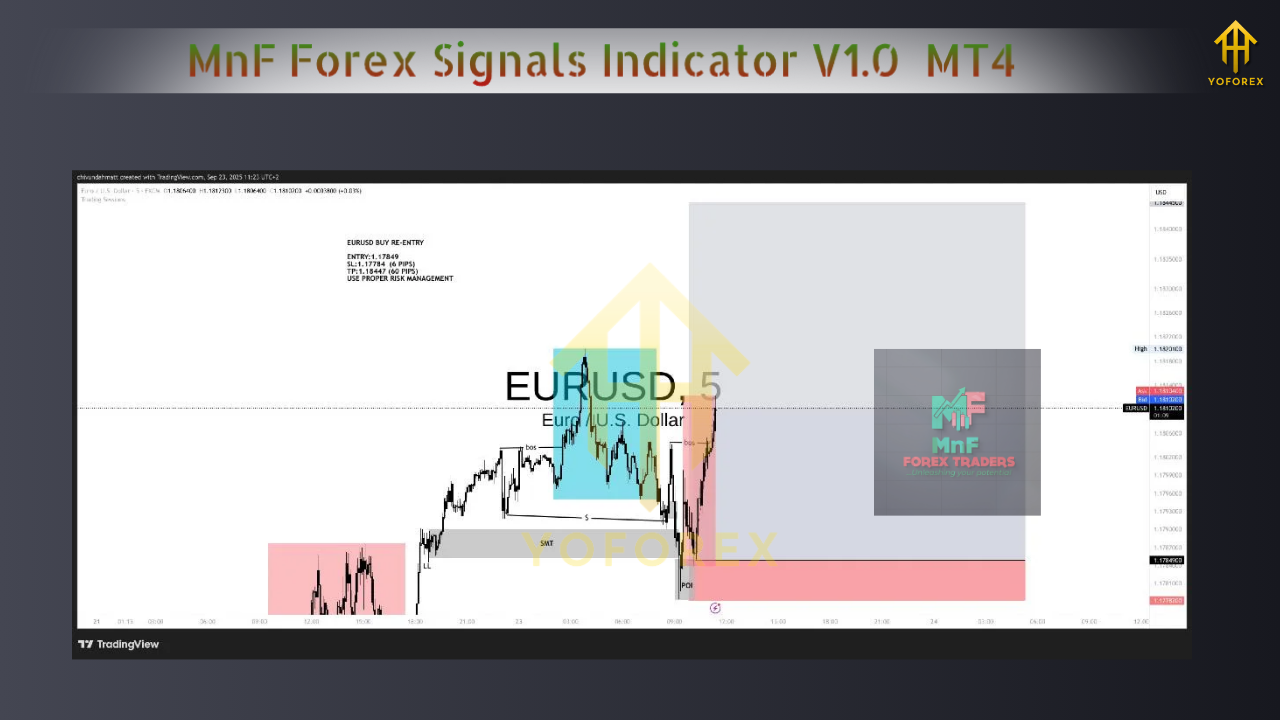
MnF Forex Signals Indicator V1.0 is promoted as a signal-generating tool for MetaTrader 4 that overlays buy/sell arrows and push/desktop alerts on price charts. Like most alert-based tools, its value doesn’t come from the arrows alone; it comes from how you integrate those signals into a rule-based plan—timeframe selection, filters (trend/volatility/session), entry confirmation, risk model, and exit logic. This review focuses on that integration so you can test MnF systematically and decide whether it adds edge to your workflow.
Key Goals of a Good Signals Indicator
-
Clarity: No clutter; easily readable arrows/alerts on your chosen timeframe.
-
Stability: Signals should not repaint after candle close.
-
Actionability: Works with defined SL/TP, not just “directional hints.”
-
Compatibility: Runs smoothly on standard MT4 builds without unusual DLL needs.
-
Configurability: Basic inputs: signal sensitivity, alert mode (on candle close), filters (trend/session), and display options.
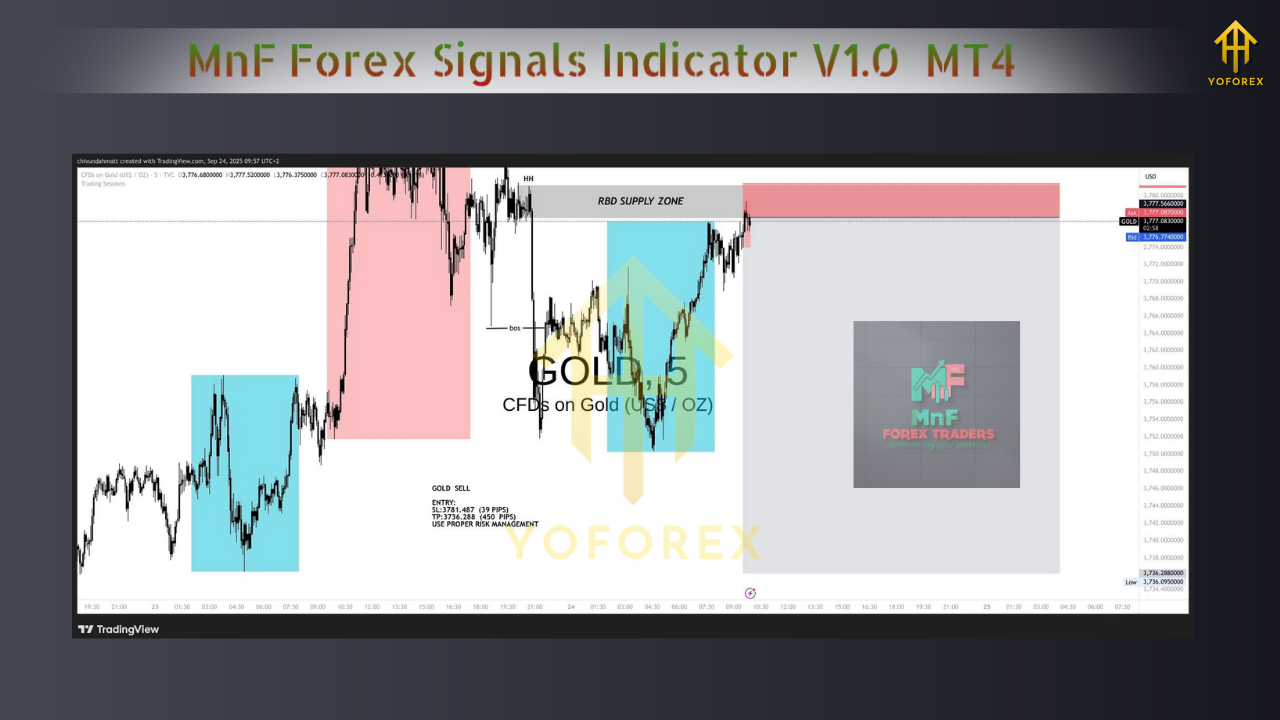
Installation & First-Run Checklist (MT4)
-
Copy files: Place the
.mq4/.ex4indicator file inMQL4/Indicators/. Restart MT4. -
Attach to chart: Open EURUSD M15 to start (liquid, balanced noise).
-
Disable DLLs: Keep “Allow DLL imports” off initially unless vendor documentation explicitly requires it and explains why.
-
Alert mode: If available, set “Signal on bar close = true.” Intrabar alerts can look great in hindsight but often fade as bars form (classic repaint trap).
-
Baseline template: Candlesticks + 20/50 EMA (trend filter) + ATR(14) (volatility-aware stops). This template helps you contextualize any arrow.
Tip: Use a portable MT4 instance for testing to keep your live setup clean.
Recommended Pairs & Timeframes (to start)
-
Majors: EURUSD, GBPUSD, USDJPY—deep liquidity and tighter spreads.
-
Timeframes: M15 and H1 for a good balance of signal frequency and noise.
-
Sessions: London and New York overlap for higher-quality momentum.
You can expand to Gold (XAUUSD) or indices later, but start with majors to validate stability and signal quality first.
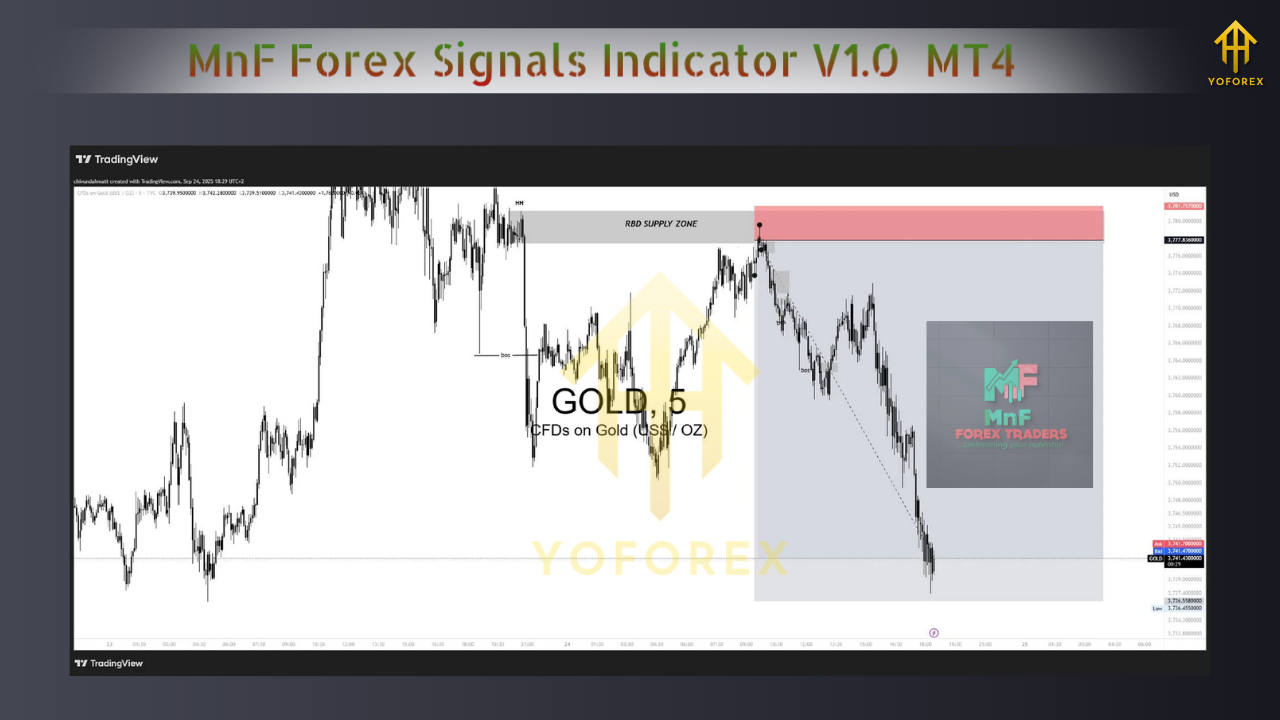
Strategy Framework: Turning MnF Signals into Trades
Core idea: Use MnF for directional timing, then control risk and exits with objective rules. Below is a complete, backtest-ready ruleset you can adapt.
1) Trend Filter (context first)
-
EMA20 above EMA50 = uptrend bias; EMA20 below EMA50 = downtrend bias.
-
Only take MnF buy arrows in an uptrend; only take sell arrows in a downtrend.
2) Entry Confirmation (on bar close)
-
Buy: MnF buy arrow and candle closes above EMA20.
-
Sell: MnF sell arrow and candle closes below EMA20.
-
Optional: Require a minimum ATR(14) threshold (e.g., current ATR > 75% of its 6-month median) to avoid dead ranges.
3) Stop-Loss (volatility-aware)
-
Use ATR(14) × 1.5 from entry, or the recent swing beyond EMA20 (whichever is wider).
-
Place SL immediately; no exceptions.
4) Take-Profit & Exits
Pick one of the following and stick with it through your test period:
-
Fixed R multiple: TP at 1.8R–2.2R; move SL to breakeven at +1R.
-
Hybrid trail: Partial at +1.5R, then trail the rest with EMA20 or ATR(14) × 1.
-
Time-based exit: If neither SL nor TP hits by end of session (or 24 bars), exit at market.
5) Risk Per Trade
-
Start with 0.5%–1.0% of account equity per trade.
-
Max 2–3 concurrent positions per symbol to avoid correlation shocks.
6) News & Session Filter
-
Avoid high-impact news if you’re new to execution.
-
Prefer London/NY overlap. If you must trade Asia session, use stricter ATR filters.
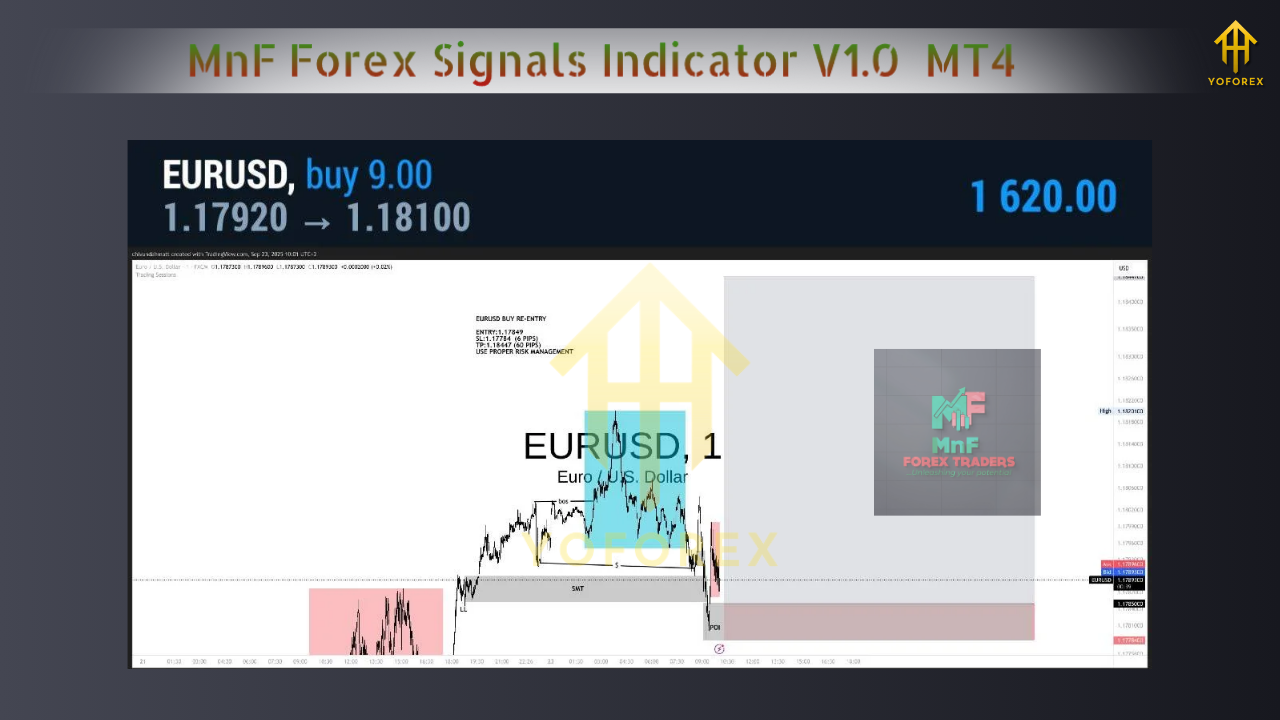
Backtesting Workflow: How to Validate MnF Properly
Because “signals” tools can look perfect in hindsight, your test method matters as much as the indicator itself.
-
Visual Mode (Strategy Tester):
-
Symbol: EURUSD; Timeframe: M15; Model: Every tick.
-
Period: Last 6–9 months to capture mixed regimes.
-
Log each trade in a simple sheet: entry time/price, SL/TP (in pips and R), exit time, result in R.
-
-
Signal Integrity Check:
-
Watch live bar formation in the tester; confirm arrows do not disappear after candle close.
-
Refresh chart (change TF forward/back) to ensure arrows remain where they were.
-
-
Forward Test (Demo):
-
Run the same rules for 2–4 weeks on a demo account.
-
Compare live results to your backtest stats—large gaps indicate slippage, spread, or behavioral differences.
-
-
Metrics That Matter:
-
Win rate (target 40–60% with a 1.8R–2.2R TP can already be profitable)
-
Profit factor (PF) – aim for ≥ 1.2 initially; >1.4 is solid
-
Max drawdown – keep ≤ 15–20% in testing; if higher, reduce risk/adjust filters
-
Trade frequency – at least 8–15 trades/month per pair on M15/H1 for meaningful data
-
Suggested Default Settings (Starting Point)
While exact inputs vary by vendor build, here’s a sensible baseline you can mirror in MnF:
-
Signal Sensitivity: Medium (avoid hyper-sensitive settings that trigger during chop)
-
Alert Timing: Bar close only = true
-
Trend Filter: Enabled (align arrows with EMA20/EMA50 bias)
-
Session Filter: Enabled (London/NY preferred)
-
Arrow Display: On (keep chart readable; hide clutter like historical labels if needed)
Save this as an .set file for repeatable testing.
Risk Management & Position Sizing
Even a strong indicator can’t overcome poor risk rules. Adopt a fixed-fractional model (e.g., 0.7% risk/trade) and scale lots to the SL distance. This ensures that wider stops don’t over-expose you and tighter stops don’t under-utilize your equity. Reassess size weekly; never martingale after losses.
Drawdown protocol: If equity is down >10%, cut risk in half and pause trading during major news or low-volatility sessions. Resume full risk only after equity recovers.
Pros & Cons (What to Expect)
Pros
-
Clear visual cues can reduce hesitation and standardize entries.
-
Works across majors on M15/H1 where spreads are favorable.
-
Easy to incorporate with EMA/ATR filters and R-multiple exits.
Cons
-
Any signals tool can tempt over-trading in choppy ranges.
-
If repainting occurs intrabar, results may look better than they are—hence the bar-close rule.
-
Performance varies by session and pair; validation is essential.
Common Mistakes to Avoid
-
Trading every arrow: Filter by trend and ATR; skip micro-consolidations.
-
Ignoring costs: On lower timeframes, spread and slippage erode edge—use quality ECN accounts.
-
Changing rules mid-test: Keep one ruleset for the entire backtest; iterate only after you’ve finished a cycle.
-
Oversizing after a win streak: Stick to fixed fractional; let sample size, not emotions, drive decisions.
Mini-FAQ (For Quick Decisions)
Does MnF repaint?
Test it: set alerts on bar close only, run a visual backtest, refresh the chart. If closed-bar arrows move or vanish, treat with caution.
Best timeframe?
Start with M15 and H1. If you want fewer trades and smoother signals, try H1.
Can I use it on Gold?
Yes, but validate separately. Gold’s volatility demands wider ATR stops and careful session timing.
What risk per trade is safe?
For most accounts, 0.5–1.0% is a robust starting range.
What win rate do I need?
With ~2R average winners, even 45–50% win rate can be nicely profitable.
Final Verdict
MnF Forex Signals Indicator V1.0 (MT4) can be a useful timing layer—if you enforce bar-close confirmations, align with a simple trend filter, and control exits with R-based targets or an ATR/EMA trail. Because public information is limited, treat it like any proprietary signals tool: validate first, trade second. If your forward test shows PF ≥ 1.2, max DD ≤ 20%, and a steady stream of 8–15 qualified trades per month on majors, it’s a candidate for your playbook. If not, refine filters (trend/session/ATR) before considering different pairs or timeframes.