

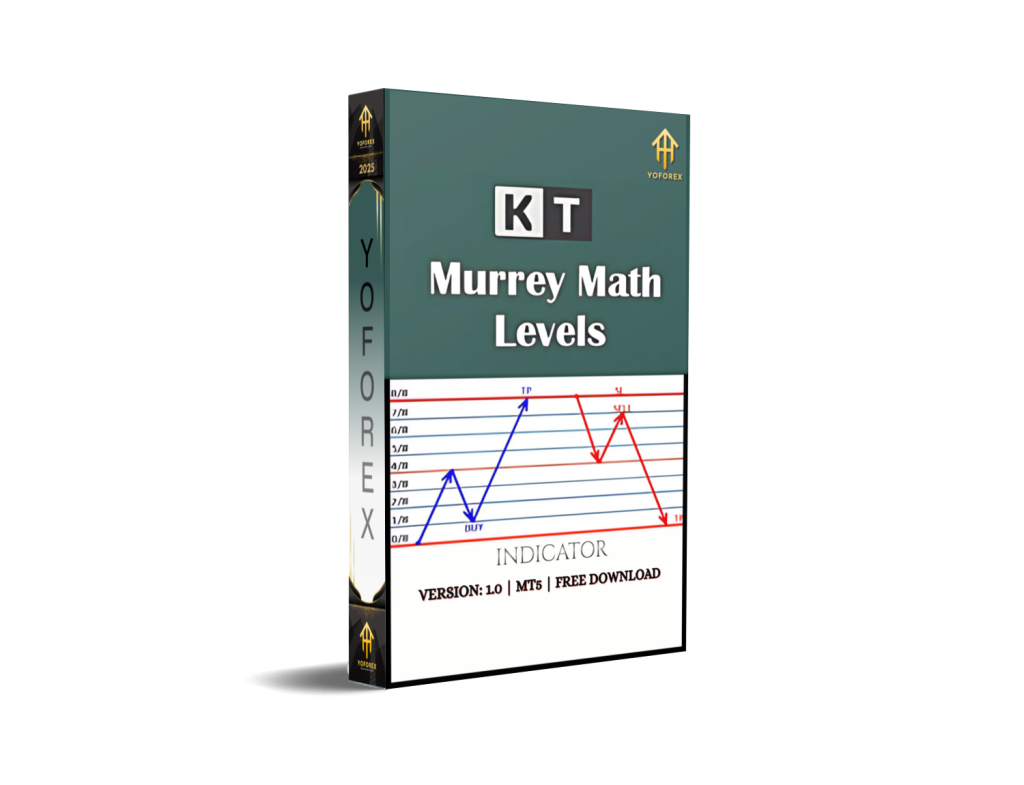
Murrey Math Levels Indicator MT5: A Comprehensive Guide for Traders
Introduction: Unlocking Market Geometry with Murrey Math
In the dynamic world of financial trading, technical indicators serve as essential tools for analyzing price movements and making informed decisions. Among these tools, the Murrey Math Levels Indicator stands out as a unique and powerful system that blends geometry, mathematics, and market psychology. Originally developed by T. Henning Murrey in the early 1990s, this indicator has gained significant popularity among MetaTrader 5 (MT5) users for its ability to identify key support and resistance levels with remarkable precision.
The Murrey Math Levels Indicator MT5 is designed to help traders visualize market structure through a series of horizontal lines that divide price action into eight equal intervals, or “octaves.” These lines represent potential reversal points, trend continuation zones, and areas of high trading interest. Whether you’re a day trader, swing trader, or long-term investor, understanding how to leverage this indicator can significantly enhance your market analysis and trading strategy.
In this comprehensive guide, we’ll delve deep into the Murrey Math Levels Indicator for MT5, exploring its theoretical foundations, practical applications, and strategies for integration into your trading routine. By the end of this article, you’ll have a thorough understanding of how to use this powerful tool to navigate the complexities of the financial markets.
What is the Murrey Math Levels Indicator?
The Murrey Math Levels Indicator is a technical analysis tool that applies principles of geometry and mathematics to financial markets. At its core, the indicator is based on the concept that markets move in predictable patterns and that price action tends to reverse or react at specific harmonic levels. This approach is inspired by Gann theory and the idea that markets operate within a natural geometric framework.
The Origins and Philosophy
T. Henning Murrey developed this system after studying the works of W.D. Gann, a legendary trader known for his geometric and mathematical approach to market analysis. Murrey simplified Gann’s complex theories into a more accessible format by creating a grid-based system that divides price movement into eight equal parts. This division is based on the concept of “octaves,” a term borrowed from music theory where an octave represents a complete cycle that repeats at different scales.
The underlying philosophy of Murrey Math is that markets are fractal in nature, meaning similar patterns occur at different timeframes and price levels. By identifying these repeating patterns, traders can anticipate potential turning points and make more informed trading decisions.
Mathematical Foundation
The Murrey Math Levels Indicator calculates its lines based on the high and low prices over a specific period. The indicator first identifies the significant high and low points within the selected timeframe, then divides the range between these points into eight equal intervals. Each interval represents 1/8th of the total range, creating nine horizontal lines (including the top and bottom boundaries).
The mathematical formula for calculating these levels is straightforward:
- Identify the highest high (H) and lowest low (L) over the selected period.
- Calculate the range: Range = H – L.
- Divide the range by 8 to get the interval size: Interval = Range / 8.
- Plot the levels starting from the low (L):
-
- Level 0/8: L
- Level 1/8: L + Interval
- Level 2/8: L + 2 × Interval
- Level 3/8: L + 3 × Interval
- Level 4/8: L + 4 × Interval (the midpoint)
- Level 5/8: L + 5 × Interval
- Level 6/8: L + 6 × Interval
- Level 7/8: L + 7 × Interval
- Level 8/8: H
This creates a visual grid where each line represents a potential support or resistance level, with the 4/8 line being the most significant as it marks the midpoint of the range.
How Does the Murrey Math Indicator Work?
The Murrey Math Levels Indicator operates on the principle that price tends to react at specific harmonic levels within a given range. These levels are not arbitrary; they are derived from natural mathematical relationships that reflect market psychology and the behavior of market participants.
The Octave System
The core of the Murrey Math system is the division of price movement into eight equal parts, or octaves. This division is based on the observation that markets often reverse or consolidate at these fractional levels. Each octave represents 12.5% of the total range (since 100% divided by 8 equals 12.5%).
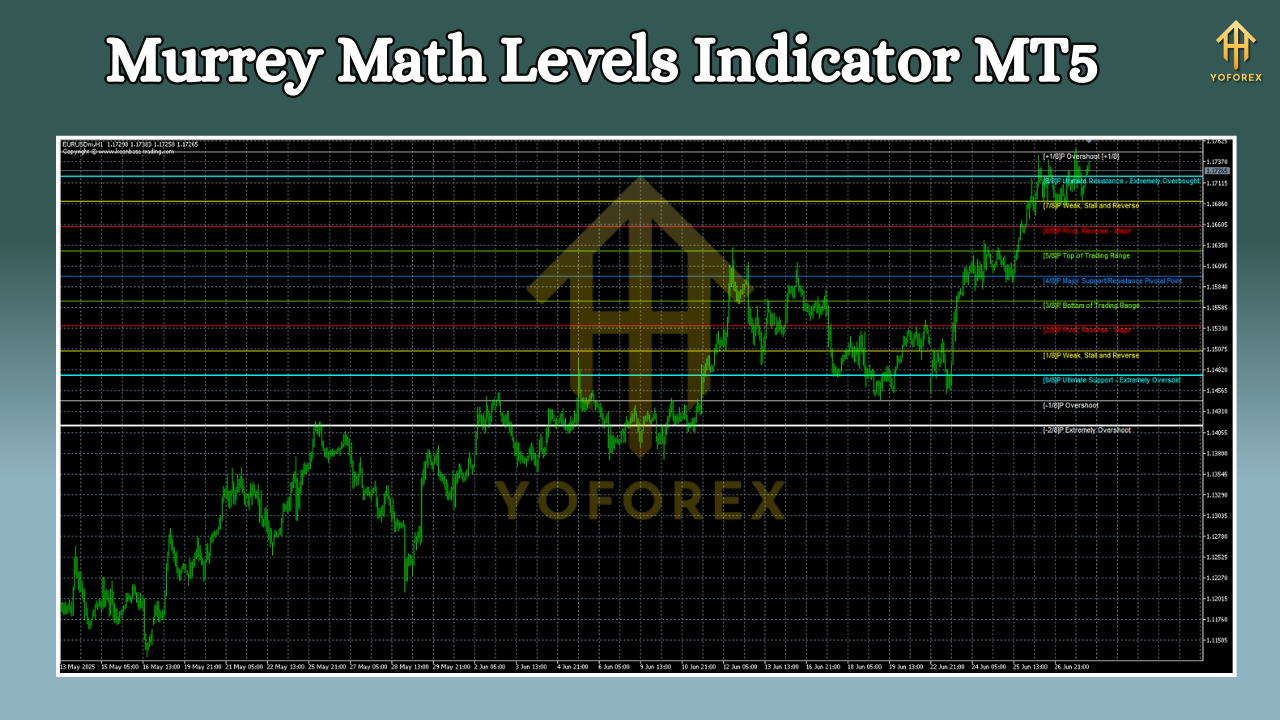
The indicator plots nine lines (from 0/8 to 8/8) that create a framework for analyzing price action:
- 0/8 and 8/8: These represent the ultimate support and resistance levels, respectively. Price rarely moves beyond these lines without a significant catalyst.
- 1/8 and 7/8: These are weak support/resistance levels where price may experience minor reactions.
- 2/8 and 6/8: These are strong reversal points where price often changes direction.
- 3/8 and 5/8: These are the top and bottom of the equilibrium range, representing areas where price tends to consolidate.
- 4/8: This is the most important level, representing the major pivot point or the center of gravity of the price range.
Dynamic Nature of the Levels
One of the key features of the Murrey Math Levels Indicator is its dynamic nature. As new highs and lows are formed, the indicator automatically recalculates and adjusts the levels to reflect the current market structure. This ensures that the levels remain relevant and adapt to changing market conditions.
The indicator can be applied to any timeframe, from minute charts for scalpers to monthly charts for long-term investors. However, it’s important to note that the reliability of the levels increases with higher timeframes, as they represent more significant market consensus.
Market Psychology Behind the Levels
The Murrey Math levels work because they align with key psychological price points where market participants tend to react. For example:
- The 4/8 level (midpoint) is where traders often reassess the market’s direction.
- The 2/8 and 6/8 levels represent areas where traders who missed the initial move might enter positions, causing reversals.
- The 0/8 and 8/8 levels represent extreme points where exhaustion often occurs, leading to reversals or strong breakouts.
Understanding this psychological component is crucial for effectively using the Murrey Math Levels Indicator in your trading.
Understanding the Murrey Math Lines
To effectively use the Murrey Math Levels Indicator, it’s essential to understand the significance of each line and how price typically reacts around them. Let’s explore each level in detail:
0/8: Ultimate Support
The 0/8 line represents the lowest level of the Murrey Math grid and acts as the ultimate support level. When price approaches this line, it often indicates that the asset is oversold, and a reversal may be imminent. However, if price breaks below 0/8, it suggests a strong bearish trend with potential for further decline.
Characteristics:
- Strong support level
- Potential reversal zone for long positions
- Break below indicates extreme bearishness
1/8: Weak Support
The 1/8 line is considered a weak support level. Price may pause or experience minor reactions at this level, but it’s generally not strong enough to cause significant reversals on its own. Traders often look for confirmation from other indicators or price action patterns before making decisions at this level.
Characteristics:
- Minor support
- Temporary pause in downward movement
- Often breached during strong trends
2/8: Strong Reversal Point
The 2/8 line is one of the most important levels in the Murrey Math system. It represents a strong reversal point where price frequently changes direction. This level is particularly significant when price approaches it from above after a decline, as it often marks the end of a corrective move.
Characteristics:
- Strong support/resistance
- High probability reversal zone
- Ideal for entry with confirmation
3/8: Bottom of Equilibrium Range
The 3/8 line marks the bottom of the equilibrium range, where price tends to consolidate. When price is between 3/8 and 5/8, it’s considered to be in a balanced state without a clear directional bias. This range is often associated with accumulation or distribution phases.
Characteristics:
- Lower boundary of consolidation
- Support in ranging markets
- Break below suggests bearish momentum
4/8: Major Pivot Point
The 4/8 line is the most critical level in the Murrey Math system. It represents the major pivot point or the center of gravity of the price range. Price reactions at this level are often strong and can signal significant trend changes or continuations.
Characteristics:
- Strongest support/resistance
- Key decision point for market direction
- High volume and volatility often occur here
5/8: Top of Equilibrium Range
The 5/8 line marks the top of the equilibrium range. Like the 3/8 line, it represents a consolidation area where price may pause before deciding its next direction. A break above 5/8 suggests bullish momentum, while failure to break it may lead to a reversal.
Characteristics:
- Upper boundary of consolidation
- Resistance in ranging markets
- Break above suggests bullish momentum
6/8: Strong Reversal Point
The 6/8 line, like the 2/8 line, is a strong reversal point. When price approaches this level from below, it often encounters resistance and may reverse. This level is particularly significant in uptrends where it can mark the end of a corrective pullback.
Characteristics:
- Strong resistance
- High probability reversal zone
- Ideal for entry with confirmation
7/8: Weak Resistance
The 7/8 line is considered a weak resistance level. Similar to the 1/8 line, price may experience minor reactions here, but it’s generally not strong enough to cause significant reversals on its own. Traders should look for additional confirmation before making decisions at this level.
Characteristics:
- Minor resistance
- Temporary pause in upward movement
- Often breached during strong trends
8/8: Ultimate Resistance
The 8/8 line represents the highest level of the Murrey Math grid and acts as the ultimate resistance level. When price approaches this line, it often indicates that the asset is overbought, and a reversal may be imminent. However, if price breaks above 8/8, it suggests a strong bullish trend with potential for further advance.
Characteristics:
- Strong resistance level
- Potential reversal zone for short positions
- Break above indicates extreme bullishness
How to Use the Murrey Math Indicator in MT5
Now that we understand the theory behind the Murrey Math Levels Indicator, let’s explore how to apply it in MetaTrader 5 (MT5) and integrate it into your trading workflow.
Installing the Indicator
The Murrey Math Levels Indicator is not included in the default set of MT5 indicators, so you’ll need to download and install it:
- Download the Indicator: Find a reliable source for the Murrey Math Levels Indicator MT5 file (usually in .mq5 or .ex5 format).
- Install in MT5:
- Open your MT5 platform
- Go to “File” > “Open Data Folder”
- Navigate to MQL5 > Indicators
- Copy the downloaded file into this folder
- Restart MT5
- Apply to Chart:
-
- Open a chart of your preferred instrument
- Go to “Insert” > “Indicators” > “Custom” and select the Murrey Math Levels Indicator
- Adjust the input parameters as needed (see next section)
Configuring the Indicator
The Murrey Math Levels Indicator in MT5 typically offers several customizable parameters:
- Timeframe: Select the timeframe for the indicator’s calculations. Higher timeframes (like H4 or Daily) generally provide more reliable levels.
- Period: Set the number of bars used to calculate the high and low. A common setting is 64, but you can adjust it based on your trading style.
- Show Lines: Choose which Murrey Math lines to display (0/8, 1/8, etc.).
- Colors and Styles: Customize the appearance of each line for better visibility.
Interpreting the Indicator on MT5 Charts
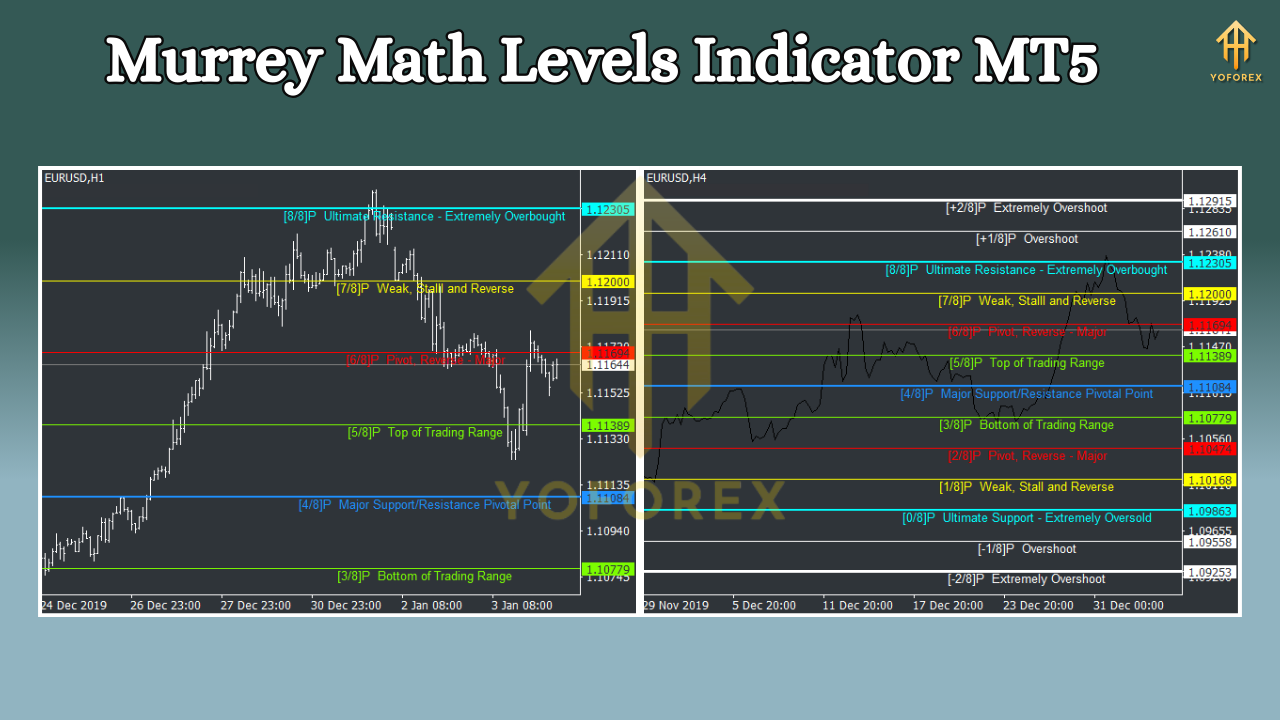
Once applied to your chart, the Murrey Math Levels Indicator will display horizontal lines representing the support and resistance levels. Here’s how to interpret them:
- Identify the Current Range: The indicator will automatically draw lines between the recent high and low, creating the Murrey Math grid.
- Observe Price Reactions: Watch how price reacts at each level. Look for reversals, breakouts, or consolidations around the key lines (especially 2/8, 4/8, and 6/8).
- Combine with Price Action: Use candlestick patterns (like pin bars, engulfing patterns) or chart patterns (like double tops/bottoms) to confirm signals at Murrey Math levels.
- Multiple Timeframe Analysis: Apply the indicator to multiple timeframes to get a broader perspective. For example, use the Daily chart levels for major support/resistance and the H1 chart for entry timing.
Practical Example
Let’s walk through a practical example of using the Murrey Math Levels Indicator in MT5:
- Setup: Apply the indicator to a EUR/USD H4 chart with default settings.
- Analysis: Notice that price is approaching the 6/8 level after a strong uptrend.
- Confirmation: Observe a bearish engulfing candlestick pattern forming at the 6/8 resistance level.
- Entry: Enter a short position with a stop loss above the 6/8 level and a take profit at the 4/8 level.
- Management: If price breaks above 6/8, consider exiting the position as it suggests a continuation of the uptrend.
Trading Strategies with Murrey Math Levels
The Murrey Math Levels Indicator can be used in various trading strategies, from simple reversal trading to complex multi-indicator systems. Here are some effective approaches:
1. Reversal Trading at Key Levels
This strategy focuses on trading reversals at the strongest Murrey Math levels (2/8, 4/8, and 6/8).
Rules:
- Long Entry: Price touches or slightly breaks below the 2/8 level and shows bullish reversal patterns (e.g., hammer, bullish engulfing). Place stop loss below 0/8 and take profit at 4/8 or 6/8.
- Short Entry: Price touches or slightly breaks above the 6/8 level and shows bearish reversal patterns (e.g., shooting star, bearish engulfing). Place stop loss above 8/8 and take profit at 4/8 or 2/8.
Advantages: High probability entries with favorable risk-reward ratios. Considerations: Requires confirmation from price action or other indicators to avoid false signals.
2. Breakout Trading
This strategy involves trading breakouts above the 8/8 resistance or below the 0/8 support levels.
Rules:
- Long Entry: Price closes above the 8/8 level with increased volume. Enter on the retest of the 8/8 level as new support. Place stop loss below 8/8 and take profit at the next octave’s 0/8 level.
- Short Entry: Price closes below the 0/8 level with increased volume. Enter on the retest of the 0/8 level as new resistance. Place stop loss above 0/8 and take profit at the next octave’s 8/8 level.
Advantages: Captures strong trending moves with potential for large profits. Considerations: Breakouts can be false; wait for confirmation and manage risk carefully.
3. Range Trading Between 3/8 and 5/8
When price is confined between the 3/8 and 5/8 levels, it’s in an equilibrium range. This strategy exploits the mean-reverting nature of price within this range.
Rules:
- Long Entry: Price bounces off the 3/8 support level with bullish confirmation. Place stop loss below 3/8 and take profit at 5/8.
- Short Entry: Price rejects the 5/8 resistance level with bearish confirmation. Place stop loss above 5/8 and take profit at 3/8.
Advantages: High win rate in ranging markets with defined risk. Considerations: Avoid this strategy when price is trending strongly.
4. Combining Murrey Math with Other Indicators
Enhance the reliability of Murrey Math signals by combining them with other technical indicators:
- Murrey Math + RSI: Use RSI to confirm overbought/oversold conditions at Murrey levels. For example, a bearish reversal at 6/8 with RSI above 70 strengthens the signal.
- Murrey Math + Moving Averages: Use a 50-period moving average to determine the trend direction. Only take long signals when price is above the MA and short signals when below.
- Murrey Math + Volume: Look for increased volume at key levels to confirm the strength of reversals or breakouts.
Example Strategy:
- Identify the trend using a 50-period EMA.
- Wait for price to reach a key Murrey level (2/8, 4/8, or 6/8).
- Confirm with RSI divergence and increased volume.
- Enter the trade with a stop loss beyond the level and take profit at the next opposite level.
Advantages and Limitations of the Murrey Math Indicator
Like any technical tool, the Murrey Math Levels Indicator has its strengths and weaknesses. Understanding these will help you use it more effectively.
Advantages
- Objective Framework: Provides a clear, mathematical framework for identifying support and resistance levels, removing subjective guesswork.
- Versatility: Can be applied to any financial instrument (forex, stocks, commodities) and any timeframe.
- Dynamic Nature: Automatically adjusts to new market conditions, keeping levels relevant.
- Psychological Alignment: Levels correspond to natural psychological price points where traders tend to react.
- Complementary Tool: Works well with other indicators and price action analysis to confirm signals.
- Risk Management: Clear levels make it easier to place stop losses and take profits.
Limitations
- Repainting: Some versions of the indicator may repaint (recalculate past levels) as new data comes in, which can be misleading.
- False Signals: Like all indicators, it can generate false signals, especially in choppy or highly volatile markets.
- Lagging Nature: Based on past price data, so it’s inherently lagging and may not capture sudden market shifts.
- Complexity: Requires time and practice to understand the nuances of each level and how price reacts to them.
- Over-Reliance Risk: Traders may become too dependent on the indicator and ignore other important market factors.
- Parameter Sensitivity: Results can vary significantly based on the chosen timeframe and period settings.
Conclusion: Mastering Market Geometry with Murrey Math
The Murrey Math Levels Indicator for MT5 is a powerful tool that brings a unique geometric perspective to market analysis. By dividing price action into harmonic intervals, it provides traders with a structured framework for identifying key support and resistance levels, potential reversal points, and areas of market equilibrium.
Throughout this guide, we’ve explored the theoretical foundations of the Murrey Math system, the significance of each level, and practical strategies for implementation in MT5. We’ve seen how this indicator can be used for reversal trading, breakout trading, and range trading, and how it can be combined with other technical tools for enhanced accuracy.
While the Murrey Math Levels Indicator is not a holy grail and has its limitations, it offers valuable insights into market structure and trader psychology. When used correctly, it can significantly improve your market analysis and trading performance.
To master the Murrey Math Levels Indicator:
- Practice: Apply it to historical charts to understand how price reacts at different levels.
- Combine: Use it in conjunction with other indicators and price action analysis.
- Adapt: Adjust the settings to suit your trading style and the instruments you trade.
- Manage Risk: Always use proper risk management techniques, regardless of how strong a signal appears.
As you incorporate the Murrey Math Levels Indicator into your trading routine, remember that no indicator works in isolation. The most successful traders use a combination of technical analysis, fundamental understanding, and sound risk management. The Murrey Math system is a valuable addition to this toolkit, offering a unique perspective on market geometry that can help you navigate the complexities of financial markets with greater confidence and precision.
Whether you’re a seasoned trader or just starting your journey, the Murrey Math Levels Indicator MT5 is worth exploring. Take the time to understand its nuances, practice its application, and integrate it into your trading strategy. With patience and discipline, you may find it to be a powerful ally in your quest for trading success.
Support & Disclaimer
Got questions or need help? Reach out anytime:
- WhatsApp: https://wa.me/+443300272265
- Telegram: https://t.me/yoforexrobot
Disclaimer: Past performance is no guarantee of future results. All trading carries risk. Always demo-test the KT Murrey Math Levels Indicator MT5 in a risk-free environment before deploying on a live account.