

Thanos EA V1.0 MT4 Review 2025: Unsnapping Forex Profits or Your Account?
In the vast universe of Forex trading, the allure of automated solutions is undeniable. Traders constantly seek the “Infinity Gauntlet” of tools—a system that can harness market volatility and deliver consistent profits with minimal effort. Enter the Thanos EA V1.0 MT4, an Expert Advisor whose powerful name evokes images of ultimate control and decisive action.
But like its namesake, does this EA bring balance to your trading portfolio, or does it risk “snapping” your account out of existence?
This comprehensive review will dive deep into the Thanos EA V1.0, exploring its core strategy and, most importantly, answering the critical questions every trader asks: What are the best pairs to trade, and what is the optimal timeframe?
What Exactly is the Thanos EA V1.0?
Before we dissect its strategy, let’s start with the basics. An Expert Advisor (EA) is a trading robot that runs on the popular MetaTrader 4 (MT4) platform. It automates your trading decisions, executing entries and exits based on a pre-programmed set of rules. The goal is to remove human emotion and trade the market 24 hours a day, 5 days a week.
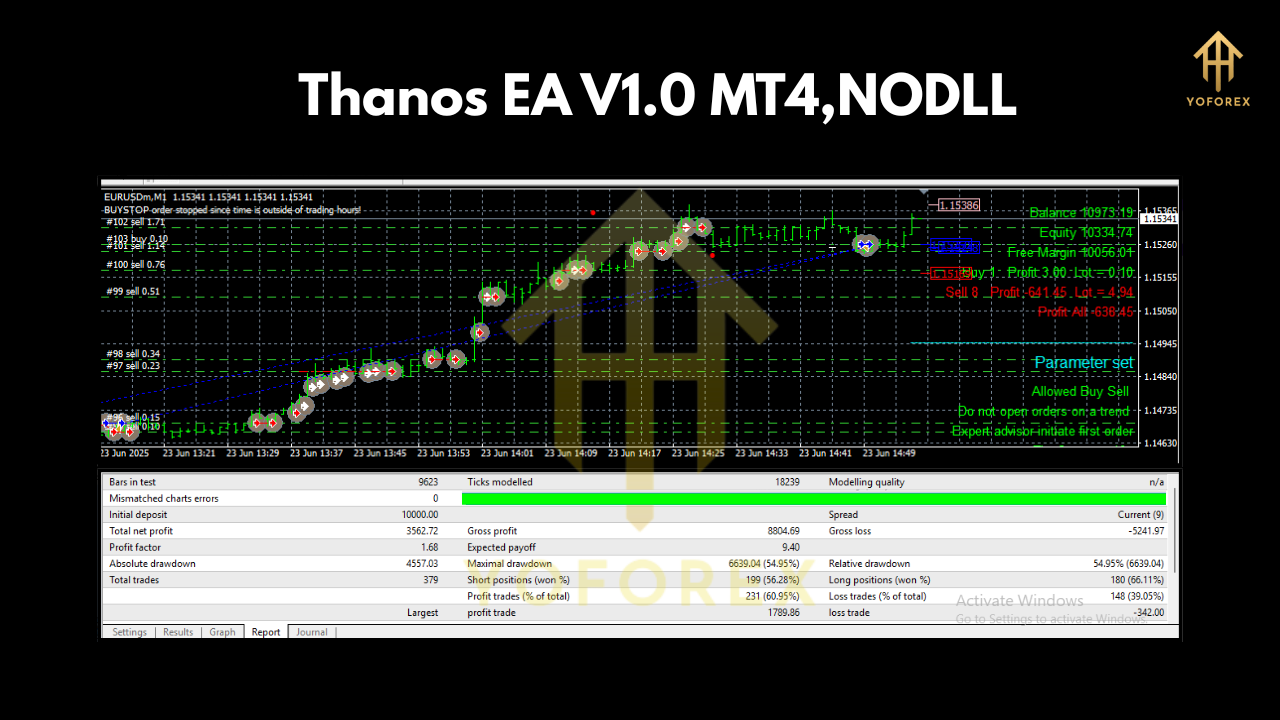
The Thanos EA V1.0 is a specific type of automated system that has gained notoriety in trading circles. While official developer claims can be ambitious, analysis of its trading behaviour strongly suggests it operates on a grid-based martingale strategy.
What does this mean?
- Grid Trading: The EA doesn’t just open one trade. Instead, it places a series of pending orders (a “grid”) above and below the current price. As the price moves and triggers these orders, the EA manages a basket of trades.
- Martingale Component: This is the high-risk element. If a trade moves into a loss, the EA will open another trade in the same direction but with an increased lot size (e.g., doubling the position). The goal is to achieve a small profit when the market eventually reverses, allowing the entire basket of trades to be closed.
This strategy can produce a very high win rate on individual baskets of trades, making it look incredibly impressive in the short term. However, it carries a significant, inherent risk that we will discuss later.
Answering the Core Question: Recommended Pairs and Timeframe for Thanos EA
You came here for the specifics, so let’s get straight to it. The performance of a grid martingale EA like Thanos is heavily dependent on the instrument and timeframe you choose. The wrong settings can lead to catastrophic failure, while the right ones can give the strategy a fighting chance.
Recommended Currency Pairs
The ideal pairs for the Thanos EA are those with predictable volatility, low spreads, and a tendency to range or revert to the mean rather than trend indefinitely.
Top Tier Recommendations:
- EUR/USD: The undisputed king for these types of EAs. It has the tightest spread in the industry, high liquidity, and spends significant time in consolidation phases, which is perfect for a grid strategy.
- GBP/USD: While more volatile than EUR/USD, it also exhibits strong mean-reverting characteristics. The higher volatility can lead to quicker profits but also requires a larger account balance to weather the drawdowns.
- AUD/USD: Another major pair with relatively low spreads and predictable behaviour. It’s often less volatile than GBP/USD, making it a slightly more conservative choice.
- USD/CAD: Tends to range well, but can be influenced heavily by oil price news, which can introduce sudden, strong trends. Use with caution.
- USD/CHF: Traditionally a stable, ranging pair. Its “safe-haven” status can sometimes lead to sharp, one-directional moves during market panic.
High-Risk, High-Reward Pair:
- XAU/USD (Gold): Many traders attempt to use grid EAs on Gold due to its massive daily range. When it works, the profits can be astronomical. However, Gold is notorious for its brutal, sustained trends that can wipe out a martingale system in a matter of hours. Only attempt this on a demo account first with a very large virtual balance to understand the risk.
Pairs to Avoid: Avoid exotic pairs with high spreads and low liquidity. Also, be wary of pairs known for extremely strong, multi-week trends like GBP/JPY, as these are the natural enemy of this EA’s strategy.
Optimal Timeframe
For a grid-based system like the Thanos EA, the chart timeframe is less about generating entry signals (as the grid is the entry system) and more about the frequency of management and trade placement.
Recommended Timeframe: (1-Hour)
The timeframe is widely considered the sweet spot for the Thanos EA for several reasons:
- Noise Reduction: It filters out the erratic “noise” of lower timeframes like or , preventing the EA from opening too many trades based on minor, insignificant price jitters.
- Responsiveness: It’s still responsive enough to manage the grid effectively during a typical trading day. A higher timeframe like or might be too slow to react to market reversals, leaving the EA stuck in a deep drawdown.
- Backtesting Efficiency: Backtesting on the timeframe provides a good balance between data granularity and speed, allowing you to run more comprehensive tests.
While you could experiment with the or charts, the timeframe provides the most stable foundation for letting the strategy operate as intended.
The Thanos “Snap”: How the Strategy Aims for Profit
Imagine the market is a battlefield. The Thanos EA doesn’t send a single soldier. It deploys an army.
- Initial Trade: The EA opens an initial trade, let’s say a BUY order.
- The Grid: It simultaneously places a series of pending BUY orders at set intervals (e.g., every 20 pips) below the initial entry and a series of TAKE PROFIT orders above.
- Scenario 1 (Profit): The price moves up. It hits the take profit level, and the trade is closed for a small win. The mission is a success.
- Scenario 2 (Drawdown): The price moves down, against the initial trade. It hits the first pending BUY order. This order is triggered, and now you have two BUY trades open. The EA calculates a new average entry price and a new, closer take profit level.
- The Martingale Kick: As the price continues to fall, it triggers more pending BUY orders. Crucially, each new order is opened with a larger lot size (e.g., , , , …). This aggressively lowers the average entry price.
- The “Snap”: The market only needs to make a small retracement (a bounce) for the combined value of all open trades to reach the new, closer take-profit target. When it does, *SNAP*—the EA closes the entire basket of trades for a small overall profit.
This is why it can seem invincible. Even in a downtrend, it can survive and profit from small upward bounces. But this leads us to the inevitable, critical warning.
The Inevitable Risk: The Price of Using the Gauntlet
The Thanos EA’s greatest strength is also its fatal flaw. The martingale strategy assumes that the market will always reverse. While it often does, it doesn’t have to.
A strong, sustained, one-directional trend without any significant retracements is the “Iron Man” to this Thanos.
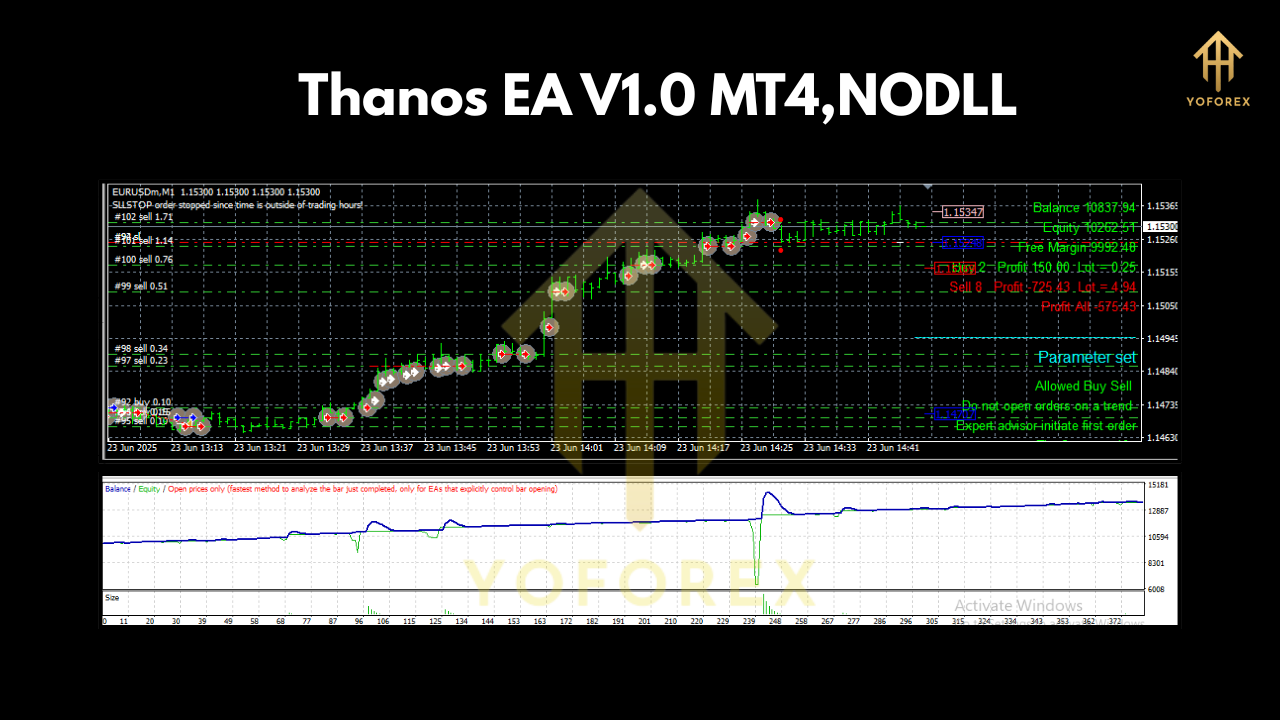
During such a trend, the EA will continue opening larger and larger positions, consuming your account’s margin at an exponential rate. The drawdown will grow from 5% to 20% to 70% and beyond. If the trend doesn’t produce a meaningful bounce, the result is a margin call, and the entire account is “snapped” away.
Key Risks Summarized:
- Extreme Drawdown: This strategy is defined by high drawdowns. You must be mentally and financially prepared to see your account equity significantly lower than your balance.
- Risk of Total Loss: This is not a “low-risk” EA. It has a high win rate but a catastrophic risk of ruin.
- Market Dependency: It excels in ranging, choppy markets but fails spectacularly in strong, trending markets.
- Requires Large Capital: To survive the inevitable drawdowns, a significant account balance is required. Running this on a $100 account is a recipe for disaster.
Essential Tips for Using the Thanos EA V1.0 Safely
If you are determined to test this EA, you must do so with the discipline of a master strategist.
- DEMO FIRST, ALWAYS: Do not even think about running this on a live account until you have tested it on a demo account for at least 2-3 months.
- Extensive Backtesting: Use the MT4 Strategy Tester to backtest the EA on your chosen pairs over several years of data. This will reveal its breaking points.
- Start with Minimum Lots: Begin with the absolute lowest lot size your broker allows (e.g., ).
- Use a VPS: An EA must run 24/7 without interruption. A Virtual Private Server (VPS) ensures your MT4 terminal is always online and connected, preventing missed trades or management failures due to your home computer shutting down or losing internet.
- Understand the Settings: Do not run the EA with default settings. Learn what each parameter (Grid Spacing, Lot Multiplier, Max Trades, etc.) does and how it impacts the risk.
Conclusion: Is the Thanos EA V1.0 a Hero or a Villain for Your Account?
The Thanos EA V1.0 MT4 is the quintessential high-risk, high-reward trading tool. It’s neither a hero nor a villain—it is simply a powerful force that must be understood and respected.
For Pairs, stick to majors like EUR/USD and GBP/USD. For the Timeframe, the chart provides the best operational balance.
Its grid martingale strategy can deliver an impressive stream of small profits in the right market conditions, making it feel like an unstoppable force. However, it operates with the constant, looming threat of total account annihilation. It’s a tool for the advanced trader who understands the immense risks involved, has sufficient capital to absorb deep drawdowns, and possesses the technical skill to optimize and monitor its performance relentlessly.