

Understanding the Volume Oscillator Indicator V1.0 for MetaTrader 5
In the fast-paced world of financial trading, having the right tools to analyze market conditions is crucial for success. One such tool is the Volume Oscillator Indicator V1.0 for MetaTrader 5 (MQ5), a powerful and customizable indicator designed to help traders assess market liquidity and avoid unfavorable trading conditions. By analyzing the relationship between two moving averages of volume, this indicator provides valuable insights into market dynamics, enabling traders to make informed decisions. In this blog post, we’ll dive deep into the mechanics of the Volume Oscillator, its implementation in MetaTrader 5, and how it can enhance your trading strategy.
What is the Volume Oscillator Indicator?
The Volume Oscillator Indicator is a technical analysis tool that measures volume trends by comparing two moving averages (MAs) of volume data: a fast MA and a slow MA. The core concept is simple yet effective: the indicator calculates the difference between the fast MA and the slow MA, expressing the result as an oscillator that fluctuates around a zero line. This oscillation reflects changes in trading volume momentum, helping traders identify periods of high or low liquidity.
Key Features of the Volume Oscillator V1.0 MQ5
-
Configurable MA Periods: Traders can adjust the periods of the fast and slow moving averages through the input tab in MetaTrader 5, allowing for customization based on trading style or market conditions.
-
Liquidity Insights: By analyzing volume trends, the indicator helps traders avoid entering trades in thin liquidity markets, which are prone to erratic price movements or “chop.”
-
Threshold-Based Trading: Traders can set thresholds on the oscillator’s values to filter out undesirable market conditions, reducing the risk of entering trades during periods of low volume or high volatility.
Why Volume Matters in Trading
Volume is often referred to as the “lifeblood” of the markets. It represents the number of shares, contracts, or lots traded within a given period and serves as a key indicator of market strength and liquidity. High volume typically indicates strong participation and conviction in price movements, while low volume can signal indecision or a lack of market interest. By incorporating volume-based indicators like the Volume Oscillator into your trading system, you can gain a deeper understanding of market dynamics and avoid pitfalls such as false breakouts or choppy price action.
Avoiding Thin Liquidity Markets
Thin liquidity markets—characterized by low trading volume—can be a trader’s nightmare. In such conditions, price movements are often erratic, and spreads can widen significantly, increasing trading costs and the risk of slippage. The Volume Oscillator helps traders identify these conditions by highlighting periods when volume momentum is weak. By setting a threshold on the oscillator, traders can avoid entering trades during these unfavorable periods, thereby improving the quality of their trade entries.
How the Volume Oscillator Works
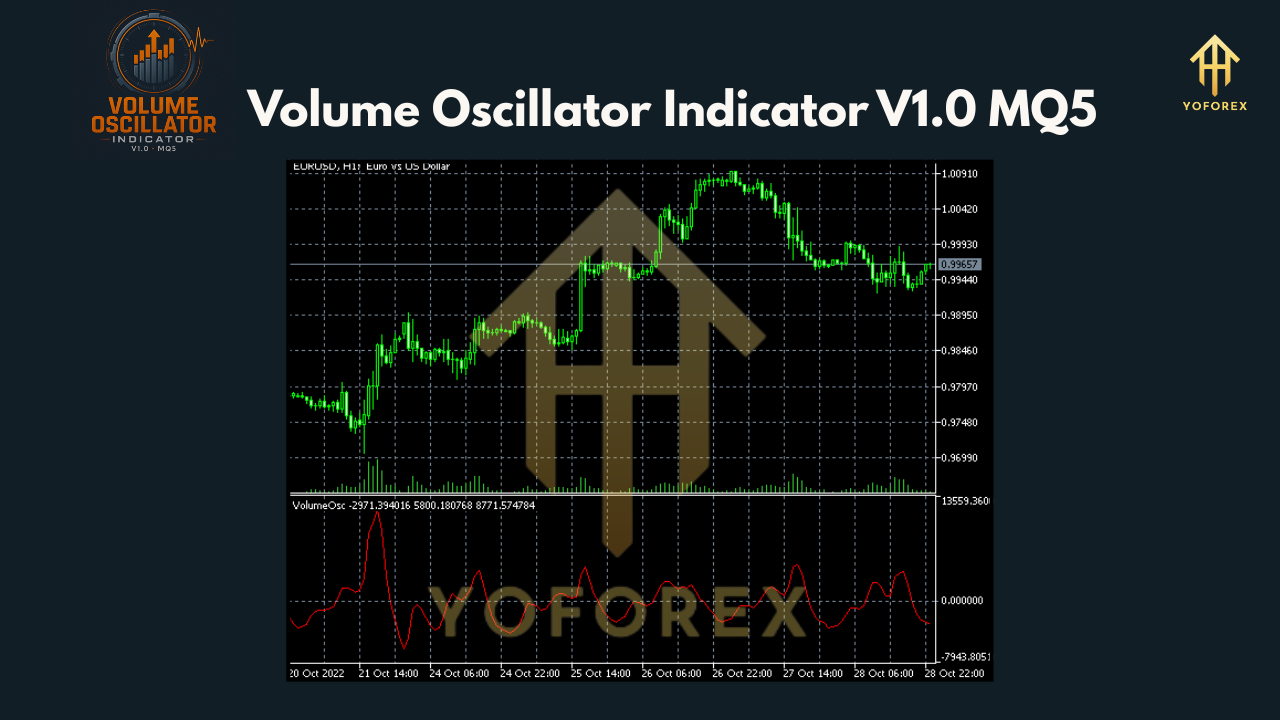
The Volume Oscillator operates on a straightforward principle: it subtracts the slow MA of volume from the fast MA of volume. The formula is as follows:
Volume Oscillator = Fast MA(Volume) – Slow MA(Volume)
-
Fast MA: A shorter-period moving average that reacts quickly to changes in volume.
-
Slow MA: A longer-period moving average that smooths out volume data over a broader timeframe.
-
Result: The difference between the two MAs is plotted as an oscillator, which oscillates above and below a zero line.
Interpreting the Oscillator
-
Positive Values: When the fast MA is greater than the slow MA, the oscillator is positive, indicating increasing volume momentum. This can signal strong market participation or the start of a trend.
-
Negative Values: When the slow MA exceeds the fast MA, the oscillator is negative, suggesting declining volume momentum. This may indicate weakening market interest or a potential reversal.
-
Zero Line: The zero line represents equilibrium, where the fast and slow MAs are equal. Crosses above or below this line can signal shifts in volume trends.
Implementing the Volume Oscillator in MetaTrader 5
The Volume Oscillator V1.0 MQ5 is designed specifically for the MetaTrader 5 platform, one of the most popular trading platforms among retail traders. Below, we outline the steps to implement and use the indicator effectively.
Installation
-
Download the Indicator: Obtain the Volume Oscillator V1.0 MQ5 file from a trusted source.
-
Install in MetaTrader 5: Copy the MQ5 file to the MQL5/Indicators folder in your MetaTrader 5 directory.
-
Apply to Chart: Open MetaTrader 5, navigate to the “Navigator” panel, and drag the Volume Oscillator onto your desired chart. Alternatively, use the “Insert > Indicators > Custom” menu.
Configuration
Upon applying the indicator, a settings window will appear, allowing you to configure the following parameters:
-
Fast MA Period: Set the period for the fast moving average (e.g., 5 or 10 bars).
-
Slow MA Period: Set the period for the slow moving average (e.g., 20 or 30 bars).
-
MA Type: Choose the type of moving average (e.g., Simple, Exponential, Smoothed, or Linear Weighted).
-
Threshold Levels: Optionally, define threshold levels to filter trade signals based on oscillator values.
Example Settings
For a scalping strategy in a volatile market like forex, you might use:
-
Fast MA Period: 5
-
Slow MA Period: 20
-
MA Type: Exponential
-
Threshold: ±50 (avoid trades when the oscillator is between -50 and +50)
For a swing trading strategy, you might opt for:
-
Fast MA Period: 10
-
Slow MA Period: 50
-
MA Type: Simple
-
Threshold: ±100
Practical Applications in Trading
The Volume Oscillator is a versatile tool that can be integrated into various trading strategies. Here are some practical ways to use it:
1. Filtering Choppy Markets
Choppy markets are characterized by low volume and erratic price movements, making them difficult to trade profitably. By setting a threshold on the Volume Oscillator, you can avoid entering trades when the oscillator is near the zero line, indicating weak volume momentum.
Example: In a forex trading system, you might only take trades when the oscillator exceeds +100 or falls below -100, ensuring sufficient volume to support your trade direction.
2. Confirming Breakouts
Breakouts from key support or resistance levels are more likely to succeed when accompanied by high volume. The Volume Oscillator can confirm breakout validity by showing a strong positive value during an upside breakout or a strong negative value during a downside breakout.
Example: If the price breaks above a resistance level and the Volume Oscillator spikes above +150, it suggests strong buying pressure, increasing the likelihood of a sustained move.
3. Trend Confirmation
In trending markets, the Volume Oscillator can help confirm the strength of the trend. Sustained positive or negative oscillator values indicate consistent volume supporting the trend direction.
Example: In an uptrend, a consistently positive Volume Oscillator suggests that buyers are driving the market, reinforcing the trend’s reliability.
4. Divergence Analysis
Divergences between price and the Volume Oscillator can signal potential reversals. For instance, if the price makes a new high but the oscillator fails to follow, it may indicate weakening momentum and a possible reversal.
Example: If the price hits a new high in a stock chart but the Volume Oscillator forms a lower high, it could be a warning of an impending pullback.
Advantages of the Volume Oscillator
-
Customizability: Adjustable MA periods and threshold levels make the indicator adaptable to various markets and timeframes.
-
Liquidity Focus: By emphasizing volume, it helps traders avoid low-liquidity traps that can lead to losses.
-
Ease of Use: The oscillator’s simple design and clear visual output make it accessible to traders of all experience levels.
-
Compatibility: Seamlessly integrates with MetaTrader 5, a platform widely used by forex, stock, and futures traders.
Limitations to Consider
While the Volume Oscillator is a valuable tool, it’s not without limitations:
-
Lagging Nature: As with all moving average-based indicators, the Volume Oscillator is inherently lagging, meaning it may not react instantly to sudden volume spikes.
-
Market Dependency: The indicator’s effectiveness varies across markets. For example, volume data in forex (which is decentralized) may be less reliable than in stocks or futures.
-
False Signals: In highly volatile markets, the oscillator may produce false signals, necessitating confirmation from other indicators or price action.
Combining with Other Indicators
To maximize the effectiveness of the Volume Oscillator, consider combining it with other technical indicators or price action analysis. Some complementary tools include:
-
Relative Strength Index (RSI): Use RSI to confirm overbought or oversold conditions alongside volume trends.
-
Bollinger Bands: Identify volatility contractions or expansions that align with volume oscillator signals.
-
Support/Resistance Levels: Use key price levels to validate trade entries signaled by the oscillator.
Conclusion
The Volume Oscillator Indicator V1.0 for MetaTrader 5 is a robust tool for traders seeking to navigate the complexities of financial markets. By analyzing the relationship between fast and slow moving averages of volume, it provides critical insights into market liquidity and momentum. Whether you’re a scalper looking to avoid choppy markets or a swing trader aiming to confirm trends, this indicator offers the flexibility and functionality to enhance your trading system. By setting appropriate thresholds and combining the oscillator with other tools, you can improve your trade timing and reduce the risks associated with low-liquidity conditions. Download the Volume Oscillator V1.0 MQ5 today and take your trading to the next level!
Join our Telegram for the latest updates and support