


Unlocking Precision in Algorithmic Trading: A Deep Dive into the Five hundred twenty nine EA
In the fast-paced, 24/5 world of Forex trading, the quest for a consistent edge is relentless. Traders are constantly battling market noise, emotional decision-making, and the sheer impossibility of monitoring every potential opportunity. This is where algorithmic trading, powered by Expert Advisors (EAs), steps in to level the playing field. Today, we’re taking a comprehensive look at a specialized tool designed for one of the world’s most popular currency pairs: the Five hundred twenty nine EA V1.0 for MT4.
This isn’t just another set-and-forget robot. The Five hundred twenty nine EA is a sophisticated algorithmic system built with a specific philosophy: to combine classic momentum indicators with volatility analysis to execute an intelligent grid strategy on the EURUSD M5 timeframe. Let’s dissect its mechanics, understand its strategy, and explore how to set it up for optimal performance.
The Core Challenge: Navigating the EURUSD M5 Timeframe
The Euro vs. the US Dollar (EURUSD) is the most traded currency pair in the world, renowned for its immense liquidity and relatively predictable price action. The five-minute (M5) timeframe, however, presents a unique set of challenges. While it offers numerous trading opportunities throughout the day, it’s also susceptible to market “noise”—short-term, erratic price movements that can trigger false signals and lead to losses.
A successful M5 strategy requires three things:
-
Speed: The ability to analyze data and execute trades in seconds.
-
Precision: A robust filtering mechanism to distinguish genuine momentum from random fluctuations.
-
Discipline: The unemotional resolve to stick to a predefined set of rules, especially when managing multiple open positions.
The Five hundred twenty nine EA is engineered to address these three requirements through its unique algorithmic design.
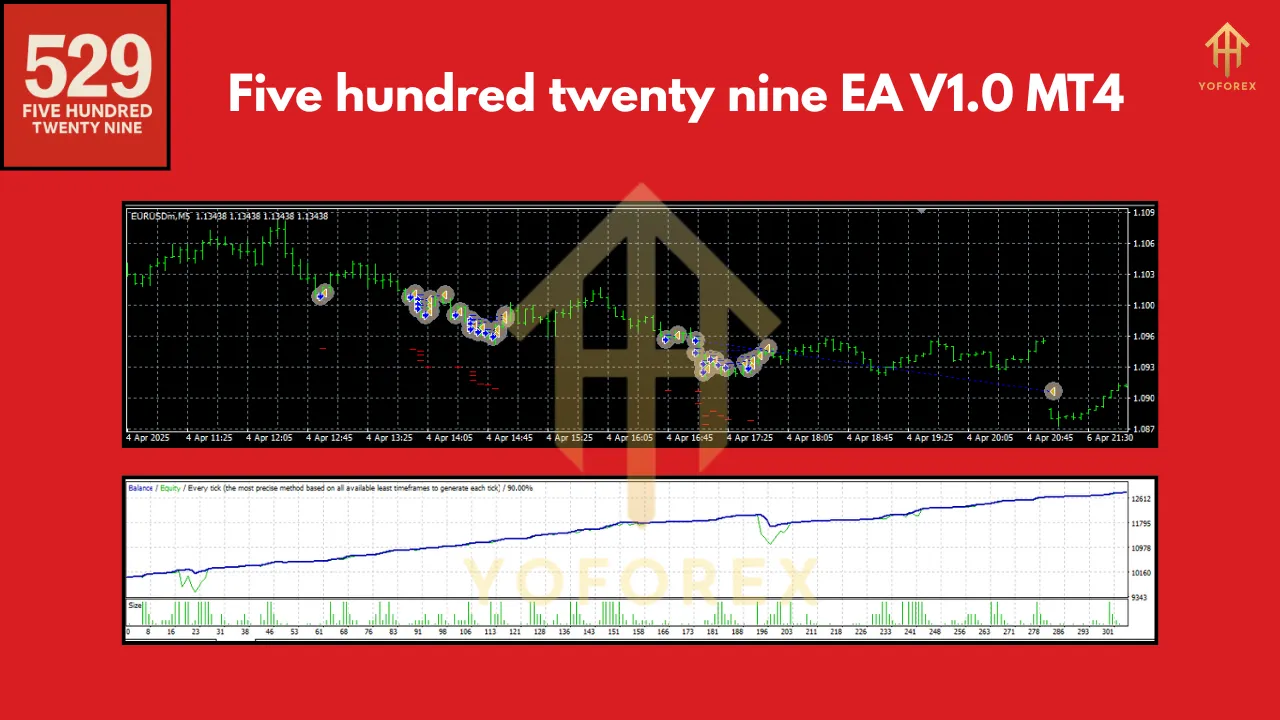
The Dual-Engine Strategy: RSI and Standard Deviation
At the heart of the Five hundred twenty nine EA lies a powerful combination of two well-respected technical indicators: the Relative Strength Index (RSI) and Standard Deviation. This isn’t a simple “RSI cross” system. Instead, it uses these tools in a layered approach to confirm entry points with a higher degree of probability.
1. The Initial Trigger: Relative Strength Index (RSI)
The RSI is a momentum oscillator that measures the speed and change of price movements. It oscillates between 0 and 100, and is traditionally used to identify overbought (typically above 70) and oversold (typically below 30) conditions. The Five hundred twenty nine EA uses the RSI as its primary signal generator.
When the RSI moves into these extreme zones, it suggests that a price reversal or pullback may be imminent. For example:
-
An oversold RSI reading indicates that the recent downward momentum is potentially exhausted, presenting a possible buying opportunity.
-
An overbought RSI reading suggests upward momentum is waning, hinting at a potential selling opportunity.
However, relying solely on RSI can be risky. A market can remain “overbought” or “oversold” for extended periods during a strong trend. This is where the EA’s second layer of analysis comes into play.
2. The Confirmation Filter: Standard Deviation Slope Analysis
This is the key feature that elevates the Five hundred twenty nine EA beyond basic systems. Standard Deviation is a statistical measure of volatility. When applied to price, it tells us how much the price is deviating from its average. A high Standard Deviation means high volatility and larger price swings; a low Standard Deviation signifies low volatility and a consolidating market.
The EA doesn’t just look at the value of the Standard Deviation; it analyzes its slope. The slope of the Standard Deviation indicator provides crucial context about the market’s underlying strength and direction.
-
How it works: The EA calculates the slope of the Standard Deviation line over a specific period. A steeply rising slope indicates a rapid increase in volatility, often confirming the strength of a new move. A flattening or declining slope can suggest that the momentum behind a move is fading.
By combining these two indicators, the EA creates a robust entry condition: A trade is only considered when an RSI signal (overbought/oversold) is confirmed by a specific, favorable condition in the Standard Deviation slope. This dual-confirmation process acts as a powerful filter, helping the EA to avoid entering trades during periods of low-conviction market noise and instead focus on moments where momentum and volatility align.
The Intelligent Grid System: Building Positions with Purpose
The term “grid trading” can be polarizing. Many traders associate it with high-risk Martingale strategies that blindly add positions at fixed intervals, hoping for a market reversal. The Five hundred twenty nine EA employs a much more refined and conditional approach.
Instead of opening new trades based on a fixed pip distance, this EA builds its grid only when the core technical conditions are met again.
Here’s how its intelligent grid functions:
-
Initial Entry: The EA opens its first trade when the RSI and Standard Deviation slope analysis align.
-
Monitoring: It then waits for the market to develop. If the trade moves into profit, it is managed towards its take-profit target. If the trade moves into a loss, the EA does not immediately open another position.
-
Conditional Additional Entries: A second (or subsequent) trade in the same direction is only opened if two crucial conditions are satisfied:
-
Technical Re-entry Signal: The RSI and Standard Deviation slope analysis must generate a new, valid signal in the same direction as the initial trade.
-
Minimum Distance: The new entry point must be a predefined minimum distance away from the last trade. This prevents the EA from “clumping” trades too close together during a slow, grinding trend and ensures there is enough price movement to justify adding to the position.
-
This approach transforms the grid from a blind gamble into a strategic method of scaling into a position at multiple, high-probability entry points. It aims to achieve an average entry price that makes the entire basket of trades profitable even with a modest market reversal.
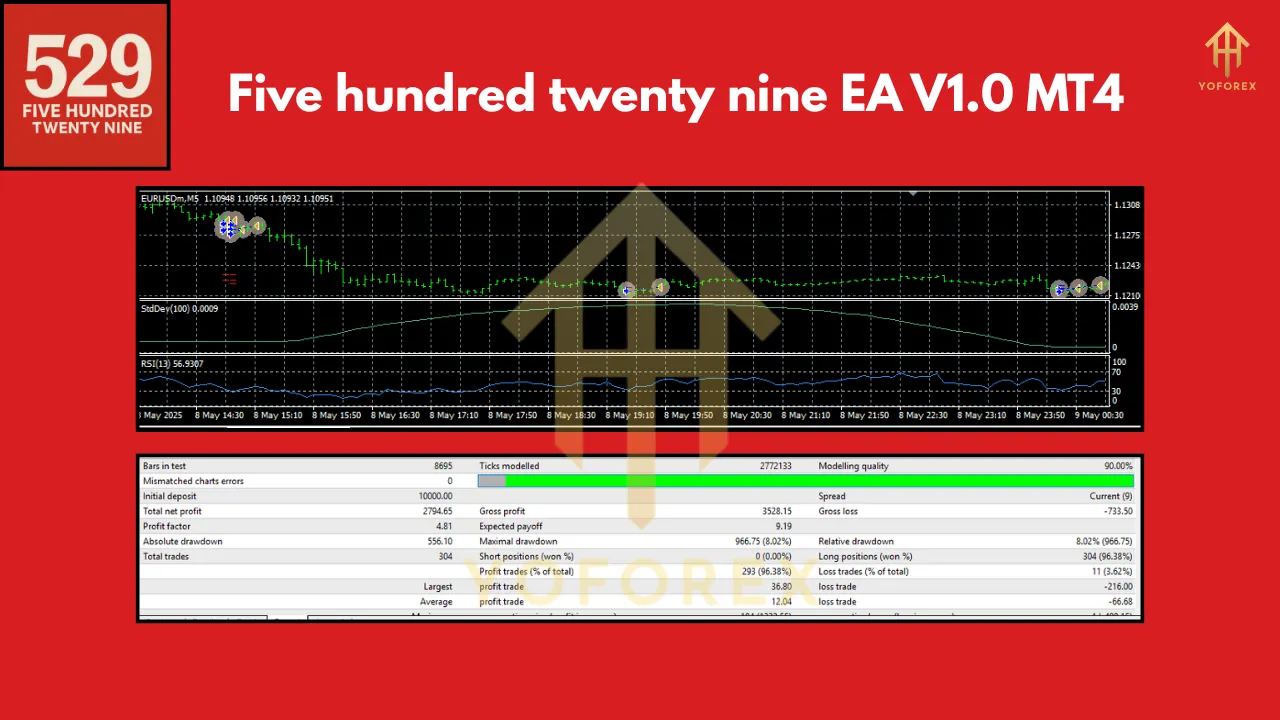
Recommended Conditions: Setting Up for Success
An EA is only as good as the environment it operates in. The developers of the Five hundred twenty nine EA provide specific recommendations to ensure its algorithm performs as designed.
-
Trading Instrument: EURUSD
The algorithm is specifically calibrated for the price behavior, volatility, and spread characteristics of the EURUSD pair. Its internal parameters are optimized for how this pair moves, especially on lower timeframes. Using it on other pairs may yield unpredictable results. -
Timeframe: M5
All calculations, from the RSI periods to the Standard Deviation slope analysis, are tuned for the five-minute chart. Changing the timeframe will fundamentally alter the indicator readings and cause the EA’s logic to fail. -
Account Type: ECN or Raw Spread
This is arguably the most critical recommendation. Grid strategies involve opening multiple trades, making them highly sensitive to transaction costs.-
ECN (Electronic Communication Network) and Raw Spread accounts offer the tightest possible spreads, often close to zero, with a fixed commission per trade.
-
Standard accounts with wide, variable spreads can cripple a grid strategy. The spread can create a significant gap between the intended entry price and the actual execution price, and the cost of crossing the spread on multiple trades can eat away at profits. Low transaction costs are essential for the profitability of this system.
-
-
Minimum Deposit: $500
Grid strategies inherently require sufficient margin to withstand drawdown. As the EA opens additional positions, the floating loss can increase before the market turns. A $500 minimum deposit provides a reasonable capital base to absorb these temporary drawdowns and prevent a margin call. Starting with less is highly discouraged, as it exposes the account to a significantly higher risk of ruin.
Risk Management and Final Thoughts
No trading system is without risk, and it’s crucial to understand the nature of the Five hundred twenty nine EA. As a grid-based system, its primary risk is a strong, prolonged, one-directional trend without significant pullbacks. While its conditional entry logic is designed to mitigate this, it cannot eliminate it entirely.
Responsible use involves:
-
Proper Lot Sizing: Start with the smallest possible lot size (e.g., 0.01) to understand the EA’s behavior on your account.
-
Backtesting: Utilize MT4’s Strategy Tester to see how the EA would have performed over historical data.
-
Demo Trading: Always run the EA on a demo account for several weeks before committing real capital. This allows you to observe its performance in live market conditions without financial risk.
Conclusion
Five hundred twenty nine EA V1.0 offers a compelling and sophisticated approach to automated trading on the EURUSD M5 chart. By moving beyond simplistic entry rules and integrating a dual-engine confirmation system of RSI and Standard Deviation slope analysis, it brings a new level of precision to the grid trading concept. It is designed for the disciplined trader who understands its mechanics and respects the importance of optimal trading conditions. When used responsibly within the recommended framework, it stands as a powerful tool for navigating the complexities of the Forex market.