

Range Average Retest Model Indicator MT5: A Comprehensive Guide
In the dynamic world of trading, technical indicators serve as crucial tools that help traders identify potential entry and exit points. Among these indicators, the Range Average Retest Model has gained attention for its unique approach to highlighting trading setups based on the retest of the average between two swing points. This article explores the concept of the Range Average Retest Model Indicator, its functionality, and how it can be effectively utilized in MetaTrader 5 (MT5), a leading trading platform.
Understanding the Range Average Retest Model
The Range Average Retest Model is a technical indicator designed to identify trading setups using the average retest entry model. This model is based on the principle of entering a position when the price retests the average made between two swing points. Swing points, which are local highs or lows in price action, play a pivotal role in this indicator’s functionality as they help define the range of price movement.
The core concept behind this model is to capture potential reversals or continuations by analyzing the price’s interaction with the average of two significant price points. By focusing on long-term volatility, this tool allows traders to refine their swing areas and strategically set take profit and stop loss levels based on their risk tolerance and trading strategy.
Key Features
The Range Average Retest Model offers several customizable parameters that traders can adjust to align with their specific trading approach:
Swing Point Detection
At the heart of this indicator is its ability to detect swing points. Swing points are local price extremes—peaks (local highs) and valleys (local lows)—that help identify potential turning points in market trends. The indicator allows users to set the period for detecting these swing points using the “Pivot Length” setting. This parameter determines how far back the indicator looks to identify significant price swings.
Entry Conditions
The Range Average Retest Model defines clear entry conditions based on the price’s interaction with the calculated average between two swing points:
- Long Position Entry: A long position is initiated when the current bar’s close is below the swing area average, and the previous bar’s close was above it. This indicates that the price has crossed down through the average level, suggesting a potential bullish trend.
- Short Position Entry: A short position is initiated when the current bar’s close is above the swing area average, and the previous bar’s close was below it. This indicates that the price has crossed up through the average level, suggesting a potential bearish trend.
These entry conditions are designed to capture the moment when the price retests and crosses the average level, which can be a strong signal for trend continuation or reversal.
Customization Parameters
The indicator provides several parameters that traders can adjust to refine their trading strategy:
- Pivot Length: Controls the period over which swing points are detected.
- Selection Mode: Determines how swing areas are selected (e.g., manual or automatic).
- Threshold: Filters swing areas based on their significance.
- Maximum Distance: Sets the maximum distance between swing points.
- Minimum Distance: Sets the minimum distance between swing points.
These parameters allow traders to tailor the indicator’s sensitivity to their specific market conditions and trading style.
Visual Markers
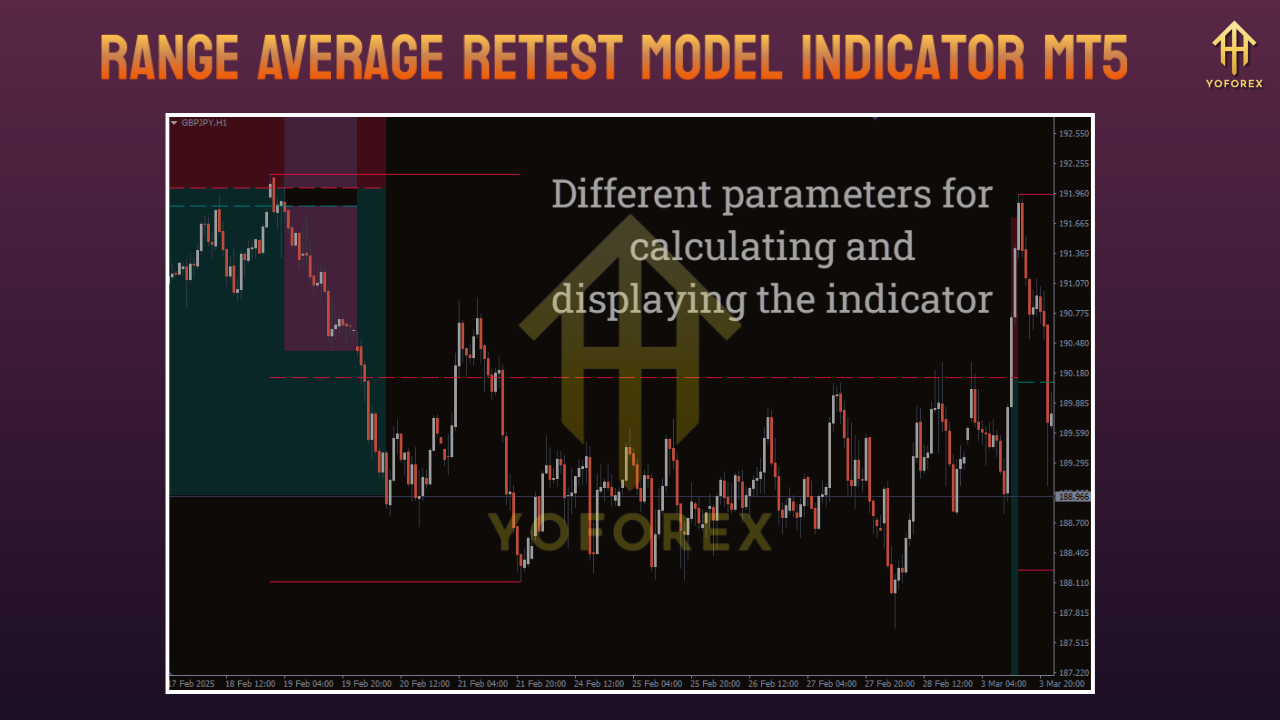
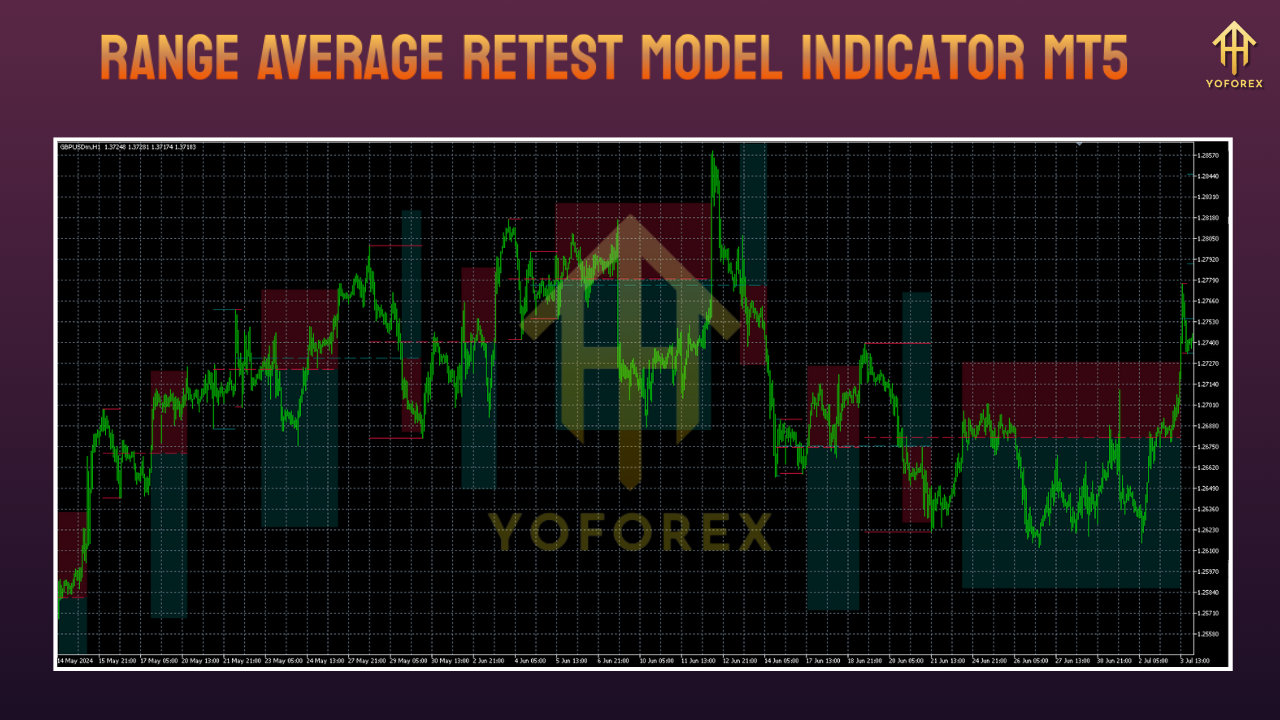
The Range Average Retest Model includes visual markers for take profit and stop loss zones, which can be customized to match individual risk management strategies. These visual aids help traders quickly identify potential exit points and manage their trades effectively.
How to Trade with the Range Average Retest Model
Identifying Swing Points
The first step in using the Range Average Retest Model is to identify swing points on the chart. Swing points are local highs or lows that mark potential turning points in price movement. The indicator uses the “Pivot Length” setting to determine the period for detecting these swing points. A shorter pivot length will detect more frequent but potentially less significant swing points, while a longer pivot length will identify fewer but more substantial swing points.
Calculating the Swing Area Average
Once two consecutive swing points are identified—one local high and one local low—the indicator calculates the average of these two price points. This average level serves as a reference point for potential entry signals.
Waiting for the Price Retest
The core strategy of the Range Average Retest Model is to wait for the price to retest this average level. A retest occurs when the price approaches and interacts with this average level after it has been established by the two swing points.
Initiating Trades Based on Entry Conditions
When the price retests the average level, the indicator checks for the specific entry conditions:
- For a long position, the current bar’s close must be below the swing area average, and the previous bar’s close must have been above it. This indicates that the price has crossed down through the average level, which can be a signal for a bullish trend.
- For a short position, the current bar’s close must be above the swing area average, and the previous bar’s close must have been below it. This indicates that the price has crossed up through the average level, which can be a signal for a bearish trend.
These conditions ensure that the trade is initiated when the price retests and crosses the average level in a specific manner, potentially indicating a strong trend.
Setting Take Profit and Stop Loss Levels
After initiating a trade, the next step is to set take profit and stop loss levels. The indicator allows traders to customize these levels based on their risk tolerance and trading strategy. By setting these levels in advance, traders can manage their trades effectively and lock in profits while limiting potential losses.
Implementing the Range Average Retest Model in MetaTrader 5
Overview of MetaTrader 5
MetaTrader 5 (MT5) is a powerful trading platform that offers a wide range of tools for technical analysis, including built-in indicators and the ability to install custom indicators. While the Range Average Retest Model is primarily associated with TradingView, its principles can be applied in MT5 using available indicators or custom scripts.
Identifying Swing Points in MT5
MT5 provides several indicators and tools that can help identify swing points:
- Swing High/Low Identifier: This custom indicator, available on MQL5, marks significant swing points directly on the chart with color-coded arrows. It is a straightforward tool for identifying local highs and lows.
- Fractals: MT5’s built-in fractal indicator marks extreme highs and lows based on a specific algorithm. While not identical to swing points, fractals can serve a similar purpose by identifying potential reversal points.
- Pivot Points: Although primarily used for determining support and resistance levels, pivot points can also help identify swing areas. The classic pivot point calculation uses the previous day’s high, low, and close to determine potential price levels of interest.
To use these tools effectively, traders can install the desired indicator from the MT5 Market or MQL5 website, add it to their chart, and adjust its parameters as needed. For example, to install the Swing High/Low Identifier:
- Open MT5 and go to the “Navigator” panel.
- Click on “Indicators” and search for “Swing High/Low Identifier.”
- Install the indicator and drag it onto your chart.
- Adjust the parameters in the “Inputs” tab if necessary.
Calculating the Average Between Swing Points
Once swing points are identified, calculating the average between two consecutive swing points can be done manually or through a custom script:
- Manual Calculation: Identify two consecutive swing points (one high and one low), note their prices, and calculate the average as (High Price + Low Price) / 2. This average price level can then be marked on the chart using a horizontal line or level.
- Custom Script: For a more automated approach, traders can create or download a custom script that automatically calculates and displays the average between identified swing points. While this may require some knowledge of MQL5 programming, it can streamline the process and make it more efficient.
Setting Up Alerts for Retest Signals
To automate the process of identifying retest signals, traders can set up alerts in MT5 for when the price crosses the average level:
- Draw a horizontal line at the calculated average price level.
- Right-click on the line and select “Alerts.”
- Set up alerts for when the price crosses this level in the desired direction (up or down).
- Choose whether to receive notifications via email, sound, or both.
Alternatively, custom indicators can be used that automatically calculate and display the average levels and send alerts when the price retests them. For instance, the “Multi Strategy Ranges Indicator MT5” available on MQL5 includes a feature for range breakout and retest, which may be useful for this purpose.
Practical Example of Using the Range Average Retest Model in MT5
Step-by-Step Guide
Let’s walk through a hypothetical example of using the Range Average Retest Model in MT5 on a daily chart of the EUR/USD currency pair:
-
Identify Swing Points:
- First, use the Swing High/Low Identifier to identify swing points on the chart.
- For instance, suppose the first swing high is at 1.2500 on Day 1, and the first swing low is at 1.2000 on Day 5.
-
Calculate the Average:
- Calculate the average of these two swing points: (1.2500 + 1.2000) / 2 = 1.2250.
- Draw a horizontal line at 1.2250 on the chart.
-
Look for Retest:
- Monitor the price action to see if it retests this average level.
- Suppose on Day 10, the price approaches 1.2250.
- Check the entry conditions:
- For a long position, the current bar’s close must be below 1.2250, and the previous bar’s close must have been above 1.2250.
- For a short position, the current bar’s close must be above 1.2250, and the previous bar’s close must have been below 1.2250.
-
Execute the Trade:
- If the conditions for a long position are met (current close below 1.2250, previous close above 1.2250), initiate a long position.
- Set take profit and stop loss levels based on your strategy. For example:
- Take Profit at 1.2750 (1.2250 + 0.0500).
- Stop Loss at 1.2000 (the swing low).
-
Manage the Trade:
- Monitor the trade and manage it according to your risk management plan.
- Close the trade when the take profit level is reached or adjust stop loss levels as the trade progresses, depending on your strategy.
This example illustrates how the Range Average Retest Model can be applied in MT5 to identify potential trading opportunities. By following these steps, traders can integrate this strategy into their trading routine and potentially improve their decision-making process.
Customization and Parameter Optimization
Adjusting Parameters for Different Market Conditions
One of the strengths of the Range Average Retest Model is its flexibility, allowing traders to adjust parameters to suit different market conditions:
- Pivot Length: In the Swing High/Low Identifier or similar tools, the pivot length determines how far back the indicator looks for swing points. A longer pivot length will identify fewer but more significant swing points, which may be suitable for longer-term trades. A shorter pivot length will detect more frequent swing points, which may be better for shorter-term trading.
- Threshold: This parameter filters swing areas based on their significance. A higher threshold will select only the most significant swing areas, reducing the number of signals but potentially increasing their quality. A lower threshold will include more swing areas, generating more signals but possibly with lower quality.
- Maximum and Minimum Distance: These parameters control the distance between swing points. Adjusting them can help filter out swing points that are too close or too far apart, depending on the trader’s preference.
Traders should experiment with these parameters to find the optimal settings for their specific trading style and market conditions. It’s often helpful to use historical data to backtest different parameter combinations and see which ones perform best.
Balancing Signal Frequency and Quality
A key consideration when customizing the Range Average Retest Model is balancing the frequency and quality of signals:
- High Signal Frequency: With looser parameter settings, the indicator may generate more frequent signals. While this increases trading opportunities, it may also lead to more false signals, especially in choppy or ranging markets.
- High Signal Quality: With stricter parameter settings, the indicator may generate fewer signals, but those signals may be of higher quality, with a better win rate. This can be particularly useful in trending markets where the price is more likely to retest and respect the average level.
Finding the right balance depends on the trader’s objectives and risk tolerance. Some traders may prefer more frequent signals to capitalize on multiple opportunities, while others may prioritize signal quality to minimize losses from false signals.
Risk Management and Trade Execution
Setting Appropriate Take Profit and Stop Loss Levels
Effective risk management is crucial when using the Range Average Retest Model. Traders should set take profit and stop loss levels based on their trading strategy and risk tolerance:
-
Take Profit Level: This should be set at a level that reflects the expected profit from the trade. It can be based on the distance from the entry point, support/resistance levels, or other technical indicators.
-
Stop Loss Level: This should be set to limit potential losses if the trade moves against the expected direction. The stop loss level can be based on the swing point used in the calculation or other significant price levels.
By setting these levels in advance, traders can manage their trades effectively and adhere to their risk management plan.
Using the Range Average Retest Model in Conjunction with Other Indicators
While the Range Average Retest Model can be a powerful tool on its own, it’s often beneficial to use it in conjunction with other indicators to confirm signals and improve accuracy:
- Moving Averages: These can help identify the overall trend direction. For example, if the price is above a long-term moving average, it may indicate an uptrend, which could be considered for long positions.
- Oscillators: Indicators like the Relative Strength Index (RSI) or Stochastic Oscillator can help identify overbought or oversold conditions, which may influence the likelihood of a successful retest.
- Volume Indicators: These can provide insights into the strength of price movements. Higher volume at the retest level may indicate stronger support or resistance.
By combining the Range Average Retest Model with other indicators, traders can develop a more comprehensive trading strategy that accounts for multiple aspects of market behavior.
Common Pitfalls and How to Avoid Them
Overreliance on the Indicator
One common mistake is overreliance on the Range Average Retest Model without considering other factors. While the indicator can provide valuable signals, it’s important to use it as part of a broader trading strategy that includes fundamental analysis, risk management, and other technical indicators.
False Signals in Choppy Markets
In choppy or ranging markets, the price may retest the average level multiple times without establishing a clear trend. This can lead to false signals and unprofitable trades. To mitigate this, traders can:
- Adjust the indicator’s parameters to filter out weaker signals.
- Look for confirmation from other indicators before entering trades.
- Use a stricter entry criteria, such as waiting for the price to close beyond the average level rather than just touching it.
Lack of Risk Management
Another common pitfall is inadequate risk management. Without proper risk management, even a well-performing strategy can lead to significant losses. To avoid this:
- Set stop loss levels to limit potential losses.
- Use position sizing to ensure that no single trade represents an excessive risk to the trading account.
- Adhere to a consistent risk management plan across all trades.
By being aware of these potential issues and taking steps to address them, traders can improve their chances of success when using the Range Average Retest Model.
Advanced Strategies and Enhancements
Combining with Trend Filters
To enhance the performance of the Range Average Retest Model, traders can combine it with trend filters that help determine the overall market direction:
- Simple Moving Average (SMA): Check if the price is above or below a long-term SMA (e.g., 200-period SMA) to identify the primary trend.
- Moving Average Convergence Divergence (MACD): Use the MACD histogram to confirm the presence of a trend.
- Bollinger Bands: Look at the position of the price relative to the upper and lower Bollinger Bands to identify potential breakouts or reversals.
By filtering trades based on the overall trend, traders can potentially reduce false signals and improve the accuracy of their trading decisions.
Using the Model for Different Timeframes
The Range Average Retest Model can be applied to different timeframes, from scalping on lower timeframes to swing trading on higher timeframes. Each timeframe may require different parameter settings and risk management strategies:
- Lower Timeframes (e.g., M1, M5): These are suitable for scalping or day trading. However, they may generate more frequent but potentially less reliable signals due to market noise.
- Higher Timeframes (e.g., H1, D1): These are better for swing trading or position trading. They may generate fewer signals, but those signals may be more reliable due to reduced market noise.
Traders should experiment with different timeframes and adjust their strategy accordingly to find the best fit for their trading style and objectives.
Implementing the Model in Automated Systems
For traders who prefer automated trading, the Range Average Retest Model can be implemented in expert advisors (EAs) in MT5. While this requires some knowledge of MQL5 programming, it can streamline the trading process and reduce the need for constant monitoring.
Several services, such as Freelance on MQL5, offer the option to order custom EAs based on specific strategies. Traders can describe their requirements, including the use of the Range Average Retest Model, and hire developers to create the desired EA.
Conclusion
The Range Average Retest Model Indicator is a valuable tool for traders seeking to identify optimal entry points based on the retest of the average between two swing points. While it was originally designed for TradingView, its principles can be effectively applied in MetaTrader 5 using available indicators or custom scripts.
By understanding how to identify swing points, calculate their average, and set up alerts for retest signals, traders can enhance their trading strategy and potentially improve their performance in the financial markets. However, it’s important to use the indicator in conjunction with other tools and risk management techniques to achieve the best results.
As with any trading strategy, consistent practice, continuous learning, and adaptation to changing market conditions are key to long-term success. With the right approach and discipline, the Range Average Retest Model can become a powerful addition to a trader’s toolkit.
Support & Disclaimer
Got questions or need help? Reach out anytime:
- WhatsApp: https://wa.me/+443300272265
- Telegram: https://t.me/yoforexrobot
Disclaimer: Past performance is no guarantee of future results. All trading carries risk. Always demo-test the Range Average Retest Model Indicator MT5 in a risk-free environment before deploying on a live account.