

In the realm of automated trading, mastering signal reliability is often the difference between consistent returns and persistent drawdowns. SignalFXPro Consensus EA v3.4 is a MetaTrader 4 expert advisor built around that principle: consensus. Rather than relying on a single indicator or strategy, this EA waits for a strong alignment across multiple signals before entering trades. The idea is to filter noise, reduce random losing trades, and focus only on statistically favorable setups.
In this post, we’ll explore how SignalFXPro Consensus works, what features it offers, potential advantages and risks, and how best to deploy it in live trading. By the end, you’ll have a clear picture of whether it’s a fit for your portfolio.
What Is SignalFXPro Consensus EA v3.4?
SignalFXPro Consensus EA is a commercial trading robot available on MQL5 Market for MetaTrader 4.
Key details from its official listing:
-
Version: 3.4
-
Activations: Up to 20 allowed licenses
-
Price: USD 750 (as of listing)
-
Primary Selling Pitch: Multi‑symbol, multi‑timeframe, and “no‑loss close” logic.
-
Consensus Engine: Uses 7 indicators (EMA, MACD, RSI, Stochastic, Bollinger Bands, ADX, Ichimoku) to require agreement among them before triggering entries.
-
Multi‑symbol scanning: Capable of scanning all pairs in MarketWatch without needing to attach to each chart.
-
Multi‑timeframe settings: Each timeframe can have independent Stop Loss, Take Profit, and trailing stop parameters.
-
No‑Loss Close: Opposite trades in the same symbol are closed only at breakeven or profit, not at loss.
-
Smart Trailing Stop: Custom trailing and step logic per timeframe to lock in gains.
-
Money Management: Offers either fixed lot or automatic lot sizing by risk percent.
-
Plug & Play: Claims to have optimized defaults so users don’t need deep indicator tuning. Because it uses multiple indicators and consensus logic, the EA’s entry signals may be less frequent but potentially more robust.
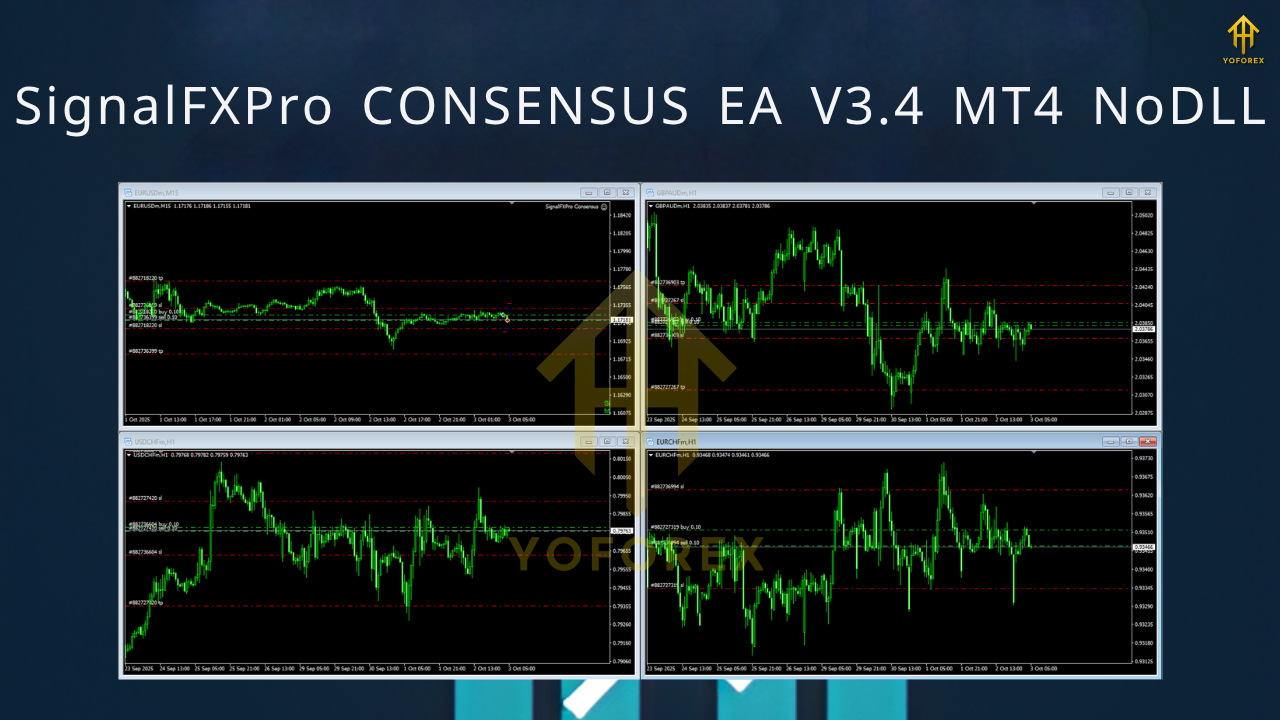
SignalFXPro CONSENSUS EA V3.4 MT4
How SignalFXPro Consensus Operates?
Consensus Strategy
The core differentiator is its consensus engine. The EA will only initiate a new trade when a majority (or all) of the configured indicators align in the same direction (buy or sell). This acts as a filter to reduce weak or conflicting signals.
For example:
-
EMA indicating trend direction
-
MACD showing momentum
-
RSI indicating strength or overbought/oversold
-
Stochastic confirming continuation
-
Bollinger Bands showing volatility breakout
-
ADX ensuring trend strength
-
Ichimoku offering overall trend context
Only when these signals agree does the EA place a trade. This helps avoid chasing weak or whipsaw setups.
Multi‑Symbol & Multi‑Timeframe Execution
You don’t need to attach the EA to multiple charts. Once installed, SignalFXPro Consensus can scan all pairs in your MarketWatch list, applying its logic across them. This makes it more efficient for traders who want to run one EA but trade multiple pairs.
Each timeframe (for example, M15, H1, H4) can have distinct settings for SL, TP, and trailing stops, giving fine control over how the EA behaves in different timeframes.
Entry & Order Handling
When consensus is reached, the EA places an order according to its risk settings. It can use either:
-
Fixed lot size, or
-
Automatic lot sizing based on a percentage of risk
It also supports a “no‑loss close” approach: if an opposite signal triggers for a symbol where a trade is already open, the EA will only close the existing trade if it is at breakeven or in profit—not at a loss. This prevents forced losses from conflicting signals.
Trailing Stop & Smart Exit
Once a trade is active, the EA uses a smart trailing stop algorithm. It moves the stop according to configured rules per timeframe and “step” logic so that as price moves favorably, it locks in gains while leaving room for further movement.
This is combined with the consensus logic so that the trade is only closed when conditions reverse or trailing stop is hit, reducing premature exits.
Strengths & Advantages
Using a consensus-based expert advisor like SignalFXPro Consensus offers several benefits:
-
Better signal filtering
By requiring several indicators to agree, the EA reduces the chance of entering weak or random trades. -
Multi‑symbol efficiency
You can monitor and trade many instruments from one EA instance, simplifying setup and management. -
Risk control built-in
The “no-loss close” logic, trailing stops, and risk‑based lot sizing all contribute to better capital preservation. -
Flexible settings per timeframe
You can fine-tune behavior depending on timeframe characteristics without using multiple copies. -
Plug & play defaults
Beginners may find the default settings usable without heavy tuning, making it more user-friendly.
Risks & Limitations to Consider
While the design is compelling, there are some inherent risks and possible drawbacks:
-
Lower trade frequency
Because the EA waits for strong consensus, it may miss some opportunities or produce fewer trades than aggressive systems. -
Lag in reversal detection
By requiring multiple indicators to flip, the EA may enter a little late during trend changes. -
Complex configuration
Multi-indicator consensus, multi-timeframe settings, and multi-symbol scanning add complexity. Misconfiguration can degrade performance. -
Broker and execution sensitivity
Real-world issues like spread, slippage, execution delay, and spread widening can worsen performance. -
Risk of overfitting
If defaults are optimized over historical data only, the system might not generalize well to unseen market conditions. -
License limit
Activations are limited to 20, so you must plan which accounts to use.
Best Practices & Deployment Tips
If you decide to try SignalFXPro Consensus EA, follow these steps to improve your success chances:
Backtest & Forward Test
-
Run backtests across multiple pairs and timeframes (in-sample/out-of-sample).
-
Use forward demo testing to verify behavior in live conditions before deploying real capital.
Start Conservatively
-
Use lower lot sizes initially.
-
Choose pairs with reasonable spreads and liquidity.
-
Limit concurrent trades and risk per trade.
Monitor Execution Conditions
-
Use a VPS or stable hosting to minimize latency.
-
Ensure your broker supports low slippage and reliable order execution.
-
Avoid trading during high-spread or news event windows.
Adjust settings over time
-
Revisit consensus indicator thresholds periodically.
-
Tune trailing stop steps and sensitivity.
-
Use timeframe-specific tweaks depending on pair volatility.
Use Risk Safeguards
-
Set a daily drawdown limit to halt trading if losses exceed threshold.
-
Use a maximum number of open trades per symbol to avoid overexposure.
-
Consider disabling trading at volatile market hours or news events.
Example Workflow
Here’s a hypothetical example of how the EA might operate:
-
MarketWatch includes EURUSD, GBPUSD, USDJPY.
-
On M15 and H1 timeframes, the EA sees alignment: EMA up, MACD bullish, ADX trending, RSI not overbought, etc.
-
Consensus triggers; EURUSD long order is placed with configured lot and stop loss.
-
Price moves up; trailing stop activates and locks in portion of profits.
-
Later, a reversal consensus emerges for a short. The EA checks whether the long trade is at breakeven or profit. If yes, closes it; if not, holds it.
-
The EA may open a short position if consensus is strong in that direction.
Because of the consensus logic, the EA reduces the chance of conflicting entries and may produce stable returns over time.
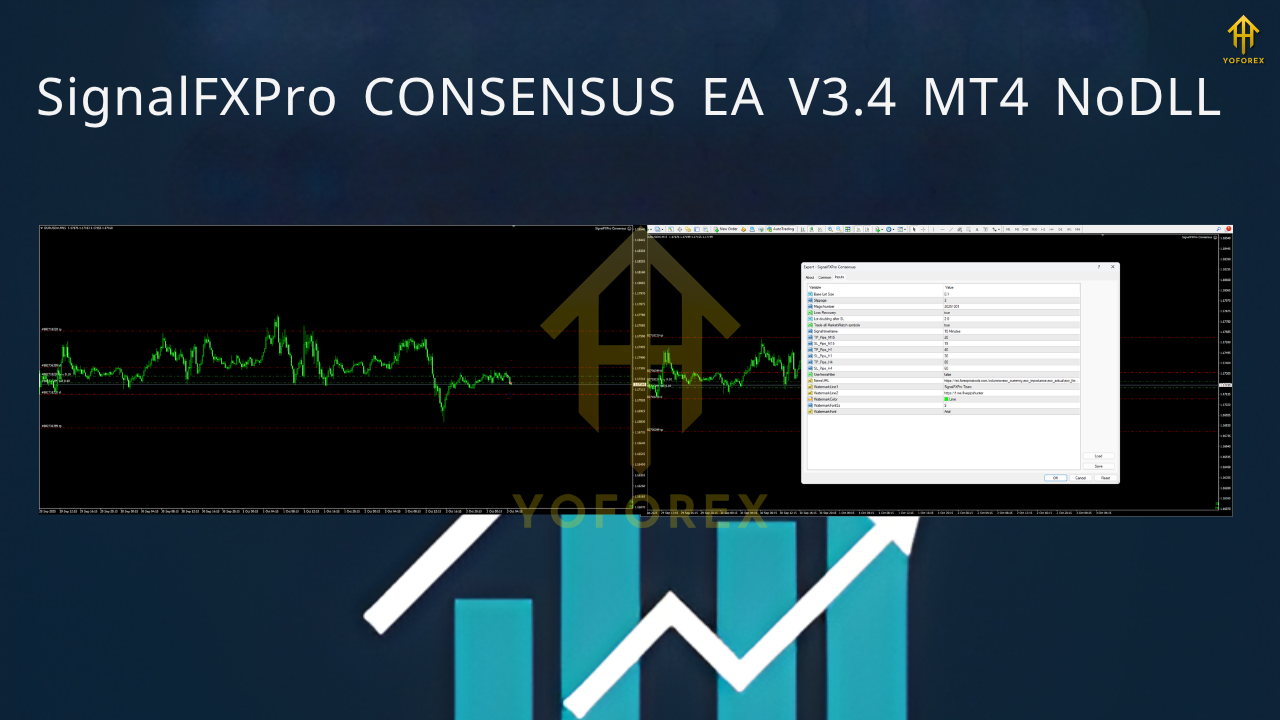
Final Thoughts & Recommendation
SignalFXPro Consensus EA v3.4 is a sophisticated expert advisor that seeks to trade only strong, high‑certainty signals by requiring multiple indicators to agree. Its multi‑symbol, multi‑timeframe capabilities, plus the “no-loss close” logic and trailing stops, make it a compelling option for traders who value precision over volume.
But it is not a silver bullet. The consensus approach may lead to fewer trades, but ideally, more reliable ones.