
Elliott Wave Indicators for MT4: A Practical 1000-Word Guide
If you’ve traded forex for a while, you’ve probably heard about Elliott Wave—Ralph Nelson Elliott’s idea that markets move in repeating cycles of crowd psychology. On MetaTrader 4 (MT4), traders try to translate that theory into practice using a combination of indicators, drawing tools, and a disciplined workflow. This guide breaks down how Elliott Wave analysis works on MT4, which indicators actually help, how to combine them with price action and risk management, and a step-by-step routine you can start using today.
What Elliott Wave Is (and Isn’t)
At its core, Elliott Wave describes markets as fractal structures built from two building blocks:
-
Impulses (motive waves): 5-wave moves in the direction of the larger trend (labeled 1–2–3–4–5).
-
Corrections: 3-wave counter-trend patterns (labeled A–B–C), which can unfold as zigzags, flats, or triangles.
Three essential rules keep your counts honest:
-
Wave 2 never retraces beyond the start of Wave 1.
-
Wave 3 is never the shortest among Waves 1, 3, and 5 (and is often the longest).
-
Wave 4 does not overlap the price territory of Wave 1 in an impulse (most instruments; some exceptions in complex structures).
What Elliott Wave isn’t: a crystal ball. Counting waves is interpretive. The goal is not perfection but a consistent framework for mapping trend, timing entries in impulsive legs, and managing risk when structures invalidate.
What MT4 Can (and Can’t) Do for Elliott Wave
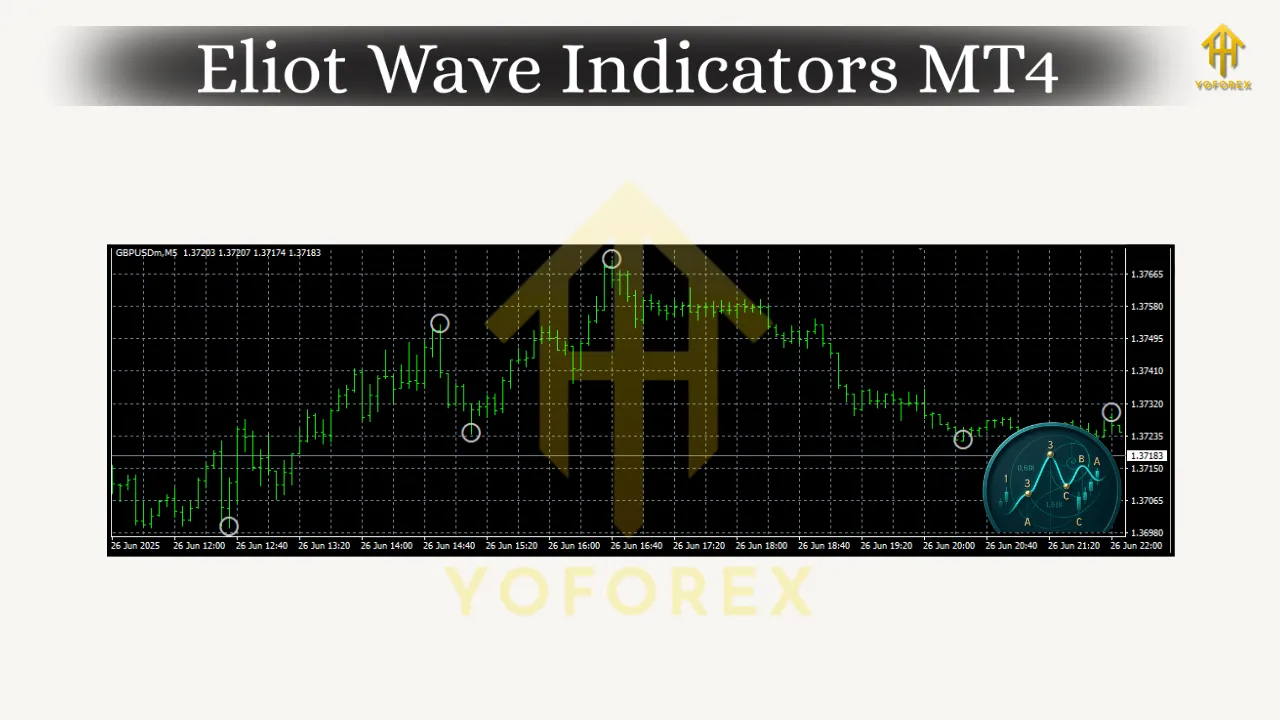
MT4 doesn’t ship with a full automatic wave counter, but it provides everything you need to build a robust Elliott process:
-
Drawing tools: Trendlines, channels, and the Fibonacci toolset are your day-to-day workhorses.
-
Core indicators: ZigZag, Fractals, RSI/MACD, Moving Averages, and custom Elliott add-ons (if you use any) to support your labeling.
-
Profiles & templates: Save your Elliott layout and recreate it on any symbol or timeframe.
The trick is to combine semi-automatic structure hints (like ZigZag) with manual validation (your rules, channels, and fib projections).
Must-Have Indicators and Tools for Elliott Wave on MT4
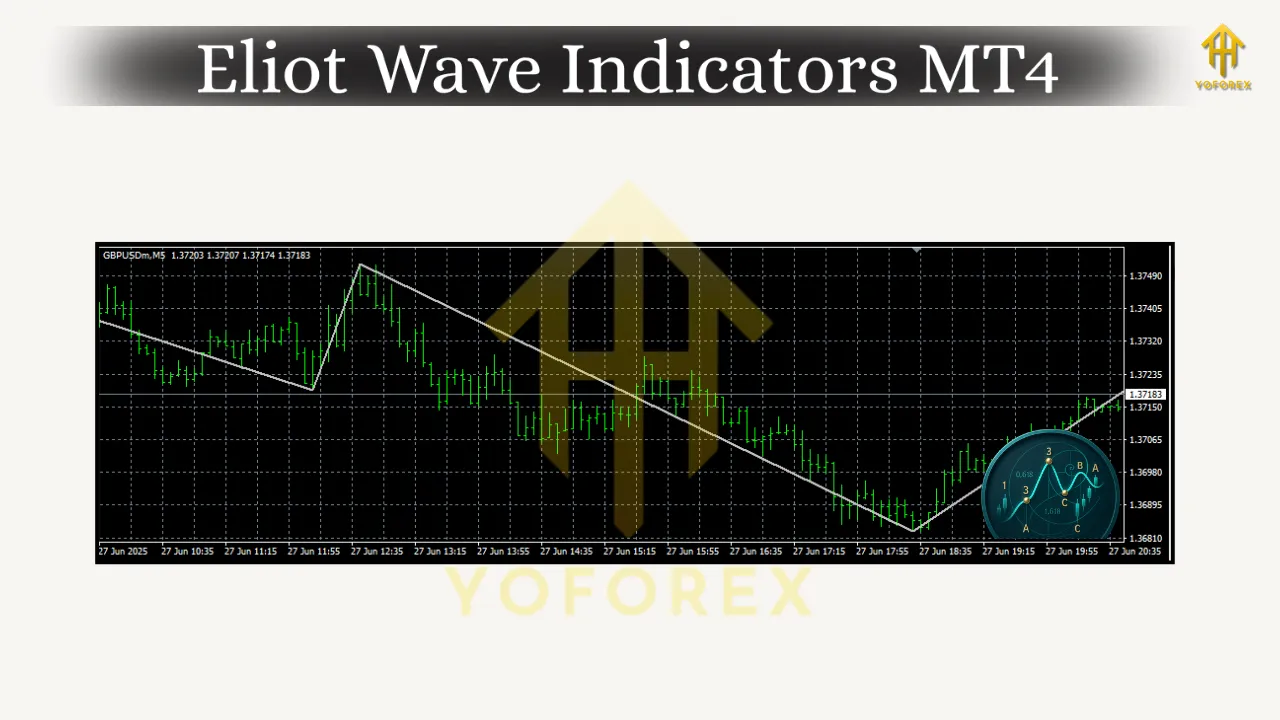
1) ZigZag (Structure Skeleton)
-
Why it helps: Filters out small swings and highlights major peaks/troughs so you can visualize the 5-3 rhythm.
-
How to use: Start with default or slightly higher depth/deviation to avoid noisy over-labeling. Use the ZigZag as a guide, not the final count.
2) Fibonacci Retracement & Extension (Wave Proportions)
-
Retracements: Common zones—Wave 2 often retraces 50–61.8% of Wave 1; Wave 4 typically 23.6–38.2% of Wave 3.
-
Extensions/Projections: Wave 3 often reaches 161.8% of Wave 1; Wave 5 can project 61.8–100% of Wave 1 measured from Wave 4.
-
Tip: Anchor fibs to the ends of confirmed swings only after a candle closes beyond a key level to reduce premature counts.
3) Fractals (Swing Confirmation)
-
Why it helps: Marks micro swing highs/lows; use them to refine the ends of waves for more accurate channels and fib anchors.
4) Momentum Confirmers (RSI or MACD)
-
Wave 3 signature: Strong momentum expansion; RSI often holds above 50 in uptrends (below 50 in downtrends).
-
Wave 5 divergence: Price makes a new high/low with weaker momentum—classic ending signal for many impulses.
5) Channels (Wave Geometry)
-
Impulse channeling: Connect Wave 2 and 4 lows (in uptrends) and copy the parallel through Wave 1 high to target Wave 5. Channel breaks help confirm trend shifts into corrections.
6) Optional: Custom Elliott Labeling Tools
-
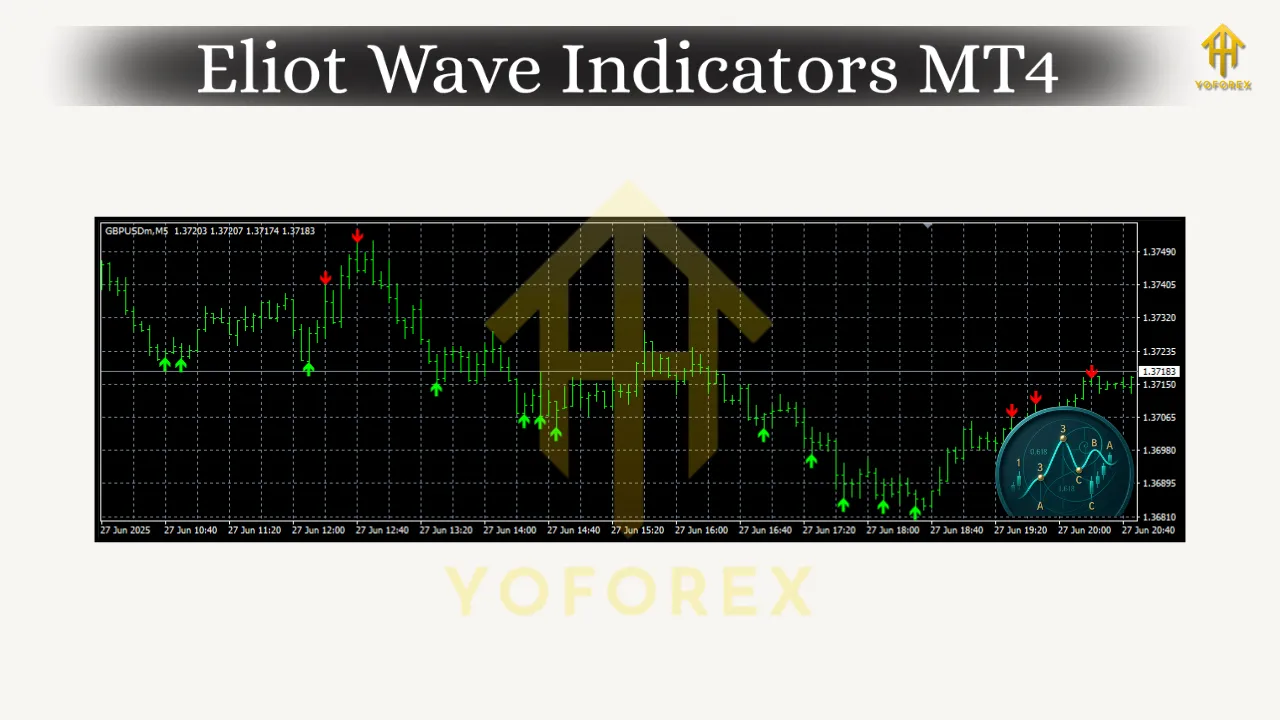
If you use a third-party indicator that auto-labels waves, treat it as a suggestion engine. Always apply the three core rules and fib/momentum checks before trusting any label.
A Simple MT4 Elliott Wave Workflow
-
Top-down scan
-
Start from higher timeframes (D1/H4) to locate the primary trend and the broad wave phase (impulse vs correction).
-
Mark key swing highs/lows with ZigZag and Fractals; draw your main channel.
-
-
Propose a count
-
Sketch a provisional 1–2–3–4–5 or A–B–C using Elliott rules.
-
Add fib retracement/extension levels to check proportion and symmetry.
-
-
Momentum check
-
Confirm Wave 3’s momentum expansion (RSI/MACD).
-
Look for divergence into Wave 5; lack of divergence doesn’t invalidate, but presence strengthens reversal expectations.
-
-
Trade the impulsive legs
-
Entries: After a shallow Wave 2 pullback (50–61.8%) with strong Wave 3 break, or after Wave 4 pullback (23.6–38.2%) toward a potential Wave 5.
-
Stops: Beyond the invalidation level (e.g., below Wave 1 start if you’re in Wave 3 long).
-
Targets: Fib extensions (161.8% for Wave 3; measured move or channel top for Wave 5).
-
-
Manage corrections
-
Treat A–B–C as recovery periods. Consider counter-trend trades only if your plan allows and the structure is clean (e.g., sharp zigzag with strong confluence). Otherwise, wait for the next impulse in the main trend.
-
-
Invalidate quickly
-
If a rule breaks (like Wave 4 overlapping Wave 1 in a standard impulse), exit or stand aside. Recount objectively.
-
Example Playbook (XAUUSD, H1—conceptual)
-
Identify a clean 1–2 leg where price retraces ~61.8% for Wave 2 and prints bullish momentum.
-
Enter on the break of Wave 1 high with stops below Wave 2 low.
-
Scale out near 1.618 extension of Wave 1 (potential Wave 3 end), then re-enter on a 23.6–38.2% Wave 4 pullback if momentum stays constructive.
-
Watch for RSI divergence as price approaches a channel top for Wave 5; trail stops under minor swing lows.
Risk Management for Wave Traders
-
Position sizing: Risk a small, fixed percent per trade (e.g., 0.5–1%). Wave counts fail; capital preservation keeps you in the game.
-
Instruments & timeframes: Choose pairs with cleaner swings (majors, gold, indices) and timeframes you can monitor. Lower TFs create more false counts.
-
News filter: Sudden macro events can distort wave rhythm. Avoid initiating new positions minutes before high-impact news.
-
Maximum exposure: If you’re stacking entries across Wave 3 and Wave 5, cap aggregate risk so a single invalidation doesn’t cascade into outsized losses.
Common Mistakes (and Fixes)
-
Forcing the count: If you need a dozen alternates to justify a trade, the structure probably isn’t ready. Fix: Wait for clarity or a channel break.
-
Ignoring proportion: Waves should “look right.” If Wave 2 retraces 5% and Wave 4 retraces 70% on the same degree, your degree selection may be off. Fix: Re-scale the count or step up a timeframe.
-
Trading every squiggle: Elliott is about context. Fix: Only trade when impulse versus correction is clear and confirmed by momentum and fib confluence.
-
No invalidation plan: Counts change; your stop shouldn’t. Fix: Hard-code invalidation levels; don’t widen stops to “save” a narrative.
Backtesting and Forward Testing on MT4
-
Backtest visually: Scroll left, hide future candles, and label swings as if live. Track win rate and R-multiple, not just pips.
-
Template discipline: Create a saved Elliott template (ZigZag + Fractals + RSI + fib levels + channel line style) to ensure consistency.
-
Journal entries: Capture screenshots of the chart at entry and exit. Note your proposed count and the invalidation logic. Over time, you’ll learn which setups truly repeat.
Final Thoughts
Elliott Wave on MT4 isn’t about predicting the future; it’s about organizing uncertainty. With a humble ZigZag to sketch structure, fibs to measure proportion, channels to frame geometry, and momentum to confirm thrust, you can turn a complex theory into a practical trading plan. Keep counts simple, respect invalidation rules, and let risk management do its quiet compounding over time. Consistency—not perfect labels—is what builds your equity curve.