

Introduction
In the modern forex market, more and more traders are shifting from emotional, fast-click manual trading to disciplined, rule-based systems that can run automatically. Instead of staring at charts all day, traders want an EA that can scan the market 24/5, respect strict risk rules, and execute trades according to a clearly defined plan. Sapphire Trading System EA was created for exactly this purpose – to bring structure, automation, and logic into your MetaTrader4 terminal so that your trades are executed according to a tested strategy instead of impulse.
This in-depth guide will walk you through what the system is, how the strategy works, which pairs and timeframes are recommended, and what kind of risk and money management you should consider. You will also get ideas for backtasting, live trading preparation, and practical tips on how to integrate the robot into your overall trading plan without expecting unrealistic “get rich quick” results. Treat this EA as a professional tool, and you can use it to build amore consistent trading routine.
What Is Sapphire Trading System EA V2.5 MT4?
At its core, Sapphire Trading System EA V2.5 is an automated Expert Advisor designed for the MetaTrader4 platform. It combines breakout logic, trend-following filters, and volatility conditions to identify moments where price is likely to move away from consolidation zones and start a directional swing. The EA then manages open trades using predefined stop loss, take profit, and optional trailing functions so that the whole process from entry to exit is handled in a mechanical way.
Version 2.5 introduces more refined logic compared to early releases. The algorithm is built to react only when the market shows a meaningful setup: price escaping a range, volatility expanding, and a clear directional bias being visible on the chart. The goal is not to open hundreds of trades in random conditions, but to wait for higher probability setups and then manage them with a consistent risk framework. This helps traders who struggle with overtrading, revenge trading, or fear-of-missing-out type decisions.
The system is particularly attractive to users who understand the idea of letting a technical edge play out over along series of trades. Instead of relying on gut feeling or social media noise, the strategy follows a fixed ruleset. That does not mean every trade will win, but it does mean that the execution is stable and repeatable over time.
Why Traders Are Interested in Sapphire Trading System EA
One of the biggest reasons traders look at Sapphire Trading System EA is its balance between simplicity and depth. On the chart, you can clearly see how the system interprets recent highs and lows, where it places stop orders or market entries, and how it manages exits. The logic is based on widely understood concepts such as breakouts, volatility filters, and trend direction, rather than mysterious “black box” indicators that nobody can explain.
Another attractive point is the focus on risk control. Many cheap EAs rely on dangerous martingale or grid approaches that keep adding positions without stop loss until either the market comes back or the account blows up. This system approaches things differently. It uses fixed stops, allows traders to choose a risk percentage per trade, and limits the number of simultaneous positions. That makes it easier to plan for worst-case drawdowns and to integrate the robot into a diversified portfolio.
Finally, the flexibility of the system matters. You can use it only on one or two of your favorite pairs, or you can build a portfolio where Sapphire Trading System EA runs on multiple symbols with small risk on each. Traders who think in terms of long-term equity curve growth rather than quick jackpots often appreciate this kind of structure.
Core Strategy Logic Behind the Sapphire Trading System EA
The strategy used by Sapphire Trading System EA can be described as a combination of breakout and trend-following techniques with a volatility confirmation layer on top. Instead of chasing every random spike, the system looks for conditions where price has been trading in a defined range or forming clear support and resistance zones. When volatility and direction suggest that a breakout is more likely to succeed, the robot prepares and executes a trade.
In practice, the algorithm first scans recent candles to define short-term market structure: swing highs, swing lows, and consolidation boundaries. Then, the robot measures volatility using internal indicators. When volatility starts expanding in the direction of a potential breakout, Sapphire Trading System EA checks whether the higher timeframe or main trend filter is aligned with that move. Only if the direction and volatility conditions agree will the system consider opening a
position.
Once a trade is open, the robot applies pre-configured stop loss and take profit targets. Depending on your settings, it can also move the stop to breakeven after a certain number of pips in profit, use a trailing stop to lock in gains, or close partial positions. All of this is controlled by inputs, giving you flexibility while keeping the
underlying logic steady and rule-based.
Supported Pairs, Timeframes & Market Conditions for Sapphire Trading System EA
While the logic of Sapphire Trading System EA can technically be used on many instruments, most traders prefer to focus on major and high-liquidity pairs. Popular choices include EURUSD, GBPUSD, USDJPY, AUDUSD, and sometimes USDCAD. These instruments usually offer lower spreads, tighter execution, and smoother trends, which are ideal for a breakout and trend-oriented robot.
The recommended timeframes are generally in the intraday and short swing range: M15, M30, and H1. On very low timeframes like M1 or M5, the market noise can be high and spreads can eat into performance. On very high timeframes like H4 or D1, you may receive strong signals but very few trades. By focusing on M15–H1, traders often find a balance between signal quality and frequency.
Market condition matters as well. The strategy tends to perform better when there are clear periods of expansion and directional moves. In completely sideways environments with tiny ranges, any breakout system will naturally suffer more false signals. This is why it is important to backtest across different years, including trending, ranging, and mixed phases, to fully understand how the Sapphire Trading System EA behaves.
Broker, VPS & Execution Requirements
Because the robot often operates around breakouts and sharp price movements, the execution environment can have a direct impact on real results. When using Sapphire Trading System EA, it is highly recommended to choose a reputable broker with tight spreads, fast order execution, and transparent commission structures. ECN or raw spread accounts are usually better than standard accounts with built-in markups.
Running the EA on a VPS is also a practical choice. A stable VPS with low latency to the broker’s server ensures that orders are sent quickly and that the platform remains online 24/5, even when your personal computer is off. Slippage cannot be removed completely in live trading, but a good technical setup can reduce it and make your backtest assumptions closer to real-world behavior.
Make sure auto-trading is enabled in MetaTrader4, that no conflicting EAs are running on the same account, and that your internet connection is reliable. Even the best strategy cannot compensate for poor technical conditions if your platform keeps disconnecting or freezing at key moments.
Risk Management Philosophy
The way Sapphire Trading System EA approaches risk is one of its key strengths. Instead of adding infinite positions against the trend, the robot is built around fixed stop losses and controlled exposure. You can configure the system to risk a fixed lot size or a percentage of your account balance per trade, which makes it easier to adapt the EA to different account sizes.
Conservative traders might choose to risk only 0.5–1% of the account per signal, while more aggressive users might go up to 2–3%. Regardless of the chosen percentage, the principle remains the same: every single trade has a known maximum loss before it is opened. This helps prevent catastrophic drawdowns from unexpected trending moves against your position.
You should also avoid running Sapphire Trading System EA on too many pairs at very high risk, as that can multiply exposure during periods when the market conditions are temporarily unfavorable for the strategy. It is much wiser to start small, observe the behavior, and gradually scale position size only after you are comfortable with the drawdowns shown in your backtests and forward tests.
Recommended Settings & Basic Template
There is no single “magic” preset for Sapphire Trading System EA, because every trader has a different broker,
spread, and risk tolerance. However, you can use the following template as a starting point and then fine-tune it
based on your own testing:
- Account Type: ECN or Raw Spread
- Minimum Recommended Deposit: $200–$300 (or higher for comfortable risk)
- Pairs: EURUSD, GBPUSD, USDJPY as primary choices
- Timeframes: M15 or M30 on EURUSD/GBPUSD, M30 or H1 on USDJPY
- Risk Per Trade: 1% of account balance (conservative baseline)
- Max Open Trades: 1–3 per pair to limit exposure
- Stop Loss: 20–40 pips depending on pair and volatility
- Take Profit: aim for at least 1:1.5 or 1:2 risk–reward when possible
- Break-even: move SL to breakeven after price moves a comfortable distance into profit
- Spread Filter: avoid trading when spread exceeds your normal average (for example, more than 2–3 pips on majors)
Use this only as a framework. After running backtests and forward tests on your own broker, you should adjust stop loss, take profit, and session filters to align with your actual market conditions. Small tweaks can make meaningful differences without changing the core logic of the EA.
Backtesting & Performance Evaluation
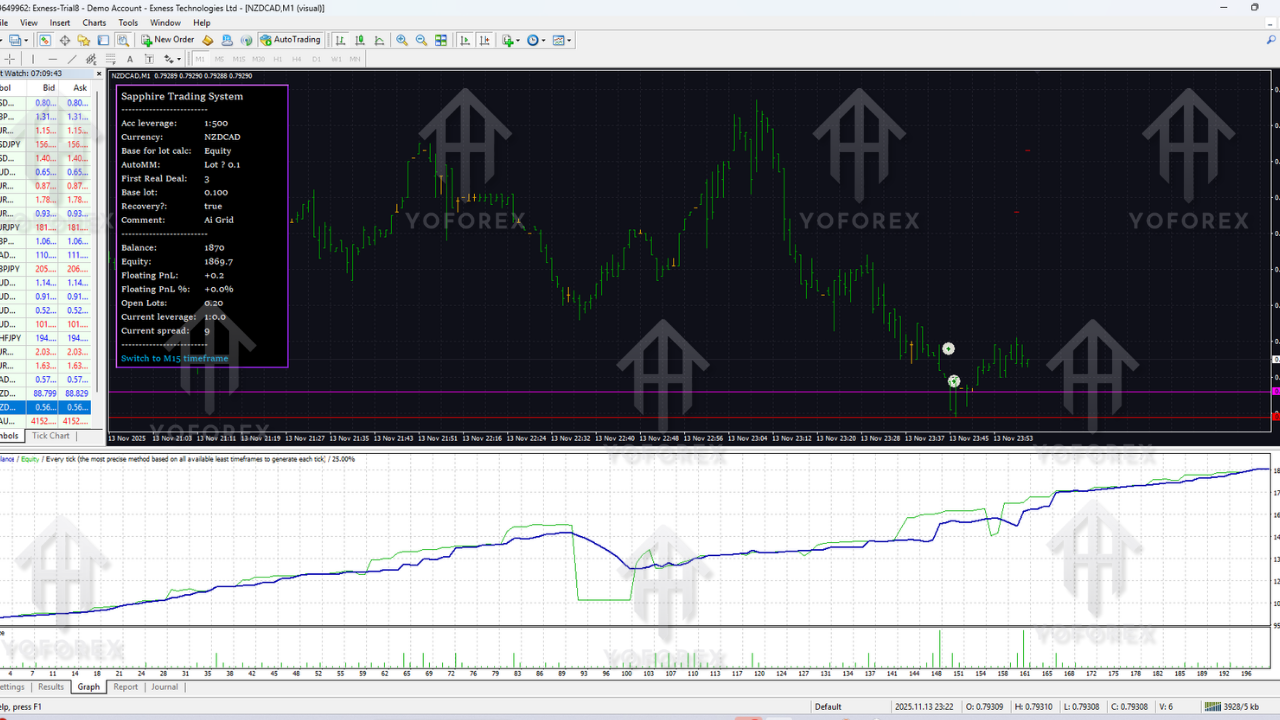
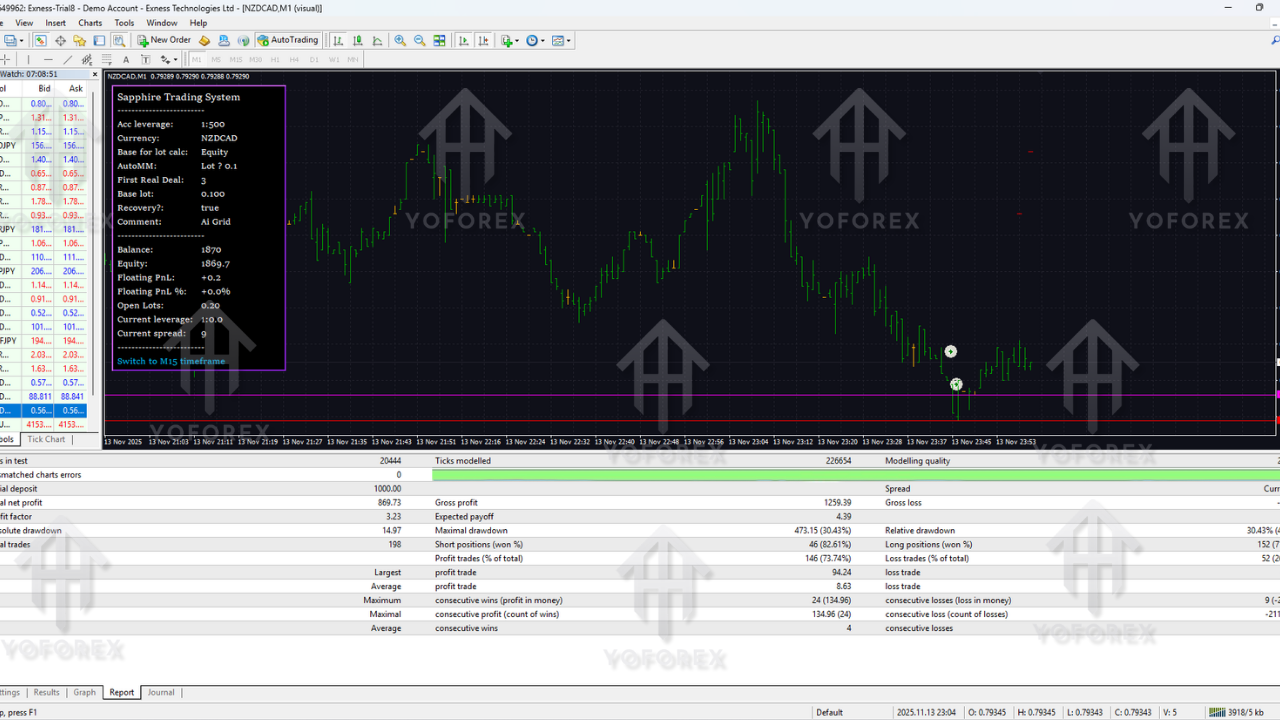
Proper backtesting is a critical step before putting Sapphire Trading System EA on a live account. The goal of a backtest is not to create a perfect, unrealistic equity curve, but to understand how the strategy behaves across different market phases. You should test at least 3–5 years of data on the main pairs you want to trade, including periods of strong trends, ranging markets, and volatile news-driven waves.
Whenever possible, use high-quality tick data with spread and commission that match your broker’s average conditions. Look carefully at metrics like maximum drawdown, average win and loss, profit factor, and longest losing streak. Ask yourself whether you are psychologically and financially comfortable with those numbers. If the EA has a 10–15 trade losing streak in the backtest, you must be ready for something similar in live trading.
You can also test the system as a portfolio by running it on multiple pairs at once to see how combined equity looks. Sometimes, a pair that performs poorly in a given year is offset by another pair that does well, smoothing the total account curve. Backtesting in this way helps you build realistic expectations instead of focusing on a single pair or a single perfect period.
Live Trading Guidelines & Trading Psychology
Even though Sapphire Trading System EA is automated, your mindset still plays a huge role in whether you succeed with it. A common mistake is to interfere with the robot out of fear or greed—closing trades too early, increasing lot size impulsively after a series of wins, or disabling the EA whenever it hits a losing streak. This kind of behavior breaks the statistical edge of the system.
Before going live, decide on your risk per trade, your maximum acceptable drawdown, and your evaluation period. For example, you might choose to run the EA for at least three months before making any major changes to the settings. During that time, you monitor its behavior, record results, and compare them with your backtests to see whether the strategy is performing within expected ranges.
Accept that losing trades are part of the plan. An EA can do many things, but it cannot remove uncertainty from the markets. If you treat every loss as a sign that “the Sapphire Trading System EA does not work,” you will constantly switch systems and never allow any edge to play out fully over the long run.
Installation & Setup on MetaTrader 4
Setting up Sapphire Trading System EA on MT4 is straightforward, even if you are not a programmer. Follow the steps below carefully:
- Copy the EA file: Download the EA file (.ex4 or .mq4). In MT4, click File → Open Data Folder, open
the MQL4 → Experts folder, and paste the file there. - Restart MT4: Close and reopen MT4 so the Expert Advisor appears in the Navigator → Expert Advisors list.
- Attach to a chart: Open your chosen pair and timeframe (for example, EURUSD M15), then drag the EA from the
Navigator onto the chart. - Allow live trading: In the EA settings, make sure “Allow live trading” is ticked and that the main
AutoTrading button at the top of MT4 is turned on. - Adjust inputs: Set your risk per trade, lot sizing mode, stop loss, take profit, and any filters according to
your plan. - Monitor early performance: For the first days or weeks, watch how the EA behaves on demo or with very small
real risk to confirm that everything is working as expected.
Optimization & Fine-Tuning Tips
Experienced users may want to optimize parameters of Sapphire Trading System EA using the MT4 Strategy Tester. The objective of optimization is not to create a perfectly fitted, unrealistic curve, but to adjust the robot to your specific broker environment and preferred pairs.
You can try different stop loss and take profit targets, small variations of the breakout filters, or session-based trading windows. For example, some traders prefer to let the Sapphire Trading System EA trade only during London and early New York hours, while others might allow it to run 24 hours with slightly different settings. Each change should be tested across a wide time range to avoid overfitting the strategy to a short, lucky period.
Whenever you discover a promising parameter set, validate it again on out-of-sample data or in a forward demo test. This extra step helps ensure that the system remains robust in changing market conditions and not just tailored to a specific historical fragment.
Pros & Cons of the Sapphire Trading System EA V2.5 MT4
Like any trading tool, Sapphire Trading System EA has clear advantages and limitations. Understanding both sides will help you decide whether it fits your trading personality.
Pros :
- Rule-based strategy with clear stop losses and controlled exposure
- Works on popular major pairs and common intraday timeframes
- Automates breakout and trend-following concepts many traders already understand
- Flexible money management and risk settings
- Can be integrated into a multi-pair or multi-system portfolio
Cons:
- Not a holy grail – losing trades and drawdowns are unavoidable
- Performance depends on broker quality, spread, and execution speed
- Breakout strategies can struggle during extended choppy, sideways periods
- Requires patience and discipline; not suitable for traders who constantly change settings
Who Is Sapphire Trading System EA Best For?
Sapphire Trading System EA is best suited for traders who appreciate systematic, rule-based trading and who are comfortable with realistic expectations. If you are looking for a super high-risk, overnight “account flipper,” this is not the right product. But if you believe in using technical edges such as breakouts, trends, and volatility in a disciplined manner, this robot can become a valuable component of your overall strategy.
It is particularly attractive to part-time traders who cannot sit in front of charts all day. By letting the EA monitor the market and execute trades automatically, you can stay aligned with your trading plan even while you are busy with other responsibilities. The key is to configure risk correctly and to accept that even a good system will have losing phases.
FAQ – Important Questions Before You Start
Can Sapphire Trading System EA guarantee profits?
No trading system can guarantee profits. This robot is designed to provide a repeatable edge, but results will always vary depending on broker conditions, market cycles, and how you configure risk. Treat it as a tool within a broader risk-managed trading plan.
Do I need a large account to use it?
Technically, you can start with a small account if you use micro lots, but having more capital allows you to keep risk-per-trade small while still making meaningful gains. Many traders feel more comfortable when using at least a few hundred dollars or more for automated trading.
Is demo testing necessary?
Yes. Demo testing or running on a cent account is highly recommended before going full-size live. This helps you understand how Sapphire Trading System EA behaves with your broker’s spread and execution and lets you build confidence in the system.
Final Verdict on Sapphire Trading System EA
In conclusion, Sapphire Trading System EA V2.5 MT4 is a structured, disciplined trading robot built around breakout and trend-following concepts, reinforced by volatility filters and risk control. It is not a miracle solution, but it is a serious tool for traders who are tired of emotional decision-making and want a mechanical approach that can be tested, monitored, and refined over time.
If you combine this EA with realistic expectations, proper broker selection, a stable VPS, and sensible risk per trade, it can help you build a more professional trading workflow. As with any system, long-term consistency and patience are more important than short-term results. Used correctly, this robot can become a reliable part of your automated trading arsenal.
Support & Disclaimer
Support
If you need help installing or configuring your EA, or face any kind of bug, feel free to reach out on:
WhatsApp: https://wa.me/+443300272265
Telegram Group: https://t.me/yoforexrobot
Disclaimer: Forex and gold trading involve risk. Past performance doesn’t guarantee future results. Always test robots on demo before live trading and use proper risk management.