
Introduction: Stepping into the Future of Forex with the Titan SMC Wick Rejection & Grid EA
The world of Forex trading is constantly evolving, with new technologies and strategies emerging at a rapid pace. As a serious trader, keeping up with these advancements is crucial for staying ahead of the curve. One such development is the rise of Expert Advisors (EAs) or trading bots, which can automate your trading strategies and eliminate emotional decision-making. Today, we’re diving deep into the world of one particularly intriguing EA: the Titan SMC Wick Rejection & Grid EA.
This isn’t just your run-of-the-mill trading bot. The Titan SMC Wick Rejection & Grid EA is built on a sophisticated blend of Smart Money Concepts (SMC) and a dynamic grid-based trade management system. It’s designed specifically for the MetaTrader 5 (MT5) platform, offering a powerful tool for both novice and experienced traders who are looking to capitalize on market opportunities with increased efficiency.
So, what exactly makes this EA stand out? How does it leverage SMC to make smarter trading decisions? And how does its grid system work to manage risk and potentially enhance profits? We’ll be answering all these questions and more in this comprehensive guide. Get ready to explore the inner workings of the Titan SMC Wick Rejection & Grid EA and discover if it could be the missing piece in your trading arsenal.
Overview of the Titan SMC Wick Rejection & Grid EA
The Titan SMC Wick Rejection & Grid EA is a multi-faceted automated trading system that seeks to bridge the gap between complex analytical methods and practical trade execution. Its core philosophy revolves around identifying high-probability trading setups based on Smart Money Concepts, which focus on the actions and footprints of institutional traders.
What are Smart Money Concepts, you ask? Think of them as reading the “language” of the market as spoken by large banks and hedge funds. These concepts often involve analyzing market structure, supply and demand zones, order blocks, and, as the name suggests, “wick rejections” – instances where price spikes in one direction but is quickly rejected, often signaling a reversal.
The Titan SMC Wick Rejection & Grid EA leverages these insights to look for specific patterns and market conditions that suggest a high likelihood of a move. Once a potential setup is identified, the EA uses a wick rejection logic to pinpoint entry points. This logic aims to catch early reversals and enter trades when the “smart money” is likely moving in a new direction.
But that’s just the beginning. The Titan SMC Wick Rejection & Grid EA doesn’t just open one trade and hope for the best. It employs a sophisticated grid system to manage trades, which is designed to potentially recover from drawdown and enhance overall profit potential. This grid approach, combined with the EA’s SMC-based entries, creates a unique and potentially powerful trading system.
How This EA Works: Demystifying the Magic
Now, let’s pull back the curtain and understand the mechanics behind the Titan SMC Wick Rejection & Grid EA. It all starts with the analysis of market data. The EA scans the charts for the currency pairs and timeframes you’ve selected, looking for specific SMC-based setups.
These setups can involve various elements, such as identifying key order blocks or analyzing market structure to determine the prevailing trend. When a setup occurs, the Titan SMC Wick Rejection & Grid EA activates its wick rejection logic. It monitors for significant price wicks that interact with these identified zones or levels.
A “wick rejection” in this context usually refers to a long candlestick shadow or wick that extends significantly into a key area before the price reverses and closes back towards the other end. The EA uses specific rules to determine if a wick rejection is valid and should be considered a potential trading signal.
For example, the Titan SMC Wick Rejection & Grid EA might require the wick to be a certain length relative to the body of the candle, or for the wick to touch or close near a certain level. When all conditions are met, the EA may open a trade in the direction of the expected reversal.
This is where the grid system comes into play. If the initial trade goes into drawdown, the Titan SMC Wick Rejection & Grid EA doesn’t panic. Instead, it starts to open subsequent trades at predetermined intervals, creating a “grid” of orders. This approach allows the EA to potentially profit from price retracements or reversals, even if the initial entry was not perfectly timed.
Crucially, the Titan SMC Wick Rejection & Grid EA likely has built-in risk management features to prevent the grid from becoming unmanageable. This could involve settings for the maximum number of grid levels, the distance between levels, and perhaps even dynamic adjustment of lot sizes.
Key Features that Power the Titan SMC Wick Rejection & Grid EA
The Titan SMC Wick Rejection & Grid EA comes packed with features that are designed to give traders greater control and flexibility. Let’s explore some of these key attributes:
- SMC Integration: This is perhaps the most significant feature. By incorporating Smart Money Concepts, the Titan SMC Wick Rejection & Grid EA aims to identify high-probability trading opportunities based on market institutional flow.
- Wick Rejection Logic: The specialized wick rejection logic allows for precise entry points, potentially catching reversals at their early stages. This feature aims to improve the risk-to-reward ratio of each trade.
- Grid Management: The dynamic grid system provides a mechanism for trade recovery and potentially enhancing profits. The EA likely offers customizable grid settings, allowing traders to tailor the grid’s aggressiveness.
- Multiple Take Profit (TP) & Stop Loss (SL) Options: The Titan SMC Wick Rejection & Grid EA might include multiple TP and SL settings, providing different options for capturing profits and protecting capital.
- Risk Management Tools: To safeguard your account, the Titan SMC Wick Rejection & Grid EA is likely equipped with essential risk management tools, such as maximum drawdown limits and lot size control.
- Customizable Settings: The EA typically offers a wide range of input parameters, allowing you to fine-tune the strategy to your preferred trading style and risk tolerance. You can adjust settings related to the SMC logic, the wick rejection conditions, and the grid parameters.
- Backtesting Capability: Since the Titan SMC Wick Rejection & Grid EA is designed for MT5, you can utilize the platform’s robust backtesting capabilities to evaluate the EA’s performance on historical data before risking real money.
These features, combined with the core SMC-Grid combination, make the Titan SMC Wick Rejection & Grid EA a unique and potentially effective tool for automated Forex trading.
Trading Strategy Logic Used by Titan SMC Wick Rejection & Grid EA
Now, let’s delve deeper into the specific trading strategy logic that the Titan SMC Wick Rejection & Grid EA likely employs. The primary goal is to find high-probability entry points based on price action patterns that suggest institutional involvement.
Wick Rejection as an Entry Signal
The core entry signal for the Titan SMC Wick Rejection & Grid EA is centered on the concept of wick rejection. This pattern is interpreted as a temporary price spike that fails to hold, indicating a strong counter-trend reaction by market players (the “smart money”).
The EA likely has specific logic to analyze candlesticks and identify these significant wicks. Factors such as the wick’s length compared to the body, its position relative to previous high/low levels, and the timeframe on which it occurs could all be taken into account. When a wick rejection pattern forms, especially in alignment with the broader market direction indicated by SMC analysis, it can trigger a trade.
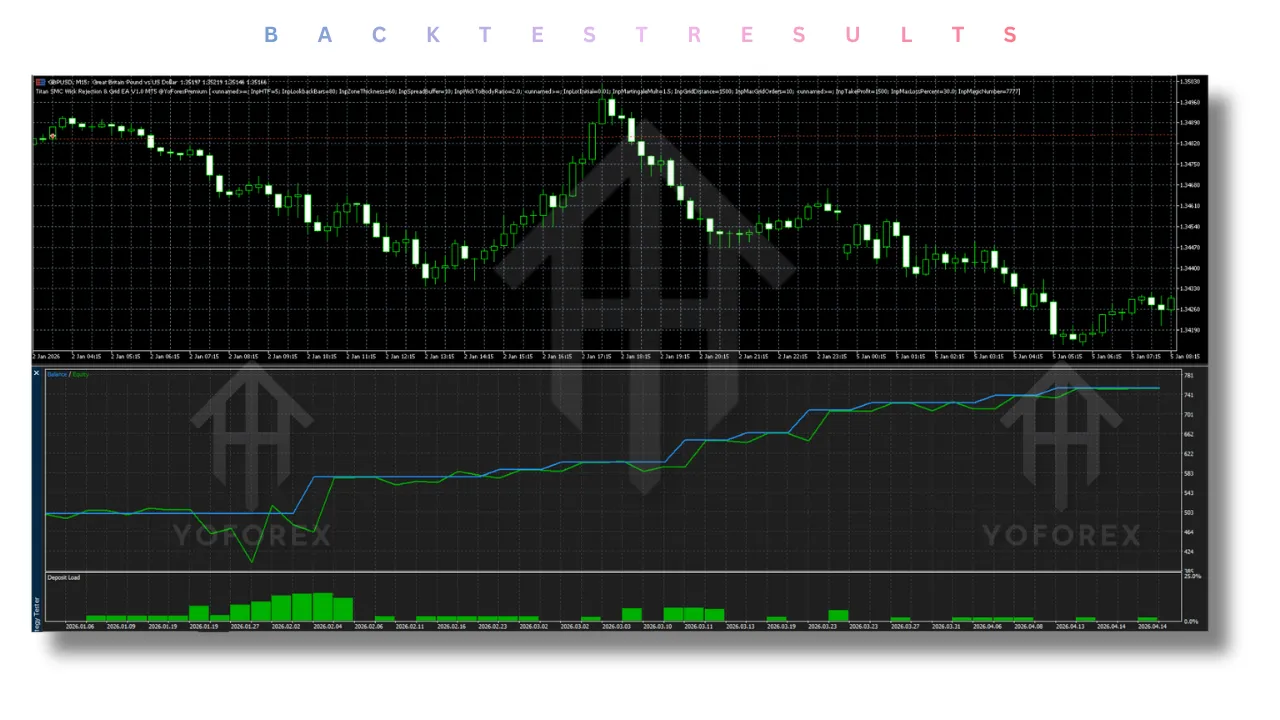
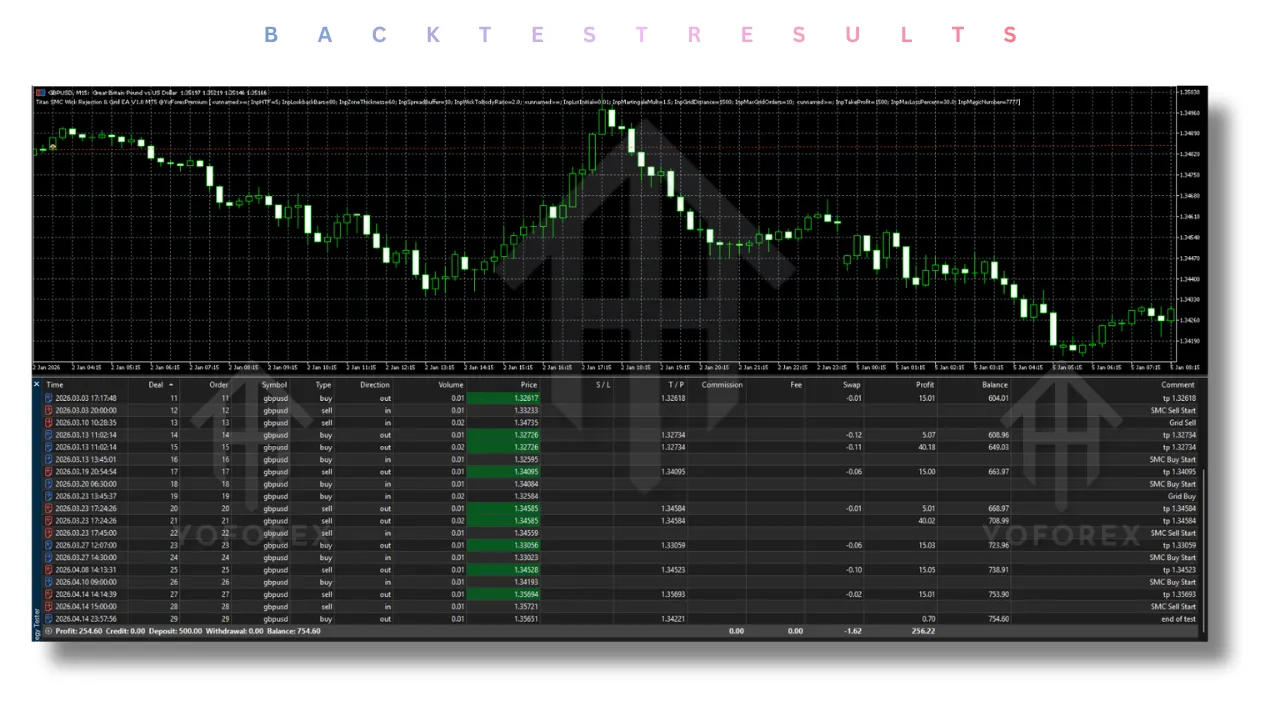
The image provided in the first input gives us a clue about the strategy’s logic. It shows a series of trades that appear to be triggered by wick rejections, particularly after a strong price movement in one direction. The EA enters against the immediate trend, aiming to profit from the subsequent retracement.
Smart Money Concepts (SMC) to Filter Trades
The Titan SMC Wick Rejection & Grid EA doesn’t just trade every wick rejection it sees. It likely uses Smart Money Concepts to filter signals and prioritize those that have a higher probability of success. This could involve several key concepts:
- Order Blocks: These are price levels where significant institutional buying or selling occurred in the past. The Titan SMC Wick Rejection & Grid EA might seek wick rejections that happen within or near these order blocks, as these levels often act as magnets for price and can lead to strong reactions.
- Market Structure: Understanding the overall market structure (uptrend, downtrend, ranging) is crucial for identifying higher-probability setups. The Titan SMC Wick Rejection & Grid EA might use SMC to determine the dominant market bias and prioritize trades that align with that trend.
- Liquidity: Institutional traders often target price levels where there is significant liquidity (e.g., above or below previous highs/lows) to fill their large orders. The Titan SMC Wick Rejection & Grid EA might try to identify these liquidity-rich areas and look for wick rejections that exploit them.
Grid Management for Trade Recovery
One of the unique aspects of the Titan SMC Wick Rejection & Grid EA is its use of a grid system in combination with SMC-based entries. While SMC aims for high-probability entries, the grid system is designed to handle trades that initially move against you.
If the first SMC-based trade goes into drawdown, the Titan SMC Wick Rejection & Grid EA will begin opening subsequent orders at set intervals. These new orders can be in the same direction as the initial trade (aiming for a bounce) or perhaps even in the opposite direction (hedging, though this is less common with this type of EA).
The grid’s goal is to lower the overall break-even point of the basket of trades. As the price moves, even a small retracement can bring the entire grid into profit, allowing the EA to close all positions and lock in gains. The logic here is that the high-probability nature of the SMC entry, combined with a smart grid, increases the overall likelihood of the trade resulting in a profit.
The specific parameters for the grid, such as the distance between levels and the lot sizing (martingale, constant, etc.), can likely be adjusted within the Titan SMC Wick Rejection & Grid EA settings. Finding the optimal grid settings is crucial for balancing profit potential with risk.
Putting it All Together
In summary, the Titan SMC Wick Rejection & Grid EA likely operates by:
- Analyzing the market using Smart Money Concepts to identify key levels (order blocks, liquidity pools) and market structure.
- Looking for specific wick rejection patterns near these high-probability areas.
- Entering trades when a valid wick rejection is identified, especially in alignment with the broader market trend.
- Activating the grid system if the initial trade goes into drawdown, managing subsequent orders to lower the break-even point and maximize profit potential from retracements.
- Utilizing Take Profit and potentially trailing stop settings to secure profits.
This combination of SMC logic for entries and grid management for trade handling makes the Titan SMC Wick Rejection & Grid EA a comprehensive and potentially powerful automated trading system.
Recommended Settings for the Titan SMC Wick Rejection & Grid EA
The input parameters provided in the third image give us a glimpse into the potential settings for the Titan SMC Wick Rejection & Grid EA. Let’s break down some of the key parameters and what they likely control. Keep in mind that these are just examples, and the specific settings you choose will depend on your risk tolerance, account size, and the current market conditions.
SMC REAL ZONE (HTF KIRISH)
- Katta Taymfreym: This setting likely allows you to select the higher timeframe (HTF) for the SMC analysis. Common choices include 1 Hour, 4 Hours, or 1 Day. The EA would then use this HTF analysis to identify key levels on the lower timeframe you’re trading on.
- Qancha sham orqani tekshirish kerak: This parameter likely determines how many past candlesticks the EA should analyze to identify SMC levels like order blocks or liquidity pools. A higher number will lead to more historical data being considered.
- Zonaning qalinligi (800 punks = 80 pips): This setting likely defines the width or thickness of the identified SMC zones (e.g., order blocks). A wider zone might be easier for price to interact with but could also reduce signal precision.
- Spred uchun bufer: This parameter probably adds a buffer to the entry points to account for spread. This ensures that trades are only opened when price significantly crosses the desired level.
- SOYA TANADAN NECHA MARTA UZUN BO’LISHI KERAK? (Masalan 2.0): This is a crucial setting that directly influences the wick rejection logic. It likely defines the minimum ratio of the wick’s length to the candle’s body for it to be considered a valid rejection.
GRID VA MARTINGALE (QUTQARUV TIZIMI)
- Boshlang’ich Lot: This setting determines the initial lot size for the first trade. It should be chosen carefully based on your account size and risk tolerance.
- Martingale ko’paytiruvchisi (Masalan 1.5 barobar): If you’re using martingale logic in your grid, this multiplier determines how much the lot size will increase for each subsequent grid level. This can significantly increase risk, so use with caution.
- KATTA SPRED UCHUN QADAM (150 pip): This parameter likely sets the minimum distance between grid levels when the spread is wide. This helps prevent the grid from becoming too dense during periods of high market volatility.
- Maksimal setka orderlar soni: This setting controls the maximum number of grid orders that the Titan SMC Wick Rejection & Grid EA is allowed to open. This is an important risk management feature to prevent the grid from growing out of control.
FOYDA VA XAVFSIZLIK
- O’rtacha narxdan TP (150 pip): This likely defines the Take Profit level for the entire grid basket, measured from the average break-even price.
- Umumiy zararni cheklash (30% minusga karsa yopish): This is a critical risk management parameter. It allows you to set a maximum drawdown limit for the entire EA. If this limit is reached, the EA will close all open positions to prevent further losses.
- InpMagicNumber: This is a unique identifier for the EA, allowing you to run multiple instances of the same EA on different charts or currency pairs.
It’s crucial to understand that these settings are highly interconnected, and changing one can affect the performance of the whole system. For example, a higher martingale multiplier increases both profit potential and risk, making careful selection of other parameters like grid step and maximum order number even more important. We strongly recommend testing any settings on a demo account before applying them to a live account.
7. Backtesting Result
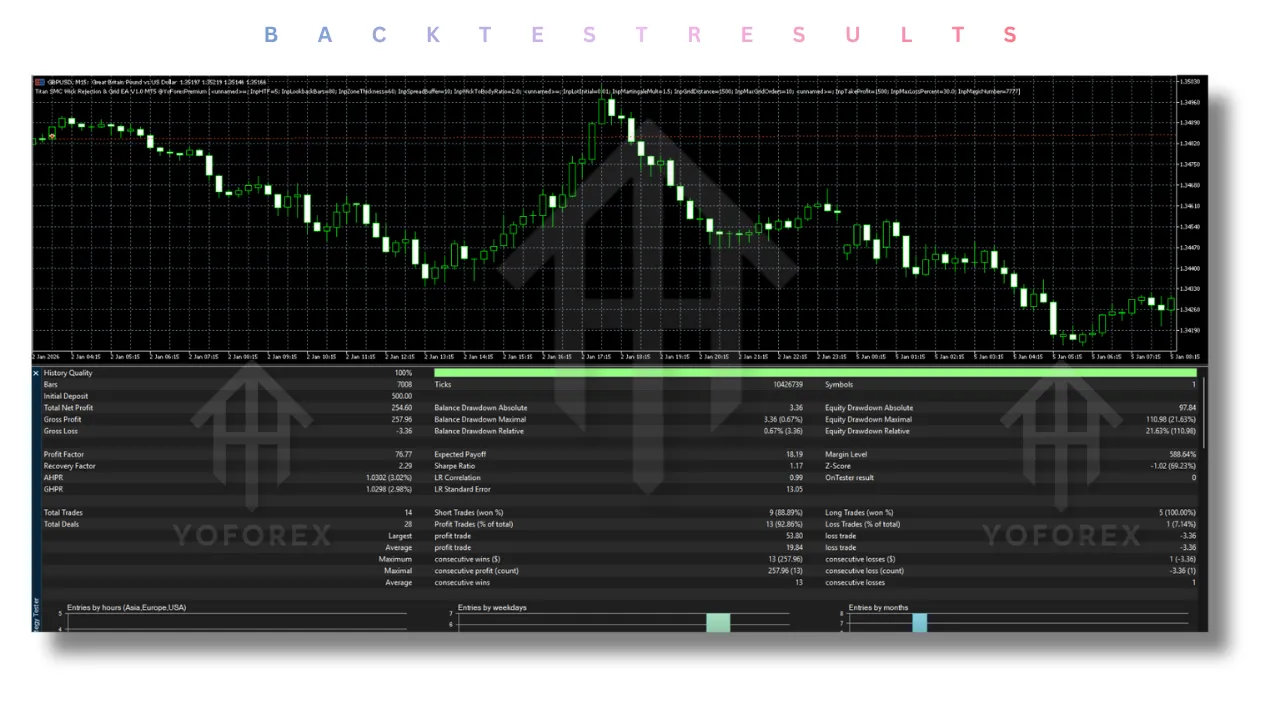
The provided image showcases a backtesting result for the Titan SMC Wick Rejection & Grid EA. While we don’t have the specific timeframe, date range, or currency pair, the data still provides valuable insights into the potential performance of the EA.
Key Metrics from the Backtest:
- History Quality: 100%. This is an excellent score, indicating that the EA was tested using high-quality historical data, which increases the reliability of the results.
- Initial Deposit: 500.00.
- Total Net Profit: 254.60. This represents a return of over 50% on the initial deposit.
- Gross Profit: 257.96.
- Gross Loss: -3.36. This extremely low gross loss is remarkable and suggests that the EA has very few losing trades or that the grid system effectively manages losses.
- Profit Factor: 76.77. This is a very high number, indicating that the total profit is significantly higher than the total loss. This is a positive sign for the EA’s overall profitability.
- Recovery Factor: 2.29. This metric measures the EA’s ability to recover from drawdowns. A value above 1 is considered good, so 2.29 is quite positive.
- Total Trades: 14.
- Total Deals: 28.
- Maximum Consecutive Wins: 13 (with a total profit of 257.96).
- Maximum Consecutive Losses: 1 (with a total loss of -3.36).
- Profit Trades (% of total): 13 (92.86%).
- Loss Trades (% of total): 1 (7.14%).
- Margin Level: 508.64%. This is a healthy margin level, suggesting that the EA did not put excessive stress on the account during the test.
- Z-Score: -1.02. The negative Z-score indicates that the winning and losing trades are clustered together, which is consistent with the very few losing trades.
- OnTester result: 0. This typically means there were no OnTester values generated or recorded during the backtest.
Interpretation:
The backtest results for the Titan SMC Wick Rejection & Grid EA are quite impressive. The high percentage of profitable trades (over 92%), combined with an extremely low number of losing trades, leads to a very high profit factor. This suggests that the EA’s strategy of combining high-probability SMC-based entries with a smart grid management system is potentially very effective.
However, it’s crucial to keep a few things in mind:
- Limited Sample Size: With only 14 total trades, the sample size is relatively small. The results might not be perfectly representative of the EA’s performance over a longer period.
- Backtesting Limitations: Even with high-quality data, backtesting can never perfectly replicate real-world trading conditions. Slippage, varying spreads, and unexpected market events can all affect actual performance.
- Context is Everything: Without knowing the currency pair, timeframe, or date range, it’s hard to assess the general applicability of these results. It’s possible the EA was backtested on a single pair during a specific period that was particularly favorable to its strategy.
In conclusion, while the backtesting results for the Titan SMC Wick Rejection & Grid EA are promising, they should be viewed as a good starting point for further investigation rather than guaranteed future performance. Extensive backtesting on multiple currency pairs and timeframes is essential to build a more comprehensive understanding of the EA’s capabilities.
Installation Guide for the Titan SMC Wick Rejection & Grid EA V3.10 MT5
- Download and Prepare the EA Files: Ensure you have downloaded the Titan SMC Wick Rejection & Grid EA files to your computer.
- Open MetaTrader 5 (MT5): Launch your MT5 platform.
- Navigate to the MQL5 Folder: In the top menu, go to File -> Open Data Folder. A file explorer window will open.
- Find the “Experts” Folder: Locate the MQL5 folder, double-click to open it, and then open the Experts folder.
- Copy the EA Files: Copy the
.ex5file for the Titan SMC Wick Rejection & Grid EA and paste it into the Experts folder. - Refresh or Restart MT5: Go back to your MT5 platform and either restart it or right-click on the “Expert Advisors” section in the Navigator window and select Refresh. The Titan SMC Wick Rejection & Grid EA should now appear in the list.
- Enable Automated Trading: In the MT5 top menu, click the Algo Trading button to enable it. It should be green or highlighted.
- Attach the EA to a Chart: Open the chart for the currency pair you want to trade (e.g., GBPUSD on the M5 timeframe). Then, from the Navigator window, drag and drop the Titan SMC Wick Rejection & Grid EA onto the chart.
- Configure the Settings: A settings window will pop up. In the Common tab, ensure that “Allow Algorithmic Trading” is checked. In the Inputs tab, you can adjust the parameters for the Titan SMC Wick Rejection & Grid EA as discussed in the “Recommended Settings” section.
- Save Settings (Optional): If you’ve customized the settings and want to save them for future use, click the Save button in the inputs window.
- Start Trading: Once you’ve configured the settings and clicked OK, the Titan SMC Wick Rejection & Grid EA will begin scanning the market for trading opportunities. You should see its name and smiley face icon in the top right corner of the chart, indicating that it’s running.
Now that you’ve installed the Titan SMC Wick Rejection & Grid EA, it’s crucial to test it on a demo account before considering moving to a live account. This will help you understand how the EA behaves in real-world market conditions and ensure that your chosen settings are appropriate.
Advantages and Disadvantages of Using the Titan SMC Wick Rejection & Grid EA
Like any trading system, the Titan SMC Wick Rejection & Grid EA has its pros and cons. It’s essential to understand both sides of the coin before deciding whether to use it.
Advantages:
- Emotions Removed: One of the main benefits of automated trading with the Titan SMC Wick Rejection & Grid EA is that it eliminates emotional decision-making. The EA follows its programming, taking trades based on logic and rules rather than fear or greed.
- Time-Saving: Trading can be a time-consuming endeavor. With the Titan SMC Wick Rejection & Grid EA, you can free up your time as the bot takes care of market analysis and trade execution.
- SMC-Based Entries: Leveraging Smart Money Concepts can potentially lead to higher-probability trade setups by identifying areas of interest for institutional players.
- Potentially Improved Risk-to-Reward: By targeting wick rejections at key levels, the Titan SMC Wick Rejection & Grid EA aims for precise entries, which can potentially improve the risk-to-reward ratio of each trade.
- Trade Recovery via Grid: The sophisticated grid management system provides a mechanism for recovering from initial drawdowns, potentially turning losing situations into winning ones.
- Backtesting Capability: Since the EA runs on MT5, you can utilize the platform’s powerful backtesting features to evaluate its performance on historical data.
Disadvantages:
- Risk of Grid Blowouts: While the grid system offers recovery potential, it can also lead to significant losses if the market moves against the grid for an extended period. This is especially true if aggressive grid settings (like high martingale multipliers) are used.
- Requires Careful Configuration: Finding the optimal settings for the Titan SMC Wick Rejection & Grid EA is crucial. Suboptimal settings can lead to poor performance or excessive risk.
- Backtesting Limitations: Past performance is not indicative of future results. No matter how good the backtesting results are, they don’t guarantee that the EA will perform equally well in the future.
- Broker Dependency: The performance of any EA can be affected by factors like spread, slippage, and execution speed, which are dependent on your Forex broker.
- Market Risk: No automated system is perfect. Even with high-probability SMC entries, unexpected market events can still lead to losses.
- Technical Issues: Like any software, the Titan SMC Wick Rejection & Grid EA can be susceptible to technical glitches, power outages, or other issues that could affect its operation.
It’s vital to carefully weigh these advantages and disadvantages to decide if the Titan SMC Wick Rejection & Grid EA is a suitable fit for your trading goals and risk tolerance. We strongly recommend thorough testing on a demo account before risking real capital.
Why Choose the Titan SMC Wick Rejection & Grid EA Over Other Forex Robots??
The Forex robot market is crowded, with countless options vying for your attention. So, what sets the Titan SMC Wick Rejection & Grid EA apart from the competition? Why should you choose it?
- Unique SMC-Grid Fusion: Most grid EAs rely on simple price movements for entries, which can lead to high risk. The Titan SMC Wick Rejection & Grid EA differentiates itself by integrating Smart Money Concepts to identify high-probability trading opportunities. This combination aims to reduce the overall risk of the grid system by prioritizing higher-quality entries.
- Specialized Wick Rejection Logic: The EA’s dedicated wick rejection logic offers a more nuanced approach to entering trades, focusing on key points of institutional interaction. This can lead to more precise entries compared to EAs that use simpler entry signals like moving average crossovers.
- Advanced Trade Management: The Titan SMC Wick Rejection & Grid EA likely features sophisticated grid management controls, giving you greater flexibility to tailor the system to your risk tolerance. Features like dynamic grid adjustment or maximum drawdown limits add layers of safety.
- Transparency and Customizability: The EA typically offers a wide range of input parameters, allowing you to understand its logic and customize it to your needs. This is in contrast to some “black box” EAs with very few adjustable settings.
- Focus on Higher-Probability Setups: By leveraging SMC, the Titan SMC Wick Rejection & Grid EA aims to find setups where the “smart money” is likely involved. This focus on probability over frequency can potentially lead to more consistent results compared to EAs that chase every minor market movement.
- Potential for Consistent Growth: The backtesting results, although limited, show a high profit factor and a low number of losing trades, suggesting the potential for consistent growth when the EA is set up correctly.
While no Forex robot can guarantee profits, the unique feature set and focus on high-probability, institutionally-driven setups make the Titan SMC Wick Rejection & Grid EA a potentially superior choice for traders who value both strategic depth and trade recovery capabilities.
Conclusion: A Sophisticated Tool for Today’s Market
The Titan SMC Wick Rejection & Grid EA for MT5 presents a compelling proposition in the world of automated Forex trading. By combining the power of Smart Money Concepts for high-probability entries with the robust trade management capabilities of a grid system, this EA offers a unique approach that seeks to balance precise execution with drawdown recovery.
Its focus on GBPUSD and the M5 timeframe, along with its intricate wick rejection logic, points to a strategy designed for the fast-paced world of short-term trading. The impressive backtesting results, while needing to be taken with a grain of salt, highlight the EA’s potential for consistent profitability when properly configured.
However, the power of the Titan SMC Wick Rejection & Grid EA is not to be underestimated. Grid systems carry inherent risks, and careful consideration must be given to settings like martingale multipliers and drawdown limits. This is not a “plug and play” bot; it requires understanding, patience, and diligent testing.
If you’re a serious trader, familiar with SMC and comfortable with automated systems and grid mechanics, the Titan SMC Wick Rejection & Grid EA could be a valuable addition to your trading toolset. It represents a sophisticated blend of market-tested principles and modern technology, potentially opening up new avenues for automated trading success in today’s dynamic Forex market. Remember, thorough demo testing and proper risk management are non-negotiable for long-term success with any EA.
Support & Disclaimer
Support
If you need help installing or configuring your EA, or face any kind of bug, feel free to reach out on:
WhatsApp: Click here
Telegram Group: Join our community
Disclaimer:
Forex and gold trading involve risk. Past performance doesn’t guarantee future results. Always test robots on demo before live trading and use proper risk management.
Referral
Join the VIP Signals Telegram Channel for real-time expert trading signals and stay ahead in the forex market. Get personalized strategies by becoming a part of our Real Account Management Telegram Channel and optimize your trading experience. If you’re aiming to Pass PropFirm Challenges , join our dedicated channel for tips and proven methods. Start managing your capital effectively with expert advice from our Funded Account Management Telegram Channel. For advanced traders, our HFT EA / Passing Telegram Channel offers high-frequency trading insights and strategies to boost your performance.