

Polish EA V1.0 MT4 — A Stable, Rule-Based Expert Advisor for Consistent Growth
Automated trading can either supercharge your discipline or magnify your mistakes. Polish EA V1.0 for MetaTrader 4 is built to do the former: it “polishes” raw market noise into clear, rule-based signals, prioritizing capital protection while seeking steady compounding. Whether you’re transitioning from manual trading or adding a reliable system to your EA portfolio, this guide explains exactly how Polish EA works, where it shines, and how to deploy it properly.
What Polish EA Tries to Achieve
Polish EA focuses on consistency over excitement. It avoids martingale, dangerous grid averaging, and impulse entries. Instead, it combines a trend filter with momentum confirmation and a volatility gate. The core idea is simple: only trade when trend direction, momentum, and volatility agree. In choppy markets, the EA sits out; when conditions align, it executes with predefined risk and exits by rules, not feelings.
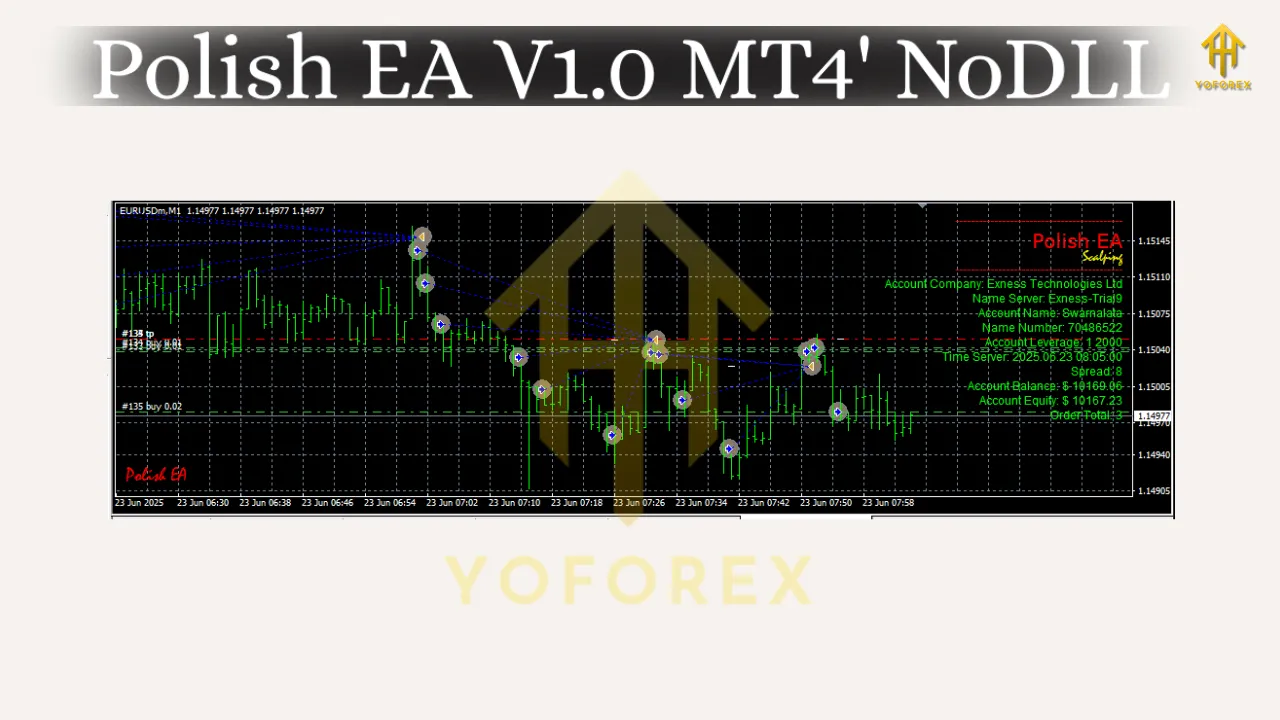
Core Strategy, Simplified
-
Trend Baseline: A smoothed moving average framework (think EMA/SMMA blend) determines the dominant direction. Price relative to this baseline and the slope of the baseline act as the first filter.
-
Momentum Confirmation: An RSI/ROC composite confirms whether momentum supports the potential trade. Bullish trend + positive momentum = long bias; bearish trend + negative momentum = short bias.
-
Volatility Gate: An ATR-based check ensures there is sufficient range to justify a trade but not so much volatility that risk becomes chaotic.
-
Timed Entries: The EA avoids entries at known illiquid or erratic micro-windows (such as the first few minutes of a session) and can optionally pause around major news if you configure a news filter via your own indicator.
-
Risk-First Exits: Each position carries a hard Stop Loss. Take Profit uses a blend of R-multiple targeting and a trailing mechanism that tightens as price extends. If momentum flips or the baseline slope flattens, the EA will exit early to protect equity.
Markets and Timeframes
Polish EA is designed primarily for major FX pairs (EURUSD, GBPUSD, USDJPY, AUDUSD, USDCAD) and also supports XAUUSD if you prefer metals. For beginners, start with M15 or H1 charts on a single pair, then expand. H1 tends to deliver cleaner signals with fewer trades, while M15 increases frequency at the cost of more noise.
Position Sizing and Risk
Polish EA uses fixed fractional risk by default—risk per trade is a percentage of account balance, converted into lot size via SL distance. This ensures consistent risk regardless of volatility. A typical range is 0.25%–1.0% per trade. New users should start at 0.25%–0.5% until they collect data.
Why It’s Safer Than Many Off-the-Shelf EAs
-
No Martingale, No Blind Grid: It never doubles down to chase losses.
-
One Trade Logic per Signal: It avoids pyramiding unless you enable the optional add-on mode.
-
Broker-Safe Orders: If a broker rejects stop orders at entry, the EA places a market order then attaches SL/TP immediately.
-
Equity Protection: Optional daily loss limits and session stops are included; when hit, the EA pauses until the next day.
Installation and Quick Start
-
Copy the EA file to
MQL4/Expertsand restart MT4. -
Open your chosen symbol and timeframe (e.g., EURUSD H1).
-
Drag Polish EA onto the chart, enable “Allow live trading,” and set your inputs.
-
Confirm AutoTrading is enabled.
-
Run it on a demo for at least 2–3 weeks to verify broker conditions and spreads.
Recommended Starter Settings
-
Timeframe: H1 (beginner) or M15 (intermediate).
-
Pairs: Start with EURUSD, then add GBPUSD and USDJPY.
-
RiskPerTrade: 0.5% to begin.
-
MaxConcurrentTrades: 1 per symbol.
-
ATRPeriod/ATRMultiplier: Defaults are conservative; increase slightly only if spreads are tight.
-
Trailing Mode: Enabled, with a sensible step so you avoid micro-whipsaws.
-
Trading Sessions: Focus on London and early New York for majors. If you trade XAUUSD, include NY.
-
News Pause (optional): If you use a third-party news indicator, set the EA to suspend entries shortly before high-impact releases.
Broker, VPS, and Execution Notes
Use an ECN/Raw spread account with tight average spreads and low commissions. A reliable VPS close to your broker’s server reduces slippage and keeps execution consistent if your local machine restarts. Polish EA doesn’t require ultra-low latency, but stable connectivity is essential.
Backtesting and Forward Testing
Backtesting offers a sanity check, but your forward results depend on live spreads, slippage, and execution quality. Follow this progression:
-
Phase 1 – Backtest: Check your chosen pair and timeframe over 2–5 years. Watch for catastrophic drawdowns; they should be contained and recoverable.
-
Phase 2 – Demo Forward: Run at least a few weeks across typical sessions. Validate average R-multiple per trade and max drawdown.
-
Phase 3 – Small Live: Start tiny (e.g., 0.25% risk). Only scale if live performance aligns with your demo stats.
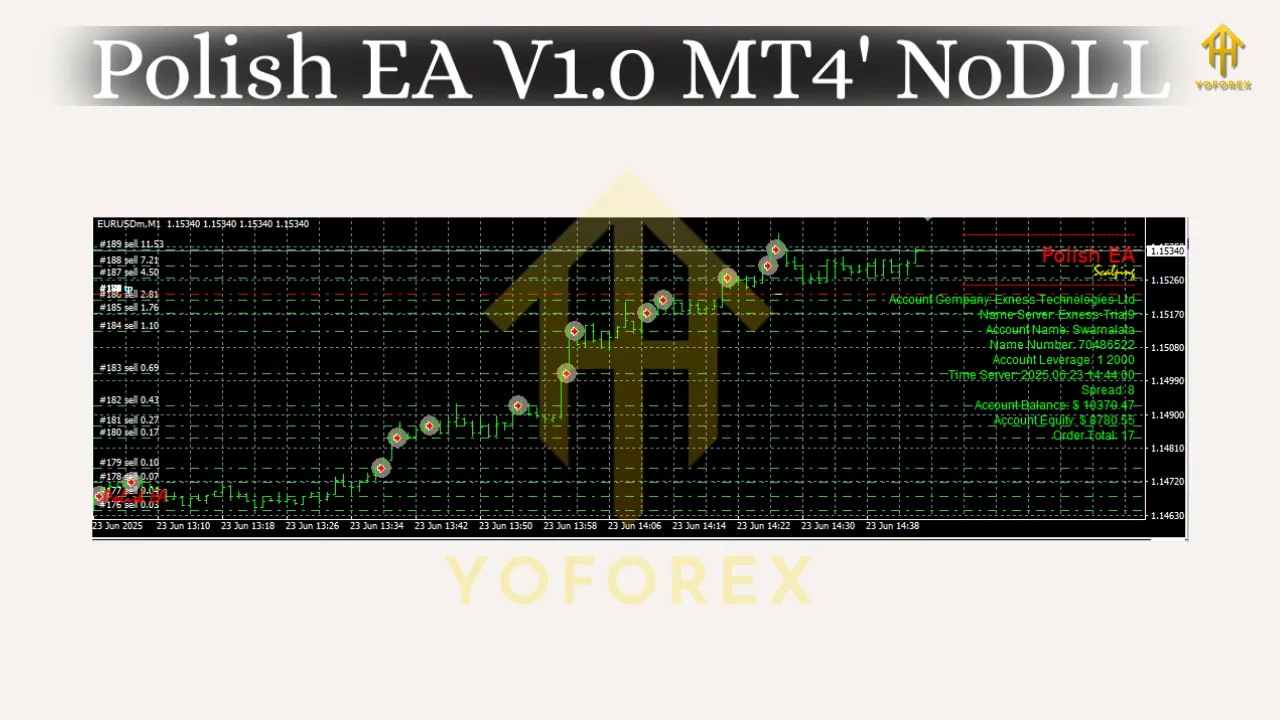
Interpreting Performance
You’re aiming for a stable equity curve and modest monthly returns rather than spectacular spikes. Important metrics:
-
Win Rate vs. R-Multiple: A 45–55% win rate with average winners larger than losers can outperform a high win rate with tiny wins.
-
Max Drawdown: Keep it within your personal comfort—ideally under 15% for conservative profiles.
-
Profit Factor and Sharpe-like Consistency: Stability matters more than a single hot month.
Advanced Features You Can Toggle
-
Session Filter: Trade only within selected hours.
-
Daily Loss/Win Guard: Stop trading after a bad (or good) day to avoid emotional over-trading.
-
Soft/Hard Trailing: Choose between a step trail or an ATR-dynamic trail.
-
Break-Even Logic: Move SL to break-even after a defined R-gain to lock profits.
-
Multi-Symbol Deployment: Run separate charts for each symbol with independent risk caps.
Common Mistakes to Avoid
-
Over-leveraging: Increasing risk after a winning streak invites a steep give-back. Keep risk steady.
-
Adding Too Many Pairs Too Soon: Start with one. Add pairs gradually once you know typical behavior.
-
Switching Timeframes Frequently: Each timeframe has its own rhythm. Frequent changes erase statistical edge.
-
Ignoring Spread/Commission: A strategy that looks great in a frictionless backtest can degrade with real costs. Validate on your broker’s data.
Sample Daily Routine
-
Check VPS and broker status.
-
Confirm spreads are normal at your start session.
-
Review economic calendar; if high-impact events approach, consider pausing new entries.
-
Let the EA run. Avoid interfering mid-trade unless risk controls trigger.
-
Log results: entry time, R-multiple, comments about conditions. Good logs accelerate optimization later.
Risk Disclaimer and Realistic Expectations
All trading involves risk. Polish EA V1.0 aims for controlled exposure and repeatable trade logic, but no system wins all the time. Expect flat periods and losing streaks. The goal is to keep losses small and winners larger on average so that the equity curve trends up over months—not necessarily every day or week.
Who Should Use Polish EA?
-
New automated traders who want a conservative, rules-based start.
-
Manual traders seeking to reduce emotional errors while keeping logical control.
-
Portfolio EA users who want a non-martingale, trend-momentum system to diversify alongside mean-reversion or breakout bots.
Final Thoughts
Polish EA V1.0 MT4 is not about chasing every pip; it’s about trading only when conditions merit it and protecting your account when they don’t. If you deploy it with disciplined risk, a quality broker, and patient expectations, it can become a dependable core system in your automated toolkit. Start on demo, collect data, and scale thoughtfully. That deliberate, polished approach is exactly what this EA is designed to reward.