

Unlocking Price Structure: Introducing the Pivot Point Profile V1.0 for MT5
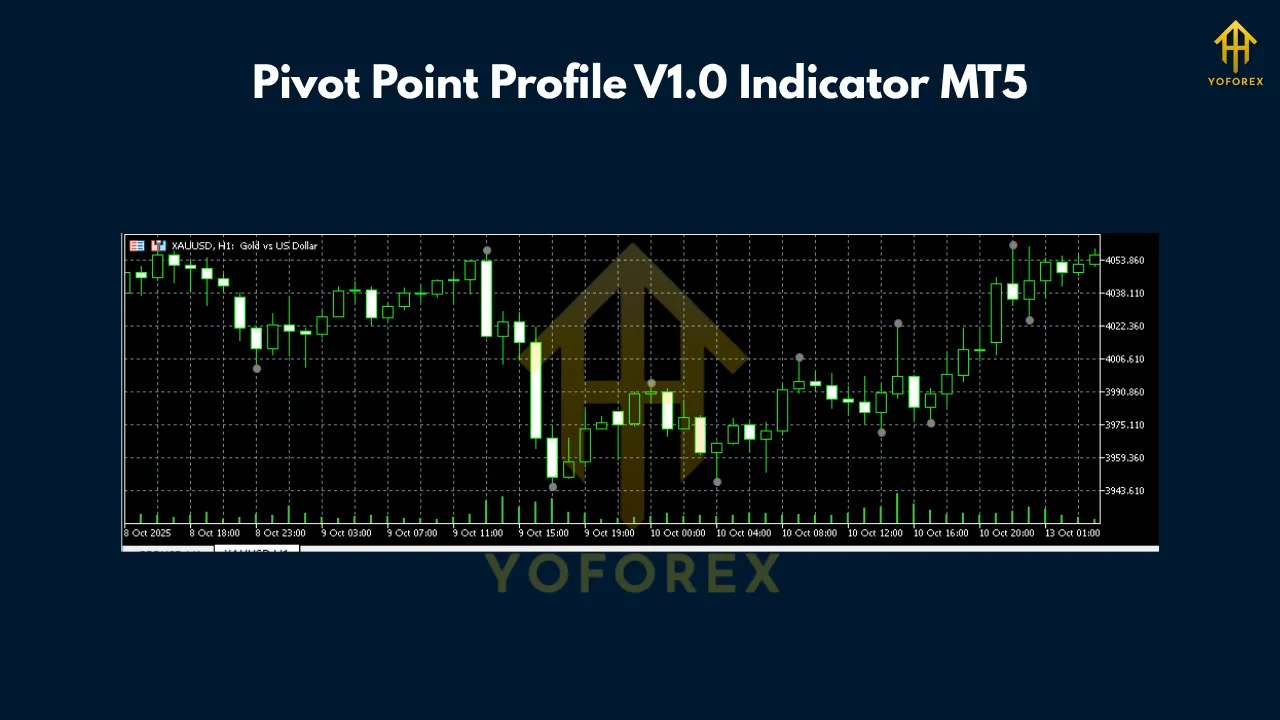
In the fast-paced world of trading, indicators that offer clarity—rather than clutter—stand out. One such promising tool seeking attention is the Pivot Point Profile V1.0, tailored for MetaTrader 5 (MT5). Unlike standard pivot indicators that plot a fixed set of levels each period, the Pivot Point Profile blends pivot theory with profiling logic to highlight zones of repeated price reactivity. In this article, we’ll dig into what it is, how it works, how traders can use it, and tips to get the most out of it (and avoid pitfalls).
What Is “Pivot Point Profile”?
At its core, the Pivot Point Profile V1.0 is a hybrid indicator. It merges two familiar concepts:
-
Pivot Points — classic support/resistance reference lines derived from prior high, low, and close values
-
Profile / Cluster Logic — grouping or layering of pivot events to reveal concentrated zones of repeated turning activity
While there are many pivot indicators for MT5 that plot daily, weekly, or custom pivot levels (Classic, Fibonacci, Camarilla, Woodie, etc.) PipTick+2FXSSI – Forex Sentiment Board+2, the Pivot Point Profile goes further by aggregating or “profiling” where multiple pivots cluster over time. This approach tends to surface zones of structural significance, rather than isolated lines, giving traders deeper insight into where price tends to pause, reverse, or consolidate.
The idea is: if many pivots (highs or lows) consistently form in a narrow price band, that band may act as a magnet or barrier in the future. The indicator highlights those “concentrated areas” or pivot clusters, and often draws an average line or “center” for each cluster.
How It Typically Works: Anatomy of the Indicator
While specifics may vary depending on implementation, here’s a general breakdown of how Pivot Point Profile V1.0 is likely to function, based on comparable profile‑pivot tools:
| Component | Purpose | Key Parameters / Options |
|---|---|---|
| Pivot Detection | Identify pivot highs and lows over a lookback length | Pivot type (fractal, structure, SMC), pivot length, retracement thresholds |
| Lookback / History | How far back (in bars or in number of pivot pairs) to collect data | Lookback count, “use full history” toggle |
| Row / Bucket Size | Vertical division of price space into rows / bins for clustering | Row size (price height), number of rows (max rows) |
| Concentration Threshold | Minimum pivot count for a row to be considered significant | CA threshold (e.g. 2, 3 pivots) |
| Display / Overlay | How and where clusters are drawn | Direction (left, right, center), width, offset, styling (colors, line thickness) |
| Averaging / Center Line | For each significant cluster, provide a representative level | Option to show average pivot price, highlight cluster band |
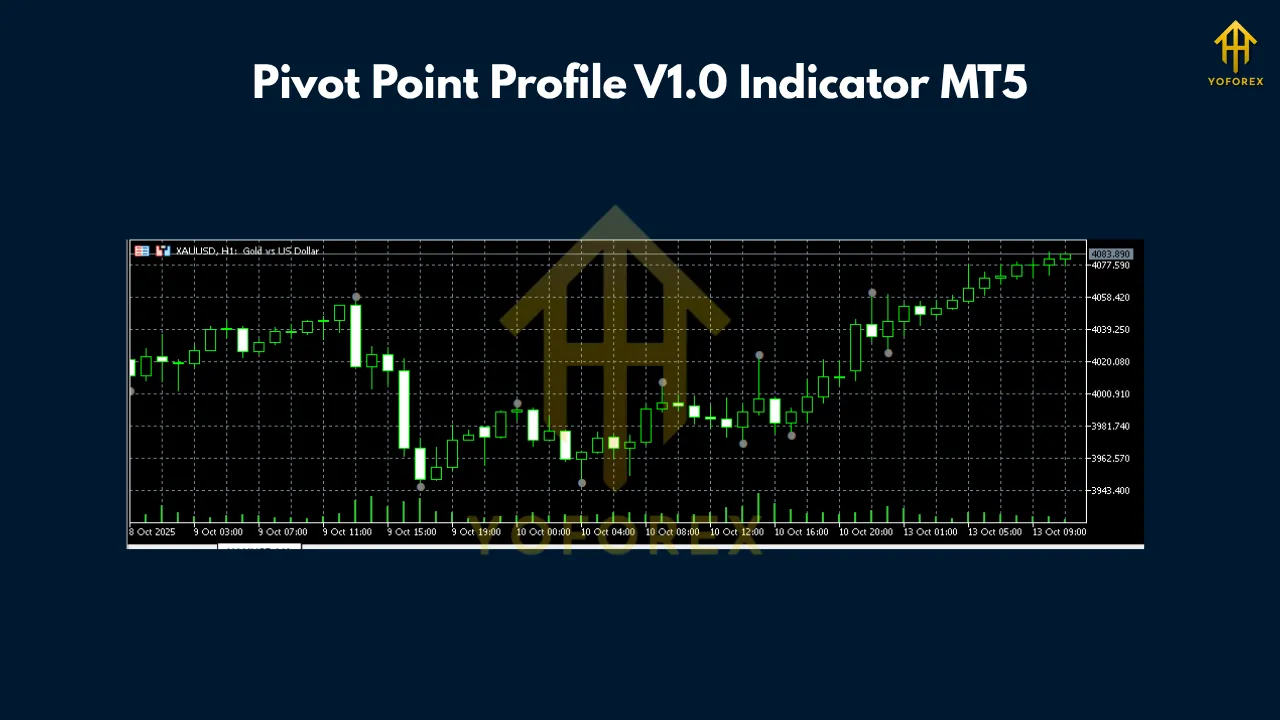
In operation, the indicator scans historical pivot points. It groups them into price “bins” (rows). Rows (bins) which contain a number of pivot events above a threshold are labeled as “concentrated areas” (CAs). Each CA may then be visualized via shading or contour, and a central line (average) might be drawn. Traders can see where past pivot activity has repeatedly stacked up, and then monitor price behavior when price re-enters or approaches those zones.
This approach is conceptually akin to a volume profile or market profile but using pivot events rather than traded volume. It adapts the profiling idea to pivot clustering logic. Indeed, a similar concept is offered in other trading platforms (e.g. the “Pivot Point Profile” in the LuxAlgo library, which is available for MT5 among other platforms) .
Why Use It? Advantages Over Traditional Pivot Indicators
Here are several reasons a trader might prefer the Pivot Point Profile V1.0 (or similar cluster-based pivot tools) to a standard pivot lines indicator:
-
Zone Focus Rather Than Static Lines
Standard pivot indicators draw fixed lines (PP, R1, R2, S1, etc.) each period. But not every line is equally meaningful in every market. Clustering helps filter and highlight the lines that “matter” — those that have historically drawn repeated price reaction. -
Contextual Strength
A pivot that appears in isolation (i.e. no other pivots around that level) tends to be weaker. But if multiple pivots have conformed near the same level, that zone tends to carry more weight as potential support/resistance. -
Dynamic Adaption
Because it is based on historical pivot aggregation rather than just the immediate prior session, the indicator can adapt to structural changes over longer periods, giving a broader context to support/resistance decision-making. -
Cleaner Charting / Less Clutter
Rather than dozens of pivot lines from various periodicities and formulas overlaying the chart, this profiling method can help reduce visual noise by emphasizing only the most relevant zones. -
Better Confluence with Other Tools
When a pivot cluster lines up with volume profile peaks, moving averages, trend lines, or market structure, you get confluence. Pivot clusters can act as confirmation anchors.
How to Use It in a Trading Setup
Here’s a step-by-step approach to incorporate Pivot Point Profile V1.0 into a trading workflow:
1. Choose Pivot Settings Thoughtfully
-
Start with default pivot detection (fractal or structural), and moderate lookback (e.g. 50–200 pivot pairs).
-
Use a row size that balances granularity and readability; too many small rows produce noise, too coarse hides nuance.
-
Set the concentration threshold (CA threshold) to filter weak clusters (e.g. require at least 2 or 3 pivot events in a bin).
2. Observe Cluster Zones as Key Reference Areas
-
When price approaches a pivot cluster zone, treat it as a “zone of interest.” Watch for price action patterns (like candlestick reversal signals, rejection wicks, confluences).
-
Use the average or center line as a reference line for entries, but don’t assume price can’t roam within the cluster band.
3. Trade Entries Based on Reaction
-
Reversal Setup: If price re-enters a cluster and shows rejection (pin bar, engulfing, false breakout), you might take a reversal entry back out.
-
Continuation / Breakout: If price breaks decisively through a cluster with momentum and volume, use it as confirmation and wait for retest.
4. Stop-Loss / Targets
-
Place stop-losses slightly beyond the edge of the cluster zone (outside the band) to reduce being taken out by noise.
-
Take-profit levels could be other cluster zones, classic pivot levels, or measured moves.
5. Timeframe & Symbol Selection
-
The indicator often works better on mid to higher timeframes (e.g. H1, H4, Daily). On very low timeframes, many pivot clusters may form too frequently and generate noise.
-
Use on more liquid instruments (major FX pairs, indices), where structural pivots tend to have more follow-through.
6. Backtest & Validate
-
Visually backtest how price historically reacted to the pivot clusters. Do price reversals or consolidations happen often at those zones?
-
You can combine it with price structure, trend direction, volume tools to filter high-probability setups.
Things to Watch Out For: Limitations & Pitfalls
No indicator is perfect. Here are some caveats when using Pivot Point Profile V1.0 (or cluster‑based pivot tools):
-
Lag in New Structure: Because clustering relies on historical pivots, fresh structural breaks may not show up immediately. The indicator could lag in shifting to new market regimes.
-
Overfitting Danger: If you set row size or threshold too narrowly, you might overfit to past pivots, creating many false zones.
-
Misleading Zones: Sometimes, a cluster emerges merely from random noise rather than genuine structural significance. Always use price confirmation.
-
Indicator Performance / Overload: Profiling many pivots over long history can be resource intensive; ensure your MT5 platform handles it smoothly.
-
Timeframe Mismatch: A cluster built from daily pivots may not hold on intraday charts or low‑liquidity times.
Sample Scenario (Hypothetical)
Let’s walk through a sample use-case to illustrate:
-
You apply Pivot Point Profile V1.0 on a EUR/USD H4 chart, using a lookback of 100 pivot pairs, row size of 20 pips, and CA threshold of 3.
-
The indicator marks a pivot cluster zone between 1.0850–1.0880, with an average line at 1.0865.
-
Price, having moved down from above, re-enters the cluster zone and forms a bearish pin bar at 1.0875.
-
Based on that rejection, you take a short entry at 1.0870, placing stop-loss at 1.0900 (above zone).
-
Your initial target is the next lower cluster or classic pivot (say 1.0780); you trail or scale down as price moves.
-
If price breaks above 1.0880 with strong momentum and volume, you instead treat the cluster as broken and flip bias (e.g. wait for retest for a long).
Over time, you track how often cluster zones act as valid barriers or magnets. You refine your row size or threshold until false signals reduce and edge improves.
Why Version 1.0 Matters
Version numbering suggests the tool is still early in its lifecycle. But that also means:
-
There may be room for enhancements (e.g. more pivot types, adaptive clustering, dynamic row sizing)
-
Be careful of bugs or performance limits
-
The developer may update or patch in response to user feedback
If you adopt the indicator, maintain version control and keep backups. If possible, test it rigorously on demo before applying to live trading.
Final Thoughts & Recommendations
The Pivot Point Profile V1.0 Indicator for MT5 represents an evolution of pivot analysis—shifting from static lines to dynamic zones of pivot concentration. It gives traders a more nuanced view of where price is likely to interact meaningfully, rather than drowning charts in every standard pivot line.
However, its strength comes when used in conjunction with other tools (trend filters, volume, order flow, price structure). Use it as guidance, not as a standalone signal generator. Always validate with price action and risk management.