

The ADX Cross Hull Style Indicator V1.0 for MetaTrader 4 blends two powerful concepts—trend strength from the Average Directional Index (ADX) and fast, low-lag direction from the Hull Moving Average (HMA)—to produce clean, actionable buy/sell cues. If you’ve ever struggled with noisy moving-average signals or false breakouts in choppy markets, this combo aims to filter the noise and keep you focused on moves with actual momentum behind them.
You can use it on MT4 and replicate a similar workflow on MT5 with equivalent components. The indicator ships as an EX4 file and is designed to be lightweight, simple to read, and suitable for both beginners and experienced traders looking for a no-nonsense trend-following tool with built-in strength confirmation.
Why ADX + Hull?
-
ADX (Average Directional Index) measures trend strength on a scale from 0 to 100. It doesn’t care about direction; it tells you whether the market is trending or ranging.
-
Hull Moving Average smooths price while reducing lag, reacting quicker than traditional MAs to directional changes.
By waiting for a Hull direction change only when ADX is elevated, you filter many of the whipsaws that occur when price wiggles around during low-energy conditions.
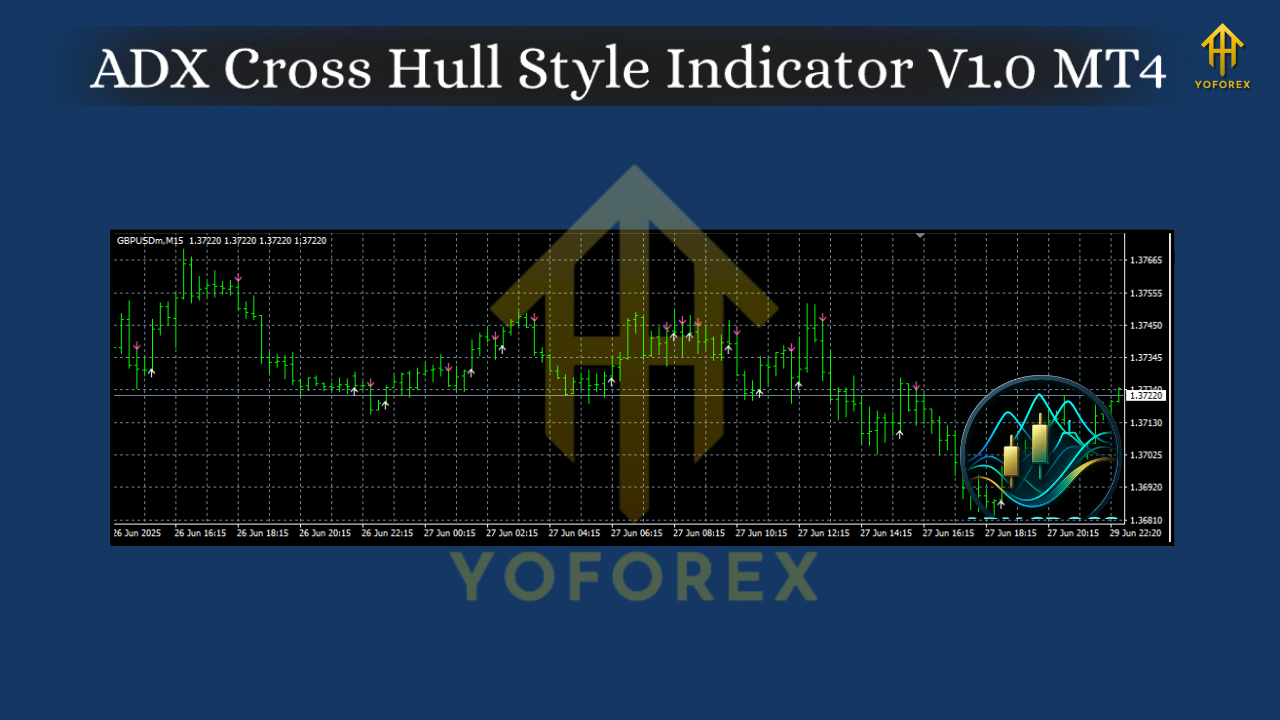
How the Signals Work (Typical Logic)
While exact visuals depend on your template, the indicator generally follows rules like these:
Bullish setup
-
Hull slope turns up (or price closes above the Hull curve).
-
ADX rises above a threshold (e.g., 18–25), confirming the trend has enough strength.
-
Candle confirmation: a bullish close beyond recent structure (optional but helpful).
Bearish setup
-
Hull slope turns down (or price closes below the Hull curve).
-
ADX > threshold indicates the downtrend has energy.
-
Bearish close confirms.
No-trade / stand-aside
-
ADX is below threshold (trend is weak or ranging).
-
Price is chopping around the Hull with small bodies and long wicks.
-
Major event risk (FOMC, NFP) within minutes if you don’t trade news.
Best Time Frames
-
M15–M30: Great for active intraday trading with a reasonable balance of signals and quality.
-
H1: Fewer trades, typically cleaner trends, ideal for day/swing traders.
-
H4: Slowest but often the highest quality directional moves—perfect for traders who can check charts a few times a day.
Tip: Start H1 to learn the rhythm, then scale down to M15/M30 once you’ve validated rules and risk controls.
Recommended Markets (Pairs)
The indicator performs best where spreads are tight and liquidity is deep:
-
Majors: EURUSD, GBPUSD, USDJPY, AUDUSD, USDCAD
-
Popular crosses: EURJPY, GBPJPY
-
Gold (XAUUSD): Possible, but use smaller positions and wider stops due to higher volatility.
Avoid illiquid exotics where noise and slippage can distort signals.
Position Sizing & the $200 Account
A $200 starting balance is workable if you:
-
Use 0.01 lots (or a cent account) and keep risk ≤1% per trade.
-
Place stops logically (behind structure or a multiple of ATR), not arbitrarily tight.
-
Accept that capital preservation outranks fast growth. The edge compounds only if you survive the variance.
Example: With $200 and 1% risk, you can risk $2 per trade. Back into position size using your stop distance (e.g., if your stop equates to $20 per 0.10 lots, then $2 risk = 0.01 lots).
Baseline Settings (A Practical Starting Point)
-
Hull Period: 21 (responsive but not too noisy).
-
ADX Period: 14 (industry standard).
-
ADX Threshold: 20–25 for trend confirmation (20 is flexible; 25 is stricter).
-
Filter: Optional ATR filter to avoid trading when ATR is extremely low (dead sessions) or extremely high (post-news whipsaw).
Tweak the Hull period per pair/time frame:
-
Faster markets (GBPJPY, XAUUSD): consider a 24–28 Hull to smooth noise.
-
Slower majors (EURUSD): you can test 18–21 to catch turns a tad earlier.
Entry, Stop, and Exit Playbook
Entries
-
Long: First candle close above Hull with ADX ≥ threshold and higher-high structure forming.
-
Short: First candle close below Hull with ADX ≥ threshold and lower-low structure forming.
Stops
-
Place stops beyond the most recent swing or 1.0–1.5× ATR from entry (time-frame dependent).
-
Avoid placing stops exactly on round numbers (e.g., 1.3000); front-run by a few pips.
Exits
-
Trend exit: Ride until Hull flips the other way or ADX falls below threshold.
-
Partial profit: Take 50% at 1R (risk multiple) and trail the rest using the Hull or a chandelier/ATR trail.
-
Time-based exit: If price stalls for several candles and ADX decays, consider closing early.
Practical Workflow (Checklist)
-
Top-down glance:
-
H4/H1 to define bias (trend up/down, key zones).
-
Drop to M30/M15 only if the higher-time-frame bias supports it.
-
-
Session awareness:
-
London/NY overlap offers cleaner momentum; Asia can be range-bound on many pairs.
-
-
Signal validation:
-
Hull cross + ADX above threshold.
-
Market structure in agreement (HH/HL for longs, LH/LL for shorts).
-
-
Risk planning:
-
Pre-define stop and target(s).
-
Position size to ≤1% risk.
-
-
Execution & management:
-
Enter on candle close; avoid chasing mid-bar.
-
Log the trade with screenshots and notes.
-
Common Mistakes to Avoid
-
Trading every cross: Wait for ADX confirmation. If ADX is low, the market is telling you there’s no trend to exploit.
-
Ignoring news: Strong trends can snap during high-impact releases; either stand aside or reduce size.
-
Over-optimization: Tiny changes that make backtests look perfect often fail live. Prefer robust, simple settings.
-
No sample size: Judge the indicator after dozens of trades across sessions, not after two wins or losses.
Example Strategy Template (You Can Backtest This)
-
Chart: EURUSD, H1
-
Hull: 21; ADX: 14; Threshold: 23
-
Entry Long: Candle close above Hull while ADX ≥ 23 and price prints a higher high vs prior swing.
-
SL: Below prior swing low or 1.2× ATR(14), whichever is further.
-
TP: Scale 50% at 1R; trail the rest with Hull flip or a 2× ATR chandelier stop.
-
Risk: 0.5%–1% per trade.
-
Filters: Skip trades within 10–15 minutes of red-flag news for USD/EUR.
Record outcomes, average R multiple, win rate, and maximum drawdown. Iterate, don’t reinvent.
Who Is It For?
-
Beginners: Clear visuals, straightforward rules, and a built-in strength check (ADX) to avoid dead markets.
-
Intraday traders: M15–H1 signals that align well with London/NY momentum.
-
Swing traders: H4 filters out noise and reduces decision fatigue.
-
System builders: A solid core you can enhance with ATR filters, session timing, or multi-time-frame confirmation.
Final Thoughts
The ADX Cross Hull Style Indicator V1.0 doesn’t promise magic. What it offers is clarity: trade with the trend when the trend actually exists, and step aside when it doesn’t. Pair it with disciplined risk management—especially on a $200 starting account—and you’ll have a framework that’s simple to execute and robust enough to refine over time.