

Funded Frm V1 VIP EA (MT4) — Built for Prop-Firm Discipline, Tuned for Consistent Execution
Launching an Expert Advisor that can survive—and thrive—under prop-firm rules demands more than a flashy strategy. Funded Firm V1 VIP EA (MT4) is designed around the realities of evaluation accounts: strict daily drawdown caps, maximum trailing losses, news-time slippage, and time-boxed profit targets. Instead of chasing every tick, it prioritizes risk discipline, stable execution, and rule compliance, so you can focus on scaling rather than firefighting. This post breaks down how it works, who it’s for, and how to deploy it confidently.
What Makes It Different
Prop-firm accounts live and die by rule adherence. Many EAs show a great curve on backtests but fail live because they ignore the rules that matter. Funded Firm V1 VIP EA tackles that head-on:
-
Daily loss guardrails: The EA tracks floating and closed P/L intraday and can halt new entries when a user-defined daily loss threshold is approached.
-
Max trailing drawdown awareness: It caps risk per position and per day, factoring unrealized losses to keep you clear of trailing limits.
-
Session & news filters: It avoids low-liquidity pockets and scheduled high-impact news (if you enable the calendar filter via an allowed news source/API or your manual event list).
-
Evaluation pace control: Targets are set modestly, with configurable profit objectives and cool-down windows after strong days to avoid give-back.
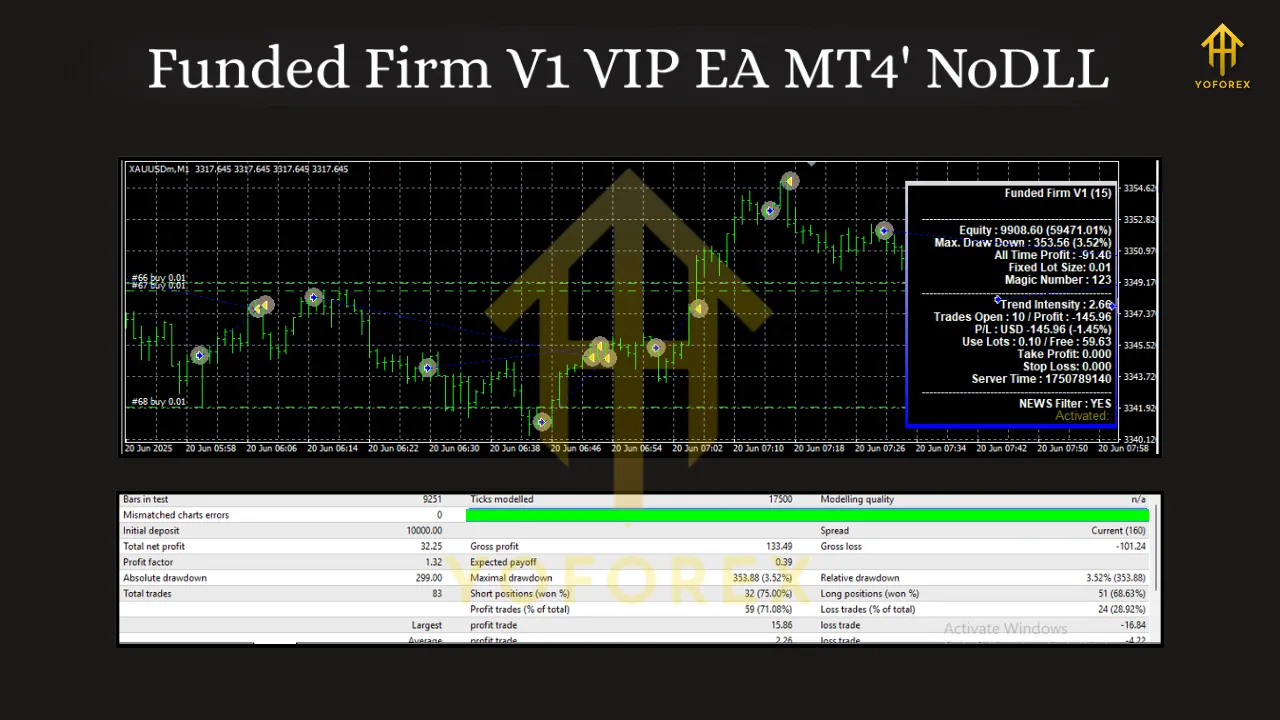
Strategy Logic (High-Level)
Funded Firm V1 VIP EA isn’t a one-trick pony. It blends trend-following entries with mean-reversion filters to reduce false triggers:
-
Market Bias Module: A fast/slow MA structure defines directional bias; only trades aligned to the bias are allowed unless optional counter-trend rules are enabled after extended deviations.
-
Volatility Gate: ATR-based bands and spread checks ensure entries happen when cost-to-target is favorable. High spread or sudden ATR spikes pause entries.
-
Signal Confirmation: A momentum oscillator (RSI or CCI by setting) confirms exhaustion or continuation. You can choose conservative or aggressive confirmation.
-
Execution Engine: Orders route with a hard stop attached. The EA supports fixed SL/TP or ATR-scaled stops with a trailing option that tightens as trades move in favor.
This layered approach aims to trade less, but better, focusing on quality setups that respect risk.
Risk Management That Puts Survival First
Prop-firm evaluation is survival math. The EA centers around three rings of protection:
-
Per-Trade Risk: Risk in % of equity or fixed lots; default is conservative (e.g., 0.5% per trade), with no martingale and no grid averaging unless you explicitly enable light scaling-in with strict spacing.
-
Per-Day Risk: A daily hard stop (e.g., 2%) ends entries for the session once hit. Optionally, it can flatten all positions if your rule set requires it.
-
Per-Week Cap: A weekly cap prevents over-trading after a drawdown. You can also enable a “two-green-days lock,” stopping trading once a weekly target is reached.
Timeframes, Pairs, and Trading Hours
-
Recommended timeframe: M15–H1. These windows balance signal quality and prop-firm stability.
-
Pairs: Major FX pairs and Gold (XAUUSD) if your prop rules allow commodities. Start with 1–2 symbols you know well; add more only after stable forward results.
-
Sessions: London and early New York are preferred. Asia is optional with stricter volatility filters.
Setup & Best-Practice Settings (MT4)
-
Attach to clean charts of your selected symbols and timeframe.
-
Inputs to review:
-
Risk per trade (%): 0.25–0.75% (start small).
-
Max daily loss (%): Align with your prop rules, but set it below the official limit to leave a buffer.
-
Max concurrent trades: 1–3 per symbol; keep total portfolio exposure modest.
-
Spread filter (points): Use broker’s typical spread × 1.5 as a cap.
-
News/session filter: Enable if you have a reliable source; otherwise manually block minutes around major events.
-
Trailing stop: ATR-based trailing with a sensible step to avoid whipsaw.
-
-
Magic numbers: Unique per chart/symbol to avoid conflicts.
-
Journaling: Keep MT4’s Journal clean; export daily to track rule adherence and performance.
Evaluation vs. Live Funded Mode
The EA supports two operational “moods” you can toggle in inputs:
-
Evaluation Mode: Tighter daily loss and softer targets, reduced position frequency, broader spread guardrails, and automatic post-win cool-downs.
-
Funded Mode: Same safety rails but slightly more flexibility once you prove stability—still within the daily and trailing rules you configure.
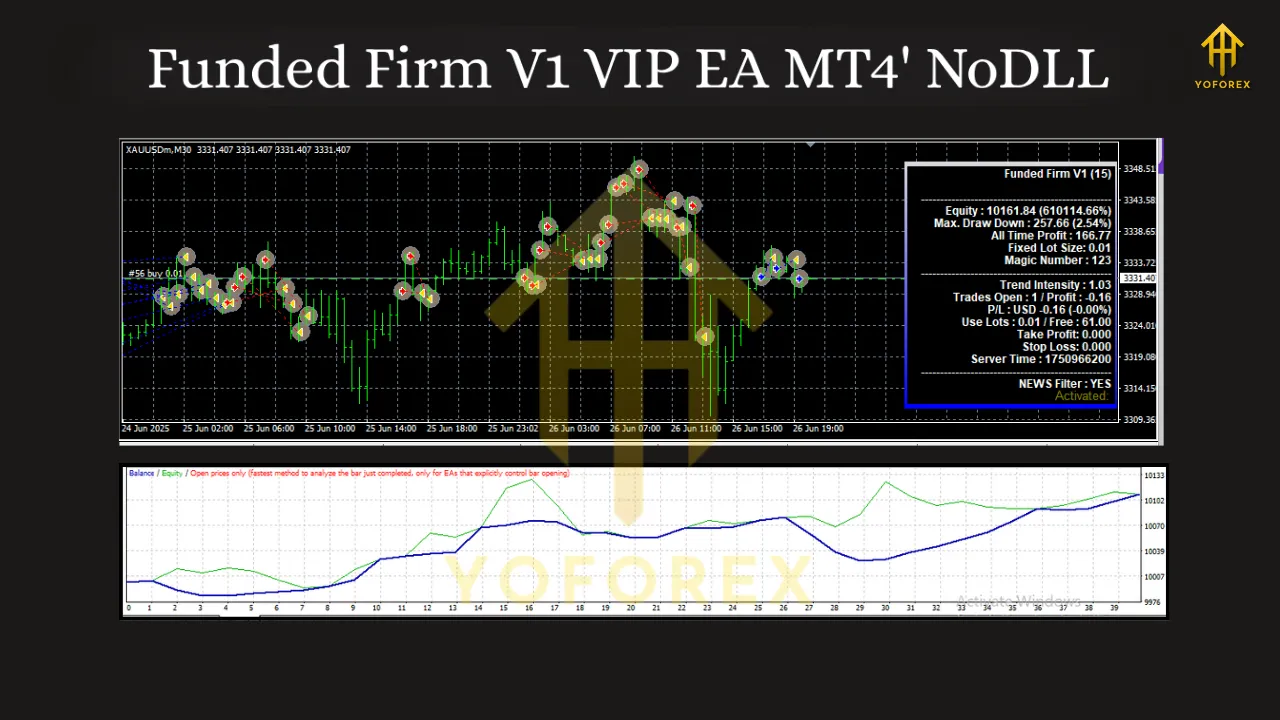
Backtesting & Forward Testing
Backtests are useful for relative tuning, but evaluations must be won forward. Suggested path:
-
Backtest 3–5 years on your intended pairs/timeframes to gauge behavior across regimes.
-
Demo forward test for at least 2–4 weeks; validate that daily guardrails behave as expected.
-
Evaluation account with conservative risk (≤0.5%/trade) and a one-symbol focus until you pass.
-
Scale gradually to multiple symbols once you’re funded and comfortable.
Tip: Judge the EA by max drawdown behavior and consecutive loss streaks, not just net profit. In prop-firm contexts, drawdown control is alpha.
Who Should Use It
-
Traders aiming for prop-firm evaluations who want rule-aware automation.
-
Discretionary traders who want systematic execution without abandoning their framework (you can restrict the EA to entries only, exits manual, or vice-versa).
-
Teams managing multiple accounts who need consistent risk application across symbols.
Do’s and Don’ts
Do:
-
Start with small risk and one instrument.
-
Keep a written trading plan that mirrors your EA inputs.
-
Update settings when prop rules change; stay compliant.
Don’t:
-
Disable daily loss limits “just for today.”
-
Add more symbols because you’re bored—let the stats earn the expansion.
-
Trade through high-impact news unless your data and tests support it.
Final Thoughts
Funded Firm V1 VIP EA (MT4) isn’t about “more trades.” It’s about better risk decisions and consistent implementation that respects the constraints of evaluation and funded accounts. With conservative defaults, configurable guardrails, and a logic stack focused on bias + volatility + confirmation, it aims to give you a repeatable, rule-compliant edge.