

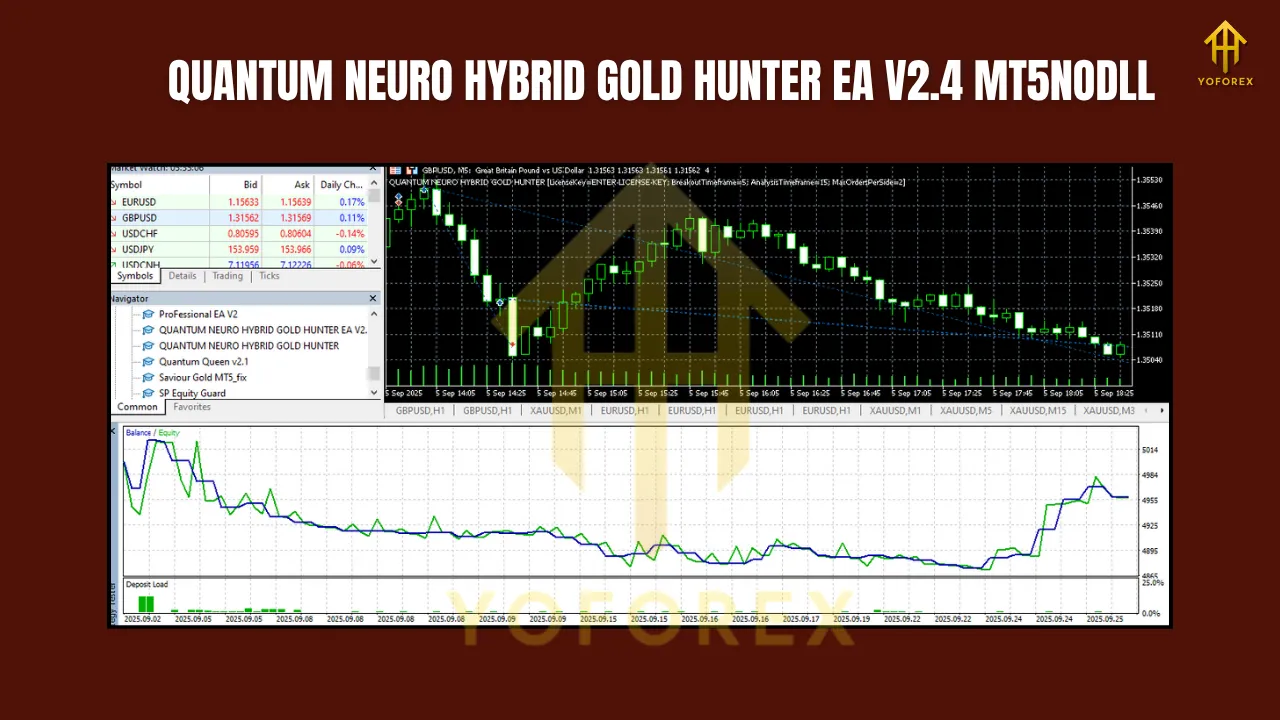
If you trade XAUUSD on MetaTrader 5 and want an automated system that blends classic market structure with modern machine-learning filters, Quantum Neuro Hybrid Gold Hunter EA V2.4 (MT5) is built for that niche. It’s a gold-focused Expert Advisor designed to capture intraday swings and momentum bursts while actively managing risk, spreads, and news volatility. Below is a deep dive into how it works, recommended settings, backtesting methodology, and practical guidance for day-to-day use.
What makes this EA “Hybrid”?
“Hybrid” here means the EA doesn’t rely on a single algorithm. Instead, it layers three logic blocks:
-
Market Structure Engine
Detects short-term trend direction using higher-high/lower-low sequences and adaptive moving ranges. This gives the EA a directional bias and a clear invalidation point when structure breaks. -
Neuro Filter (v2.4)
A lightweight statistical model trained on recent price windows to score potential entries. Think of it as a probability gate: signals must pass minimum confidence before orders are placed. In v2.4, the filter handles late-session noise better and reduces entries during flat volatility regimes. -
Volatility & Liquidity Guard
Uses ATR and depth/volatility proxies to avoid trading into thin books or during erratic news spikes. Spread, slippage, and session conditions are checked before execution.
Together, the stack aims to enter only when structure, momentum, and conditions are aligned—then exit with disciplined risk controls.
Trading style and timeframe
-
Instrument: XAUUSD (Gold)
-
Timeframes: Optimized for M15 and H1.
-
M15 pursues more frequent, smaller moves with tighter stops.
-
H1 targets cleaner swings with fewer trades but higher average R.
-
-
Session focus: London and early New York typically provide the best liquidity profile. The EA can trade 24/5, but filtering to these windows may improve quality.
Order logic and risk management
-
Entry types: Stop or limit orders depending on the pattern. Breakout conditions use pending stop orders; mean-reversion setups use limits near micro-imbalances.
-
Stop Loss: Dynamic, derived from local structure (swing points) and ATR bands. Hard SL is always placed; there is no unprotected exposure.
-
Take Profit: Hybrid partials. First target is structure-based (e.g., prior range edge), second target rides a trailing stop that tightens as momentum decays.
-
Position sizing: Fixed-fractional by default (e.g., risk % per trade), with optional fixed-lot mode for prop-friendly consistency.
-
Drawdown control: Daily loss cap, max concurrent trades, equity-guard (hard stop on equity curve breach), and cooldown after consecutive losses.
What’s new in V2.4?
-
Neuro Filter retrained on broader volatility regimes to reduce choppy-day overtrading.
-
Session-aware throttle that dampens signals in late NY or pre-Asia lull.
-
Improved partials allowing finer scaling out without overfitting.
-
Spread sentinel is stricter during news minutes; if spreads widen beyond threshold, new entries pause.
-
Faster optimization grid—parameter groups are organized so you can iterate on a few high-impact knobs first.
Minimum deposit, leverage, and broker conditions
-
Minimum deposit: From $200 for micro/cent accounts; $500–$1,000 recommended for standard accounts to give risk control room.
-
Leverage: 1:100 or higher preferred for gold, but keep position risk measured; high leverage is not a requirement to run the EA.
-
Broker considerations: Raw/low-spread accounts with tight execution on XAUUSD. A reliable VPS near your broker’s server is strongly recommended.
Recommended settings (starter profile)
-
Timeframe: H1 for clean signals, M15 if you want more trade frequency.
-
Risk per trade: 0.5%–1.0% (prop-friendly profile).
-
Daily loss cap: 2%–4% of equity, auto-disable for the rest of the day when hit.
-
Max open positions: 1–2 (no martingale, no grid by default).
-
Spread filter: Enable and set strict thresholds suitable to your broker’s typical spread on gold.
-
Session window: Enable London + early NY only for a conservative start.
Installation and setup (MT5)
-
Open MetaTrader 5 → File → Open Data Folder → drop the EA in MQL5/Experts/.
-
Restart MT5, then attach the EA to an XAUUSD chart (M15 or H1).
-
Allow algo trading (AutoTrading button) and confirm live trading permissions in the EA settings.
-
Load the included preset closest to your broker profile; then tweak only the essential risk parameters at first.
-
Run a short demo or small-risk live validation before scaling.
Backtesting: how to test it properly
To evaluate an intraday gold EA, good testing practices matter more than the result number itself:
-
Use high-quality tick data with variable spreads if available.
-
Model slippage in line with your broker’s average during peak times.
-
Out-of-sample validation: If you optimize on 2022–2023, confirm on 2024–2025 without changing settings.
-
Walk-forward checks: Re-opt small clusters (e.g., ATR multipliers, session gates) quarterly; then run forward periods untouched.
-
Drawdown realism: Expect periods of heat. A healthy test shows controllable equity swings with no catastrophic excursions.
-
KPIs to watch: Profit factor >1.3 on OOS, controlled max DD, stable average trade length, and consistency across months.
Live trading best practices
-
Start conservative: Use the recommended risk profile until you see live fills and slippage behavior.
-
Keep logs on: The EA exports concise trade logs; review weekly to spot spread anomalies or missed entries.
-
Respect the equity guard: If the daily cap is hit, stop. The system is designed to prevent revenge trading.
-
News awareness: The guard will block most of the chaotic minutes, but you can also set a personal lockout around high-impact events.
-
Scale gradually: Increase risk only after at least 20–40 trades confirm that live performance aligns with backtests.
Strategy details (under the hood)
-
Trend module: Identifies micro-trends via rolling structure combined with an adaptive channel. Breakdowns below the channel with rising ATR are short candidates; clean reclaims with breadth expansion are long candidates.
-
Mean-reversion module: On range days, the EA seeks fair-value gaps and returns to value. The Neuro Filter suppresses MR entries if volatility is rising into a breakout.
-
Exit intelligence: When momentum decays (e.g., shrinking true range, divergence against position), trailing stops tighten automatically to protect gains.
Prop-firm compatibility
The default risk model is prop-friendly:
-
No martingale or forced grids.
-
Daily loss cap and max trade count to fit firm rules.
-
Fixed-risk mode for predictable exposure.
Still, always align settings with your firm’s specific drawdown and news-trading policies.
Frequently asked questions
Does it hold trades over the weekend?
By default, no. There’s a Friday close option to avoid gaps. You can keep it on for conservative operation.
Can I run it on multiple pairs?
It’s designed for XAUUSD. You may technically attach it elsewhere, but models and filters are tuned for gold’s structure.
Will higher risk improve returns?
Not linearly. On gold, increasing risk beyond ~1% per trade can escalate drawdowns quickly. Scale using equity growth, not impatience.
Is optimization required?
Presets work out of the box for many brokers. Light optimization (ATR multipliers, session windows, SL/TP ratios) can help tailor to your spread and execution.
What if spreads spike?
The spread sentinel blocks new entries when spreads exceed your threshold and can flatten pending orders during extreme widening.
Common pitfalls to avoid
-
Over-optimizing dozens of inputs across short windows. Keep parameters simple and robust.
-
Ignoring VPS latency and execution quality—on gold, slow fills can deform strategy edges.
-
Trading all sessions without need; dead hours can erode expectancy.
-
Disabling hard stops in pursuit of “flexibility.” The EA is designed around protective SLs; keep them on.
Final thoughts
Quantum Neuro Hybrid Gold Hunter EA V2.4 MT5 targets a practical middle ground—structured logic for clarity, a neuro filter for selectivity, and protective rules for longevity. It won’t win every day, and it isn’t a get-rich switch. Its edge comes from disciplined participation in the best parts of the gold session, with tight risk and thoughtful exits. If you value consistency, prop-friendly controls, and a workflow that respects both data and discretion, V2.4 is a solid foundation for an XAUUSD automated strategy.